
Chinese EVs Crack the Premium Code with Record High-End Sales
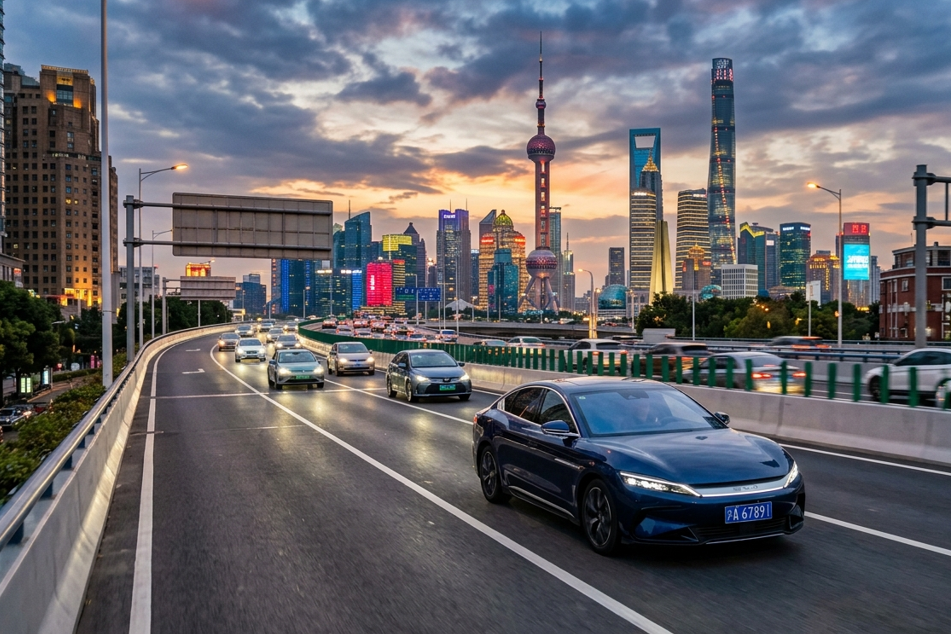
China's electric vehicle market reached a significant milestone in April 2026, with pure electric vehicles maintaining strong momentum even as overall automotive sales weakened. While total passenger vehicle retail sales fell to 1.4 million units, pure EV sales held steady at 579,000 units, lifting market penetration to 41% despite broader market pressures.
The most important development is not overall volume growth, but the breakthrough occurring in the premium segment. For the first time, multiple Chinese EV brands are achieving meaningful scale in the $35,000-70,000 price range—a category long expected to remain dominated by hybrid powertrains.
Premium EV Sales Leaders Signal Market Maturation
Li Auto's i6, positioned as a premium five-seat SUV, delivered more than 20,000 units in April, establishing itself as a major player in the mainstream premium segment. Its roughly $35,000 starting price, combined with a 720km range and advanced autonomous driving features, has resonated strongly with Chinese consumers seeking premium EV experiences.
NIO's ES8 recorded 13,000 deliveries in April, surpassing 100,000 cumulative sales since the launch of its latest generation. The ES8's success at a $57,000+ price point—supported by NIO's battery-as-a-service (BaaS) program, which lowers the effective entry price to around $43,000—demonstrates growing acceptance of premium pure electric SUVs.
BYD's Denza Z9GT also experienced a sharp sales rebound, climbing to 3,900 monthly deliveries in April following a refresh featuring second-generation blade battery technology and ultra-fast charging capabilities. The pure electric variant now reportedly accounts for nearly 80% of orders, reversing the hybrid-heavy mix seen in the previous generation.
Consumer Preference Shift: Pure Electric Overtakes Hybrids
Market data suggests a fundamental shift in consumer preferences across new launches. Vehicles offering both hybrid and pure electric powertrains are increasingly seeing pure EV variants capture the majority of orders:
- Dongfeng Nissan's NX8, launched in April, shows pure electric leading hybrid orders by 2:1
- Huawei-backed Aito M8 and M9 pure electric variants overtook range-extended versions with a 6:4 split
- Leapmotor's new C11 generated 80% pure electric pre-orders versus 20% for range-extended variants
This marks a reversal from earlier market dynamics, when hybrid powertrains dominated premium segment launches, indicating growing consumer confidence in pure electric technology at higher price points.
Infrastructure Expansion Drives Consumer Confidence
The shift in consumer behavior closely tracks China's rapid charging infrastructure expansion. The country now operates 21.48 million charging points, representing 46.9% year-over-year growth. Major automakers are also accelerating development of private charging networks:
- Li Auto aims to reach 4,000 supercharging stations by the end of 2026
- BYD plans to build 20,000 ultra-fast charging stations, targeting average spacing of 3km in tier-1 cities, 5km in tier-2 cities, and 6km in tier-3 cities
- NIO continues expanding its battery-swapping network alongside conventional charging infrastructure
Fast-charging improvements have also significantly reduced range anxiety. BYD's second-generation blade battery enables over 1,000km range under certain conditions, while ultra-fast charging materially shortens charging times. Combined with infrastructure expansion, these advances have substantially lowered the key barriers to premium EV adoption.
Market Dynamics Shift from Six-Seat to Five-Seat SUVs
The premium segment is also undergoing a category transition. Large six-seat SUVs, which dominated premium launches over the past two years, are beginning to show signs of saturation. In March 2026, only NIO ES8 and Zeekr's 009X among six-seat models surpassed 10,000 monthly sales.
Consumer demand is increasingly shifting toward five-seat premium SUVs, with Li Auto's i6 leading the transition. The five-seat premium SUV segment offers annual market potential exceeding one million units, creating a larger and more sustainable opportunity than the more niche six-seat category.
This trend reflects practical household needs in China, where multi-child families remain relatively uncommon and five-seat configurations generally provide more efficient space utilization for mainstream consumers.
Industry Impact and Future Outlook
The premium pure EV breakthrough signals a broader transformation in China's automotive market. The success of Li Auto's i6, NIO's ES8, and BYD's Denza Z9GT suggests Chinese consumers are increasingly willing to adopt pure electric powertrains across all price segments—not only in entry-level vehicles.
Competition is intensifying as more automakers enter the premium EV market. BYD's Fangchengbao Bao 7 EV ultra-fast charging variant launched in late April with strong pre-order momentum. NIO's upcoming Ledo L80, featuring BaaS pricing, is expected to add further competitive pressure to Li Auto's i6 positioning.
The April 2026 sales data indicates China's EV market has reached a maturation stage where pure electric vehicles compete successfully on product quality and user experience rather than price advantage alone. With charging infrastructure approaching critical mass and battery technology delivering increasingly competitive range performance, the transition toward electric mobility is accelerating across all segments.
This development could also strengthen the global competitiveness of Chinese EV manufacturers, particularly if similar infrastructure buildouts and consumer adoption patterns emerge in overseas markets.
Related Coverage:
The EV Juggernaut: How China Built a Car Empire to Challenge the World