
Chinese Firm Leju Taps Nvidia Chip for Humanoid Robot's Industrial Push
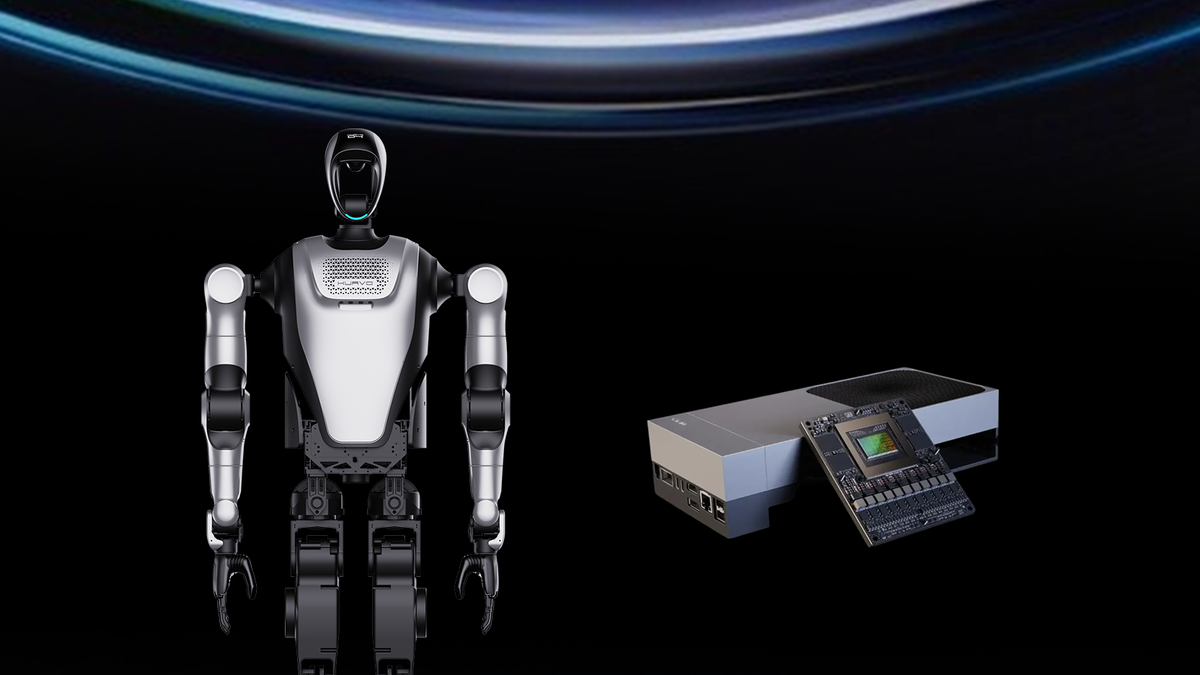
Chinese developer Leju Robotics is integrating Nvidia Corp.'s powerful Jetson Thor processor into its “Kuafu” humanoid robot, a move designed to accelerate the commercial deployment of embodied artificial intelligence in industrial settings.
The company announced that its full-size humanoid robot, powered by the new chip, has successfully completed operational tests across five major industrial sectors: logistics, smart manufacturing, 3C electronics, automotive assembly, and daily chemical production. The validation in real-world environments marks a significant step in combining advanced robotic hardware with high-performance, on-device AI computing.
This integration allows the Kuafu robot to run multiple complex AI models directly, enhancing its ability to perform tasks in unstructured environments without constant reliance on the cloud. The successful trials signal Leju's intent to move its technology from the laboratory to the factory floor, targeting industries seeking to boost automation and efficiency.
The collaboration underscores a critical trend in the burgeoning humanoid robotics field, where the fusion of sophisticated hardware and powerful processors is seen as the primary catalyst for achieving industrial-scale viability. For investors, it highlights the tangible progress being made in a sector poised to transform modern manufacturing and logistics.
A Fusion of Advanced Hardware and AI
The Kuafu robot, which features more than 40 degrees of freedom, is designed with a bionic structure that provides the flexibility needed for complex industrial operations. This high degree of mobility, however, creates significant computational demands for real-time motion control and dynamic balancing.
Nvidia's Jetson Thor platform addresses this challenge by providing what Leju calls a "brain" for the robot. With 2,070 FP4 TFLOPS of AI performance, the processor offers a 7.5-fold increase in computing power over previous solutions, according to the source material. Its 35% higher memory bandwidth enables stable processing of multi-modal sensor data, allowing Kuafu to effectively run a variety of AI models, including ACT, DP, VLA, and Pi0, directly on the device.
Proving Ground: Five Industrial Scenarios
The robot's capabilities were validated in a series of tests designed to replicate common industrial workflows, demonstrating its immediate practical value.
- Logistics: In sorting tasks, Kuafu maintained high precision and stability over long periods, using its processing power to self-correct errors and overcome the performance degradation common in traditional systems.
- Smart Manufacturing: The robot performed a full sequence of SMT reel retrieval, using whole-body coordination for delicate handling and seamless data exchange with the production line.
- 3C Electronics: On high-speed assembly lines, Kuafu demonstrated millisecond-level reaction times, achieving the precise hand-eye coordination required for rapid sorting.
- Automotive Assembly: In a less-structured task, the robot autonomously identified and collected empty bins of various sizes and weights, showcasing its adaptability in flexible manufacturing environments.
- Daily Chemicals: The robot executed complex, multi-step placement tasks by processing advanced VLA models, enabling it to understand abstract commands and handle non-rigid objects with dual-arm coordination.
Accelerating the Path to Industrial Use
The successful integration of Kuafu with Jetson Thor moves the needle on the commercial viability of humanoid robots by demonstrating enhanced agility, faster decision-making, and greater autonomy. This progress is crucial for expanding applications from highly structured, standardized tasks to more common, non-standard industrial scenarios.
Leju Robotics is leveraging its humanoid robot training facilities in Beijing and Jiangsu to further optimize performance and accelerate its commercialization roadmap. The company’s recent progress suggests that the synergy between advanced hardware and powerful, on-device AI computing is becoming the primary engine driving the next wave of industrial automation.