
Chinese Maker Hardware Shifts from Niche Toys to Mass Productivity Tools at CES 2026
Las Vegas — Chinese hardware manufacturers have dominated the "Maker" sector at CES 2026, marking a significant transition from producing niche geek gadgets to delivering high-utility consumer tools. This shift is characterized by aggressive product innovation in 3D printing and CNC machining, attracting significant venture capital and generating record-breaking crowdfunding revenue.
Leading players are solidifying their market positions with substantial valuations and IPO plans. Bambu Lab has reached a valuation exceeding US$10 billion with revenue topping RMB 6 billion (US$830 million), underscoring the sector's rapid growth. Concurrently, xTool, a specialist in laser engraving products, has filed for a Hong Kong IPO after its annual revenue surpassed RMB 2 billion (US$276 million).
The competition has intensified, pushing companies into new verticals like desktop CNC and UV printing to find growth outside saturated markets. Notable launches include the Snapmaker U1 by Snapmaker, which secured a record US$20.61 million in crowdfunding, and a new desktop CNC machine by Makera, which raised over US$10.25 million. These figures signal a broader market acceptance of these technologies as viable productivity assets rather than mere hobbies.
Editor’s Note: This article is based on on-site reporting from CES 2026 by Chinese technology media outlet 36Kr ("Hard Kr"). It synthesizes data disclosed by companies, crowdfunding platforms, and industry analysis to assess market trends. Financial figures and product details are derived from these primary sources.
Market Saturation and Strategic Diversification
The hardware sector at CES reveals that competition in established categories like laser engraving and basic 3D printing has reached a boiling point. Companies are responding by crossing into adjacent verticals. xTool, traditionally dominant in laser cutters, unveiled a desktop UV printer utilizing UV-LED curing technology. While Anker’s eufy Make E1 previously opened this market with a US$42 million fundraising record, xTool is attempting to capture market share by leveraging a "community co-creation" development model to define hardware functions and workflows.
This strategy of involving the user community in R&D, also employed by photography accessory makers, reflects a saturated market where differentiation is increasingly difficult. Manufacturers are forced to look beyond hardware specs to user-centric design to maintain momentum.
Technological Arms Race: Speed and Efficiency
In the 3D printing segment, the focus has shifted entirely to solving efficiency pain points, specifically regarding multi-color printing which traditionally wastes significant time and material.
Snapmaker introduced the Snapmaker U1, a product in development for two years. It features four print heads that can be pre-loaded and pre-heated, reducing the swap time to 5 seconds. This design claims to increase printing speed by five times and reduce material waste by five times compared to traditional single-head multi-color solutions.
Competitors are simultaneously addressing the same inefficiencies. Creality showcased its new smart 3D printing brand, SPARKX i7, which claims to reduce multi-color printing waste by 50% through a mechanism that retracts filament before cutting. While other major players like Bambu Lab and Prusa have explored similar multi-nozzle systems, cost remains a barrier. The CES showcase demonstrates that the window for first-mover advantage based on performance innovation is narrowing rapidly.
From Industrial to Desktop: The Rise of CNC
A significant trend at CES 2026 is the democratization of Computer Numerical Control (CNC) machinery—previously restricted to industrial settings due to high costs and complexity.
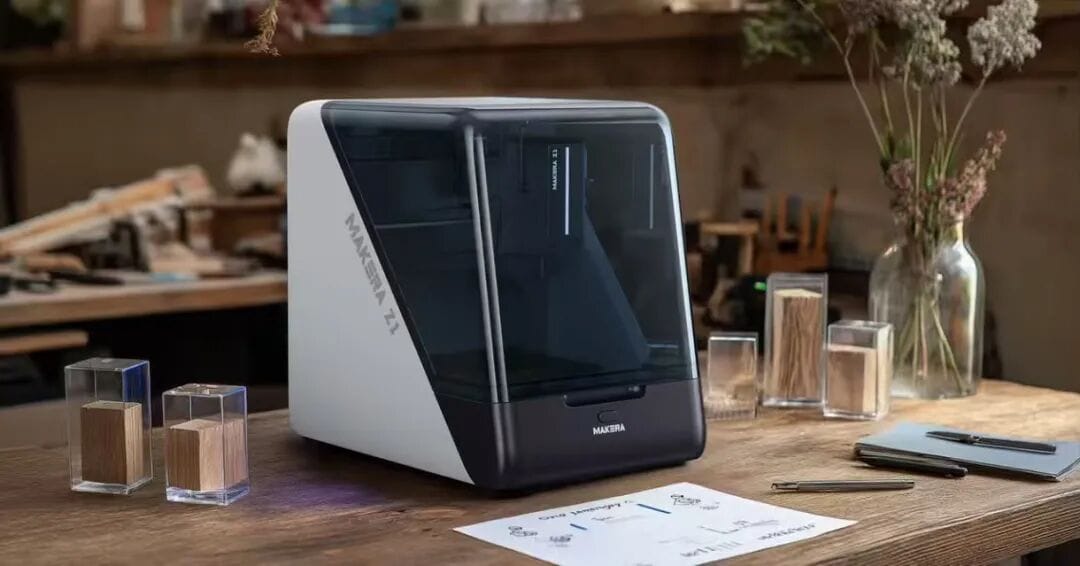
Makera displayed the Makera Z1, a desktop CNC device that raised approximately US$10.25 million (over RMB 72 million yuan) on Kickstarter, setting a new record for the category. The product lowers entry barriers through automation features such as rapid tool changing, intelligent auto-leveling, and one-key calibration.
Historically, CNC machines required extensive technical knowledge and setups costing hundreds of thousands of yuan. By condensing industrial manufacturing capabilities into a desktop form factor, Chinese manufacturers are completing the "Maker" tool puzzle, complementing additive manufacturing (3D printing) with subtractive manufacturing (CNC) for a broader consumer base.
Commercialization: The "Side Hustle" Economy
The driving force behind the explosion of these tools is a shift in user demographics from pure hobbyists to small business owners. Data from xTool and Snapmaker indicates that a significant portion of users now purchase equipment for "Small Business" or "Side Hustle" purposes.
This commercialization is fueling a demand for reliability and social connectivity. Features pioneered by Bambu Lab, such as built-in cameras, AI monitoring, and one-click social media sharing, have become industry standards. These features not only improve the user experience but serve as marketing tools for creators selling their products.
The ecosystem is evolving to support monetization. On model platforms like MakerWorld, over 60% of popular downloads are multi-color designs, which command higher commercial value than monochromatic prints. Recognizing this trend, manufacturers are actively funding the ecosystem; Bambu Lab launched the "Let's Make It" fund, offering up to RMB 1 million yuan (US$138,000) per project to support global makers.
Chinese manufacturers have successfully leveraged technology to lower the barrier to entry—what observers call "technical equality"—transforming complex industrial processes into accessible, revenue-generating opportunities for the mass market.