
Chinese Robotics Startup Spirit AI Raises US$280 Million, Valuation Tops US$1.4 Billion
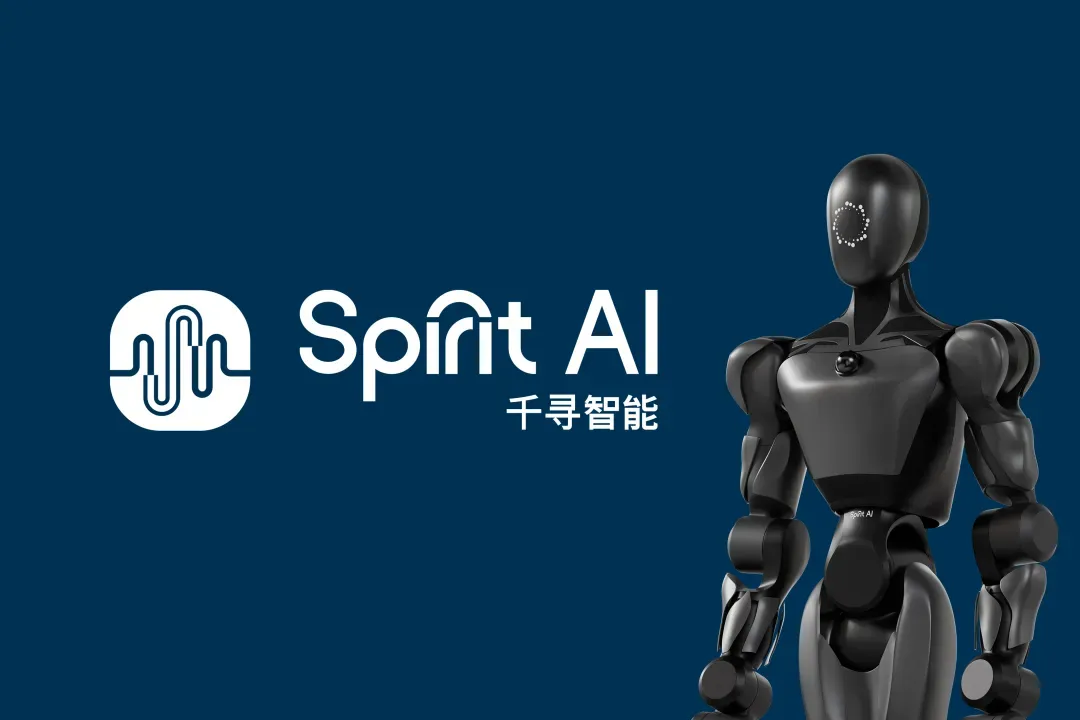
Spirit AI, a two-year-old embodied intelligence company, has completed two consecutive financing rounds totaling nearly 2 billion yuan (US$280 million), pushing its valuation past 10 billion yuan (US$1.4 billion), the company announced recently. The funding represents one of the largest capital injections in China's embodied intelligence sector since the start of 2026.
The financing attracted a broad coalition of investors spanning top-tier venture capital, industrial players, and state-backed funds. Yunfeng Capital, Sequoia China, a leading state-owned institution, and Chaos Investment led the rounds, with participation from Synstellation Capital, TCL Capital, and Mingfei Investment. Notably, existing shareholders including Shunwei Capital, Prosperity7, and Danchen Capital all increased their stakes, signaling sustained confidence in the company's technical trajectory.
The deal underscores accelerating consolidation in China's embodied intelligence industry, where capital is concentrating around a handful of technical leaders. According to IT Juzi, the sector recorded 329 financing events totaling 39.89 billion yuan in 2025, triple the prior year's volume, as the landscape shifted from fragmented competition to head-to-head battles among unicorns.
Spirit AI's rapid ascent reflects investor conviction that its vision-language-action (VLA) model approach and demonstrated industrial deployments position it to bridge the gap between laboratory demonstrations and scaled production applications.
Technical Foundation Built on Academic Pedigree
Spirit AI was founded in early 2024 by a team combining industrial robotics experience with cutting-edge AI research. CEO Han Fengtao previously served as co-founder and CTO of Luoshi Robotics, where he oversaw delivery of over 20,000 industrial robots across more than 20 industry scenarios, establishing himself as a pioneer in high-performance lightweight industrial robots and the first in China to achieve mass production of force-controlled collaborative robots.
Co-founder Gao Yang holds a PhD from UC Berkeley, where he studied under computer vision expert Trevor Darrell and robotics specialist Pieter Abbeel, the latter being co-founder of U.S. embodied intelligence leader Physical Intelligence. Gao later returned to China as assistant professor at Tsinghua University's Institute for Interdisciplinary Information Sciences.
Gao's academic work directly translates into Spirit AI's model capabilities. His ViLa algorithm was adopted by U.S. robotics company Figure, while his reinforcement learning research EfficientZero drew praise from OpenAI co-founder John Schulman. In 2025, Gao's team proposed the One-Two VLA architecture, which addresses traditional VLA models' difficulty with complex instructions by introducing a dual-system approach that autonomously assesses task complexity and breaks down sophisticated commands into manageable sub-tasks. This architecture, combined with earlier research including ViLa and CoPa, forms the technical foundation of Spirit AI's Spirit series VLA models.
Data Strategy Prioritizes Diversity Over Perfection
Spirit AI's differentiated approach centers on what Gao calls a "data pyramid" training philosophy. Rather than following the conventional "world model" path that predicts every frame—an approach Gao describes as computationally expensive and inefficient—the company leverages massive human internet video for pre-training, achieving superior results with fewer parameters and significantly lower computational costs.
The pyramid structure layers data by information density and collection cost: the base comprises abundant internet human videos (low-cost, high-coverage), the middle tier includes teleoperation and wearable device interaction data, and the top consists of high-precision data from actual robot rollouts. Different data layers serve distinct roles across training stages.
For data collection, Spirit AI has developed proprietary wearable devices now in their fifth generation, reducing collection costs to one-tenth of traditional teleoperation methods. The company has accumulated over 200,000 hours of multi-type real interaction data, with projections to exceed 1 million hours in 2026.
Crucially, Spirit AI advances a counterintuitive proposition: "Dirty data is the key to scaling VLA models." The team discovered that training on diverse "imperfect data" actually produces steeper scaling curves. In other words, data diversity matters far more than cleanliness.
This technical path received validation in January 2026 when Spirit v1.5 became the first domestic open-source embodied model to surpass Pi0.5 in performance, according to company materials. Spirit v1.5's most notable feature is zero-shot generalization capability—completing complex operations including wiping objects, manipulating hinges, and handling flexible materials without additional task-specific training. It functions not as a specialist executing predetermined actions, but as a generalist capable of autonomous decision-making in novel scenarios.
"The dedicated AI brain for the physical world is a critical prerequisite for embodied intelligence to achieve breakthrough," said Dong Huaijin, executive director at Yunfeng Capital. "The core barrier spanning cycles comes from technology's actual creation of productivity."
Industrial Validation at CATL Production Lines
Spirit AI has deployed robots on Contemporary Amperex Technology Co. Limited's (宁德时代) battery mass production lines, addressing what Beijing University of Aeronautics and Astronautics professor Wang Tianmiao identifies as the industry's deepest pain point: the chasm between demonstrations and deployment.
The company's "Xiaomo" robot operates stably on EOL and DCR processes at CATL's Zhongzhou facility battery PACK production line, functioning as core equipment. The robot has produced nearly 1,000 batteries with a plug-in success rate consistently above 99%, matching or exceeding skilled human worker cycle times. More critically, Xiaomo demonstrates millisecond-level rapid adaptation to production uncertainties and flexibility surpassing human capabilities.
In commercial applications, Spirit AI's "Mozi" robot handles interactive demonstrations and product operation presentations in JD.com retail scenarios, with both parties jointly exploring deployment of JD Cloud and Joyinside large models across extensive retail networks.
From industrial to retail settings, Spirit AI is advancing on dual fronts.
Bridging the Gap to Mass Commercialization
Looking back from early 2026, embodied intelligence has moved beyond pure future narrative. Robots are entering factories, warehouses, and production lines, yet the path to genuine large-scale industrialization faces at least three core challenges.
First is the data bottleneck. The human modality gap from language to vision to action remains vast—tasks a two-year-old child completes effortlessly still challenge robots. Training data scale and diversity fall far short, while collection costs remain elevated. Spirit AI's proprietary collection devices reducing costs by 90% and "imperfect data" strategy represent among the industry's few systematic responses.
Second is the demonstration-to-production chasm. Many companies showcase impressive action videos in laboratories, but maintaining 24/7 stable operation in real industrial environments confronts entirely different challenges including temperature, vibration, workpiece deviation, and uncertainty—any variable potentially causing failure. Spirit AI's validation at CATL production lines demonstrates this capability, though such validation remains case-specific, with scaled replication requiring time.
Third is commercial model closure. One investor noted that embodied intelligence technology truly entering factories and homes may still require three to five years or longer, during which companies cannot perpetually rely on primary market financing. Only those first achieving the positive cycle of "technical closure—mass production capability—data feedback—commercial closure" earn seats at the table.
Gao has publicly articulated a measured assessment: the industry currently sits at the "Robot GPT-1" stage, potentially reaching 3.5 status in four years. He acknowledges that for a considerable period, most embodied intelligence will only achieve "L4 within limited scenarios," with broadly applicable general intelligence remaining unrealistic.
This sober technical judgment may be precisely what attracts investors. Spirit AI promises neither an aggressive vision of "entering millions of homes next year" nor remains confined to laboratories pursuing publication counts. It has chosen a "difficult but correct" middle path: validating technology on real production lines, using production data to refine models, then deploying stronger models across more scenarios.
The 2 billion yuan financing provides ammunition for this marathon. But in this increasingly white-hot "unicorn jungle," the real test has only just begun.