
Chinese Startup Unveils Plan for 10-Exaflop Supercomputer in Orbit
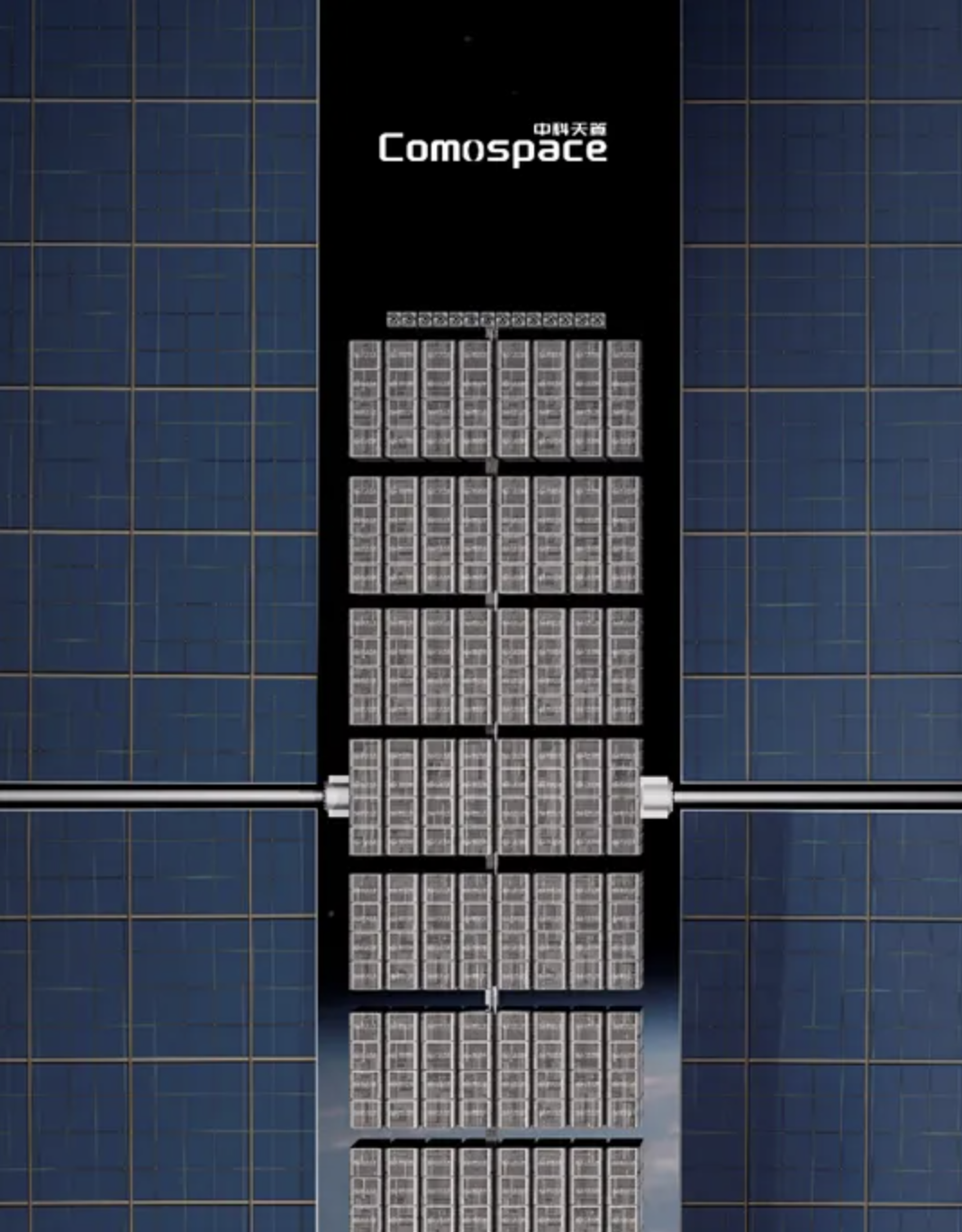
A Chinese commercial space firm has unveiled an ambitious plan to build a powerful supercomputing center in low-Earth orbit, positioning itself in the intensifying global race to move high-performance computing from Earth into space.
Zhongke Tiansuan announced its "Tiansuan Plan," which aims to deploy a 10-exaflop intelligent computing cluster powered by over 10,000 high-performance GPUs. This initiative aims to establish what the company calls a "second brain for humanity" in the vacuum of space.
The move follows recent developments from Western technology giants, including the launch of the Starcloud-1 satellite carrying Nvidia's H100 chips and Google's disclosure of its "Project Suncatcher" satellite cluster equipped with TPUs. This signals a growing trend among tech and space players to build the next generation of computing infrastructure beyond the atmosphere.
By processing data at its source, the project aims to overcome the latency and bandwidth limitations of the traditional "sense-in-space, compute-on-Earth" model. This shift could enable a new class of real-time, AI-driven applications, from autonomous systems to immediate environmental analysis, fundamentally altering the economics and capabilities of the space industry.
A New Paradigm for Space-Based Services
The current space information infrastructure is akin to the 1G era of terrestrial mobile networks—expensive and limited in function, according to Zhongke Tiansuan CEO Liu Yaoqi. The company envisions an evolution toward a "4G era" for the space internet, where in-orbit computing power fosters a vibrant ecosystem of applications, much like smartphones did for the terrestrial internet.
This new model aims to close the "sense-understand-decide" loop directly in orbit. For example, in commercial fishing, a space-based AI could analyze real-time data from hyperspectral and navigation satellites to provide immediate guidance to vessels, such as, "A school of tuna will be 20 nautical miles northeast in 30 minutes." Such time-sensitive services are impractical with ground-based supercomputers due to communication delays.
To realize this vision, the Tiansuan Plan consists of three core modular components:
- A 100-megawatt power module using flexible photovoltaic arrays and modular energy storage to provide continuous green energy.
- A 10-terabit-per-second communications module employing laser links for high-speed data transfer between space and ground nodes.
- A 10-exaflop computing module housing a cluster of 10,000 high-performance computing cards, designed to overcome the energy and cooling constraints of ground-based data centers.
Overcoming Engineering Hurdles in a Vacuum
Deploying a supercomputer in space requires a fundamental re-engineering to cope with two primary physical challenges: high-energy particle radiation and heat dissipation in a vacuum.
Radiation in orbit can cause "hard errors" like latch-ups that physically burn out chips, or "soft errors" like single-event upsets that corrupt calculations. While traditional aerospace has relied on radiation-hardened chips, these are typically several generations behind commercial technology and lack the power for modern AI. Zhongke Tiansuan’s solution involves using advanced commercial-off-the-shelf chips, which are more resistant to catastrophic failure but prone to soft errors. To ensure reliability, the company has developed a multi-mode redundant architecture where multiple computing units verify each other's work, enabling the use of cutting-edge processors.
Cooling high-power chips in a vacuum where heat convection is non-existent presents another major obstacle. The company has engineered a hybrid active-passive cooling system that uses a fluid loop to actively transfer heat from the chips, combined with structural conduction and radiation panels to dissipate it into space. This architecture is designed to manage the intense thermal loads of a high-density computing cluster in microgravity.
China’s Broader Push into In-Orbit Intelligence
Zhongke Tiansuan's commercial ambitions are built upon years of foundational research by China's state-backed institutions. Since 2019, organizations have been exploring space-based intelligent computing.
Key national efforts include:
- The Chinese Academy of Sciences, Institute of Computing Technology , which developed an early space-based intelligent computing payload and has deployed large models in orbit.
- Wuhan University , which is leading the "Dongfang Huiyan" intelligent remote sensing constellation.
- Beijing University of Posts and Telecommunications , which has used its "Tiansuan Constellation" to verify in-orbit networking technologies.
- Zhejiang Lab , which successfully launched its "Three-Body Constellation" computing satellites in May 2025 to begin network testing.
Zhongke Tiansuan itself was founded by core members from these institutions and combines expertise from both the internet and aerospace sectors. The company successfully deployed a large model in orbit in 2024.
The Future of Interplanetary Infrastructure
Proponents argue that space-based supercomputing is not merely a supplement to terrestrial systems but a critical infrastructure for future economic activity and deep-space exploration. A computing center in low-Earth orbit (approximately 500 km altitude) can offer lower latency for some cross-regional tasks than terrestrial fiber networks spanning thousands of kilometers.
Furthermore, space-based computing offers inherent resilience against terrestrial natural disasters and provides persistent connectivity for autonomous cars and drones in remote areas. In the long term, as humanity expands to the Moon and Mars, deploying a shared computing and communications hub in orbit is seen as a more viable strategy than rebuilding such complex infrastructure on other celestial bodies. The fusion of computer science and aerospace engineering is steadily pushing the boundaries of digital civilization beyond Earth’s atmosphere.