
Flying Humanoid Robots Move From Science Fiction to Laboratory Reality
Multiple research institutions worldwide are advancing the development of flying humanoid robots, marking a significant shift from theoretical concepts to functional prototypes. These platforms, combining bipedal locomotion with aerial propulsion systems, represent a new frontier in robotics designed for disaster response, industrial applications, and complex terrain navigation.
Recent demonstrations by teams from China, the United States, and Italy have showcased varied technical approaches to achieving stable flight and ground mobility. The developments follow renewed public interest in mechanized aerial platforms, particularly after China Central Television's AI-generated short film depicting military aircraft as flying mechs captured widespread attention.
While full-scale piloted mechs remain conceptual, research-scale humanoid robots equipped with jet propulsion and rotor systems have successfully demonstrated takeoff, hover, and attitude control. These advances address fundamental challenges in thrust vectoring, weight distribution, and energy management that have long constrained bipedal flight capabilities.
The emerging technologies could enable robots to rapidly deploy to hazardous locations, transition between aerial and ground operations, and perform complex tasks in environments inaccessible to conventional platforms.
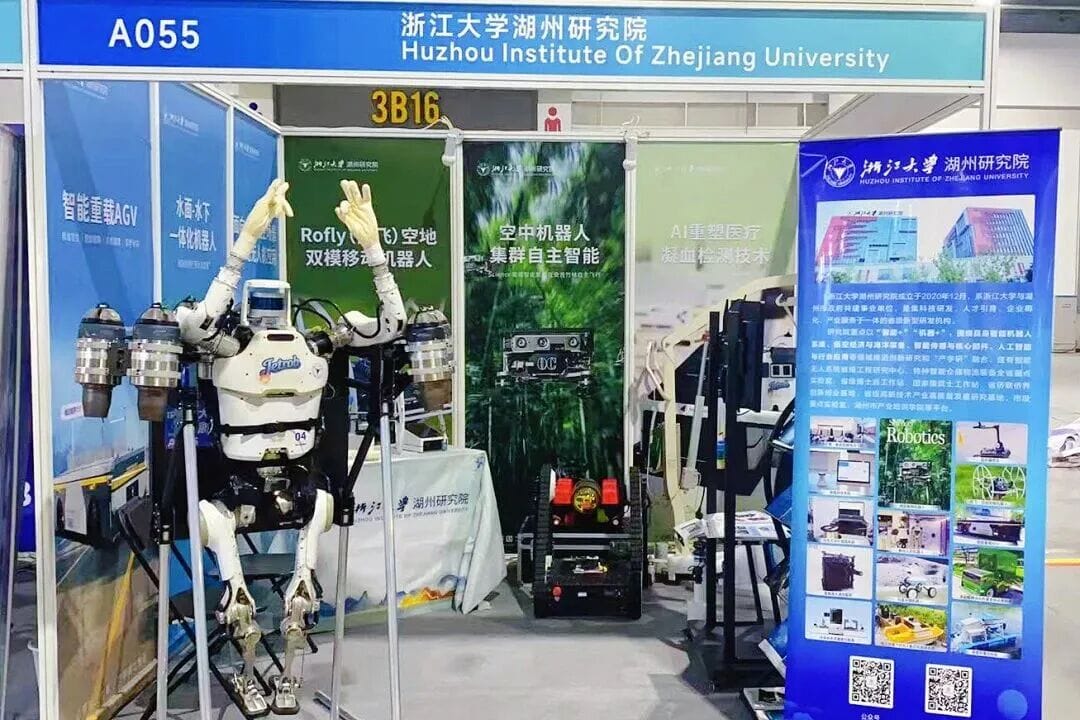
Zhejiang University Huzhou Institute
Zhejiang University Huzhou Institute unveiled its flying humanoid robot concept at the 2025 International Conference on Intelligent Robots and Systems (IROS), presenting a humanoid platform integrated with a jet propulsion system. The institute simultaneously exhibited a jet-powered flying backpack designed for practical emergency scenarios.
The backpack system features three sets of turbojet engines powered by kerosene or diesel fuel. Operators wear the main unit on their backs while gripping two additional thrusters, one in each hand, to achieve controlled flight. Target applications include emergency rescue operations, maritime pilot transfers to vessels, emergency inspections, and extreme sports demonstrations. Though distinct from the humanoid configuration, the propulsion and stability control expertise developed for the backpack system provides foundational technology transferable to future flying humanoid platforms.
California Institute of Technology
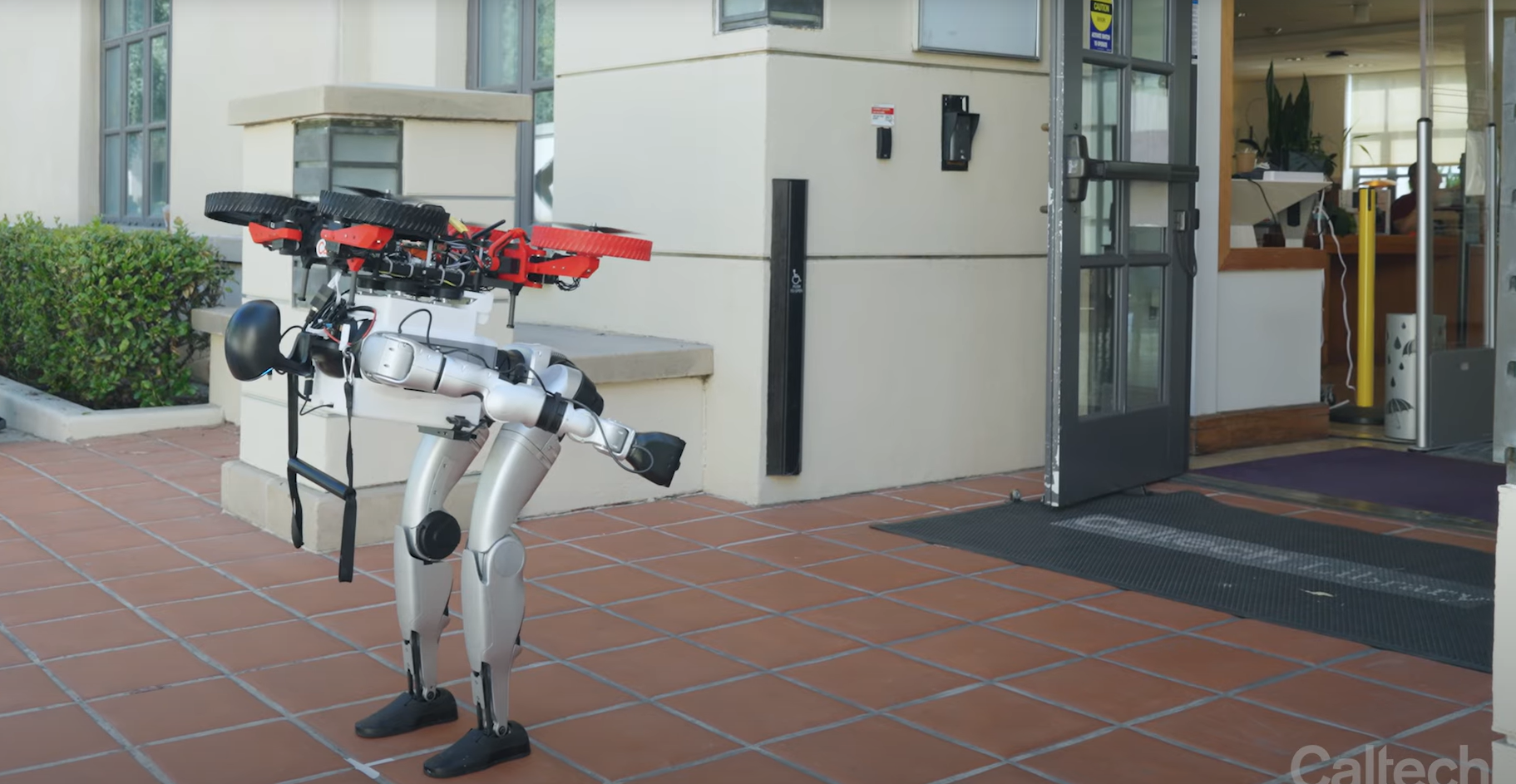
A research team from the California Institute of Technology developed LEONARDO (LEO), a multimodal robot inspired by birds' ability to seamlessly transition between ground locomotion and flight. Unlike conventional bipedal robots, LEO incorporates four propellers mounted at shoulder level, enabling it to maintain standing and walking capabilities while using brief hovering maneuvers to clear obstacles, reach elevated positions, or stabilize posture on slippery surfaces.
Standing approximately 75 centimeters tall and weighing just 2.58 kilograms, LEO integrates onboard computing and sensor systems that maintain balance across confined or rugged terrain. The platform demonstrates a hybrid mobility paradigm where flight serves as an extension of ground movement rather than a separate mode, enabling more fluid environmental adaptation through air-ground transitions.
Separately, researchers from Caltech's Center for Autonomous Systems and Technologies (CAST), collaborating with the Technology Innovation Institute (TII) in Abu Dhabi, UAE, developed what they describe as the world's first integrated multi-robot system combining a humanoid robot with a transformable drone. The system features a modified Unitree G1 humanoid carrying an M4 transformable robot on its back. In demonstrations, the humanoid walked to an elevated safe position before deploying the M4 in drone mode. The M4 then flew to its target area, landed and converted to wheeled configuration for ground traversal, and resumed flight mode to cross water obstacles. This capability chain demonstrates initial "system-level operational" potential for emergency response and hazardous area reconnaissance missions.
Guangdong University of Technology
Researchers at Guangdong University of Technology pursued a more aggressive approach with Jet-HR2, prioritizing flight as the core capability while retaining bipedal structure. The platform mounts four ducted fans at the waist and feet, controlling thrust direction through foot angle adjustments.
Despite a modest thrust-to-weight ratio, Jet-HR2 achieved stable takeoff and hover—a significant accomplishment for high-center-of-gravity bipedal platforms where minor attitude deviations can rapidly escalate into uncontrolled tipping. The team employed thrust vectoring control strategies to address this challenge, demonstrating hovering at heights exceeding one meter and validating technical feasibility.
Experimental results showed that controlling thrust vectors from foot-mounted ducted fans effectively suppressed rotational and pitching behaviors during takeoff. The robot successfully lifted off with a thrust-to-weight ratio of 1.17 (20 kilograms thrust for 17 kilograms mass) while maintaining stable attitude, reaching altitudes above 1,000 millimeters. This approach challenges conventional assumptions that airborne bipedal platforms require extreme thrust-to-weight ratios, potentially enabling lighter and safer configurations for practical deployment.
Italian Institute of Technology
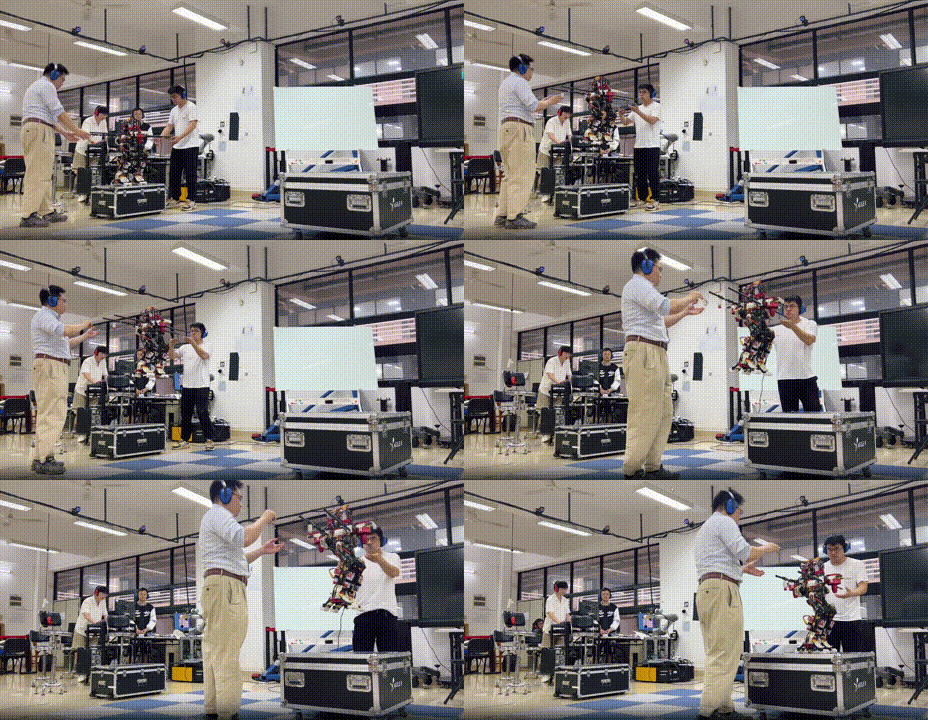
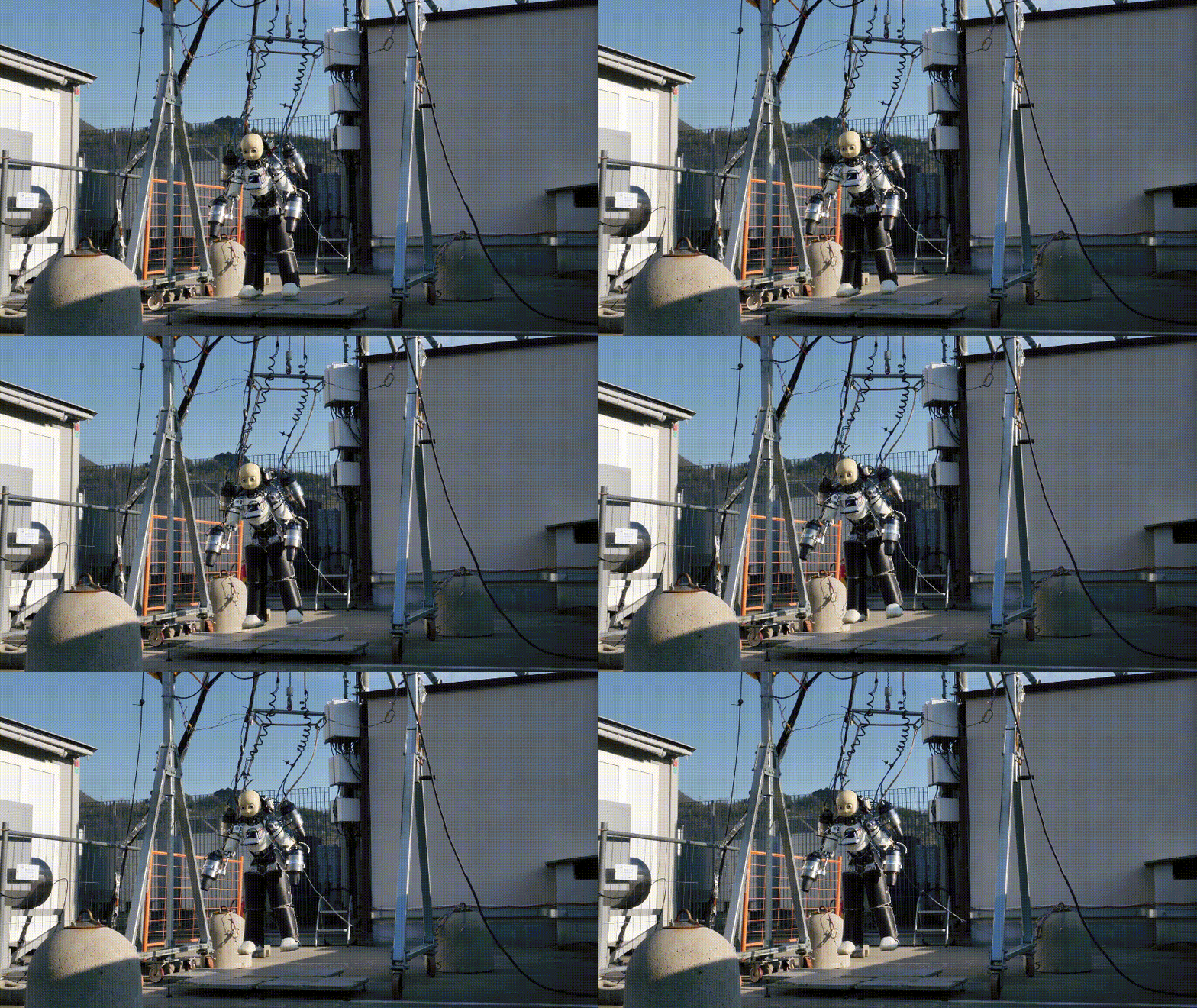
The iRonCub3 project, led by the Artificial and Mechanical Intelligence group at the Italian Institute of Technology, built upon the child-sized iCub humanoid platform to create a jet-powered aerial robot. iRonCub3's backpack provides primary propulsion, while JetCats jet modules integrated into the arms assist with attitude control. Each module delivers maximum thrust of 1,000 newtons (approximately 225 pounds-force) with exhaust temperatures reaching 800°C (1,472°F).
Despite a total mass of 70 kilograms—significantly heavier than earlier iRonCub iterations—the platform successfully completed stable takeoff and short-duration hover, validating the integration of flight propulsion systems, robotic joint actuators, and intelligent control architectures into a fully flight-capable humanoid platform.
The project targets disaster response scenarios where robots could fly rapidly to dangerous zones, land to perform tasks such as opening doors, reconnaissance, and moving objects, then take off again for extraction. This "integrated air-ground deployment capability" could prove critical in future emergency response systems, enabling robots to handle missions requiring rapid response and complex coordination.
Technical and Commercial Outlook
Current flying humanoid platforms face persistent challenges including limited flight endurance, high costs, and constrained application scenarios. However, ongoing hardware iteration, advances in AI control algorithms, and expanding use cases suggest platforms with integrated air-ground capabilities may find roles in industrial operations, disaster response, and eventually space exploration.
While science fiction depicts grand-scale mechanized warfare, practical technological progress typically begins with incremental advances. Achieving several seconds of stable hover or one meter of controlled altitude—though modest in absolute terms—represents foundational validation for aerial humanoid capabilities. These demonstrations prove that robots can transcend gravitational constraints, evolving from machines limited to planar surfaces into platforms capable of three-dimensional deployment across complex operational environments.
As these capabilities mature and integrate, such platforms may become operational partners in scenarios previously inaccessible to conventional robotic systems. The gap between science fiction and engineering reality continues to narrow with each flying bipedal prototype that successfully demonstrates controlled aerial maneuvering.