
From RMB 1 Million to RMB 9,998: China's Humanoid Robot Revolution Accelerates
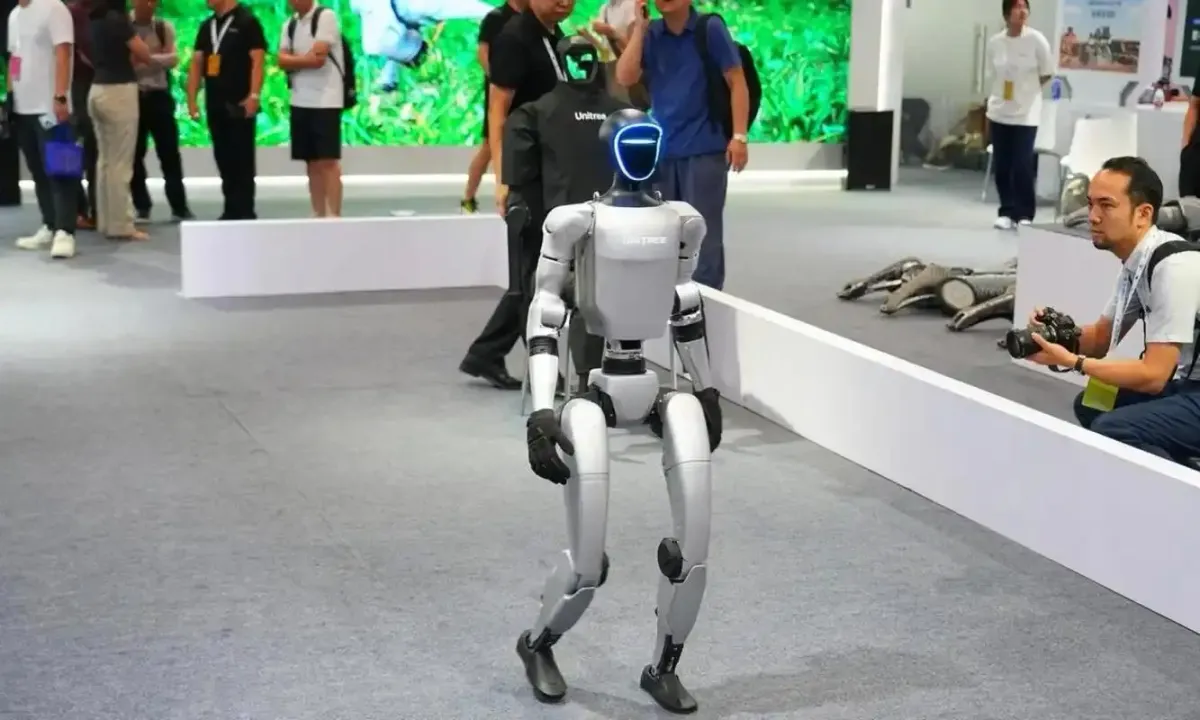
China's humanoid robot industry has crossed a structural threshold: retail prices have broken below RMB 10,000 (US$1,389), compressing what was once a near-RMB 1 million (US$138,900) price point just 12 months ago by more than 99%, as domestic supply chain dominance and automotive-sector capital converge to commoditize what was once considered science fiction hardware.
The price collapse is not a promotional anomaly. It reflects a fundamental re-rating of the sector's cost structure — one driven by over 90% domestic component substitution across servo motors, reducers, and controllers, combined with the technology transfer of sensor and battery-management systems from China's mature consumer electronics and new-energy vehicle industries. The inflection point arrived in mid-2026 and is already cascading across primary, secondary, and rental markets simultaneously.
Market participants are recalibrating quickly. Rental rates for humanoid robots — which peaked at RMB 10,000–30,000 (US$1,389–4,167) per day during the technology's scarcity phase — have dropped to RMB 800–1,500 (US$111–208) per day, effectively eliminating the arbitrage margin that sustained a layer of intermediary dealers. The secondary market has moved faster still, with used units and decommissioned test models now trading in bulk lots at approximately RMB 50,000 (US$6,944) per truckload.
Supply Chain Localization Drives Cost to Structural Floor
The mechanism behind the price compression is traceable and durable, not cyclical. Unitree Robotics, one of China's most closely watched humanoid robot developers, has brought its R1 model to a retail price of RMB 29,900 (US$4,153).
Songyan Dynamics (also known as Bumi) has gone further, pricing its entry-level unit at RMB 9,998 (US$1,389) — the first time in the industry's commercial history that a bipedal humanoid robot has been offered below the five-digit renminbi threshold.
The cost reduction is underpinned by a domestic component substitution rate that industry sources now cite at above 90% for the three highest-cost sub-systems: servo motors, harmonic drive reducers, and motion-control units. A year ago, each of these categories was dominated by Japanese and European suppliers. The substitution wave, accelerated by both policy incentives and scale demand from EV manufacturers, has driven per-unit procurement costs down on an exponential curve.
Equally significant is the manufacturing model shift. Early-stage Chinese robotics firms operated on laboratory assembly timelines — small engineering teams requiring months to complete a single unit. Leading domestic producers have since commissioned fully automated production lines with annual capacity measured in the tens of thousands of units. At that scale, marginal cost compression becomes self-reinforcing.
The technology transfer angle is perhaps the most strategically important. China's smartphone supply chain — the world's largest — contributed visual sensor modules and embedded computing architectures directly applicable to robot perception systems. The new-energy vehicle sector contributed battery management systems and high-efficiency motor controllers. These were not parallel developments; they were deliberate re-deployments of mature, amortized technology stacks into a new hardware category.
BYD Enters the Arena, Deploying 20,000 Units Internally in 2026
The entry of BYD into humanoid robotics represents the sector's most consequential strategic development of 2026, and the one with the most direct implications for competitive dynamics across the entire industry.
According to supply chain sources cited in Chinese industry media, BYD has been running an internal robotics program under the codename "Yao-Shun-Yu" for several years. The core R&D team numbers approximately 4,000 personnel, with doctoral-degree holders comprising more than 30% of headcount. The program's hardware has reportedly undergone seven internal iteration cycles.
The structural logic of an EV manufacturer entering robotics is straightforward: a humanoid robot's core architecture — battery (power), electric motor and controller (actuation), sensor array (perception), and large language model (cognition) — is functionally isomorphic to a battery-electric vehicle's powertrain and autonomy stack. BYD does not need to build new competencies; it needs to repackage existing ones.
The company's deployment plan is aggressive. Approximately 150 prototype units are currently operating on production lines at BYD's Shenzhen and Changsha facilities. The internal target for full-year 2026 deployment stands at 20,000 units — a volume that serves a dual purpose: absorbing early production capacity while generating real-world training data in high-complexity industrial environments that no simulation can replicate.
BYD Executive Vice President Li Ke has publicly articulated the consumer end-state: "When we are old, every home will have three robots — one to clean, one to cook, one to walk with you." With hardware now priced below RMB 10,000, that timeline has compressed materially.
Automotive Dealership Networks Reshape the Go-to-Market Model
The commercialization pathway being constructed by vehicle manufacturers introduces a distribution advantage that pure-play robotics startups cannot easily replicate.
BYD's reported near-term plan involves deploying humanoid robots as multilingual sales assistants in overseas 4S dealerships — a move that simultaneously addresses the dual pain points of multilingual staffing costs and brand differentiation in export markets. The longer-term strategic implication is more significant: BYD's global dealership network of tens of thousands of showrooms and urban experience centers could be converted into consumer robot experience and sales points at near-zero incremental distribution cost.
The industrial B2B economics have already closed. At a purchase price of RMB 29,900–99,980 (US$4,153–13,886), a humanoid robot capable of operating 24 hours per day without social insurance contributions, and performing at approximately 80% of human worker efficiency, delivers a return-on-investment period of under 12 months in most Chinese manufacturing contexts — a threshold that has historically unlocked large-scale enterprise capital expenditure cycles.
Software Capability Emerges as the Binding Constraint
The hardware price war, while dramatic, resolves only one dimension of the mass-market adoption equation. Industry analysts and sector observers are increasingly aligned on the view that the next competitive frontier — spanning roughly 2026 to 2030 — will be determined by software ecosystem depth and large-model generalization capability, not component cost.
Factory floors are structured, predictable, and largely static. Consumer homes are the opposite: non-standard layouts, fragile objects, unpredictable human behavior, and edge-case scenarios that occur with high frequency. The gap between a robot that can sort components on an assembly line and one that can safely navigate a kitchen containing wet surfaces, glass objects, and a child represents an AI capability challenge of a different order of magnitude.
The unresolved questions are consequential for investors evaluating the sector. Operational reliability in unstructured environments, machine ethics frameworks, and physical safety certification standards remain underdeveloped relative to the pace of hardware commoditization. Companies that solve the software generalization problem — not those that win the current price war — are likely to capture the majority of long-term value creation in the consumer segment.
China's humanoid robot industry has demonstrated, with speed that has surprised even domestic observers, that it can manufacture at scale and price for mass adoption. Whether it can build the AI layer to match is the question that will define the sector's trajectory through the end of the decade.
Related Coverage:
Unitree Prices Humanoid Robot at $3,736, Reshaping Industrial Automation Economics