
Goldman: China's Humanoid Robot Progress Is 'Stunning', But The 'ChatGPT Moment' Is 2-3 Years Away
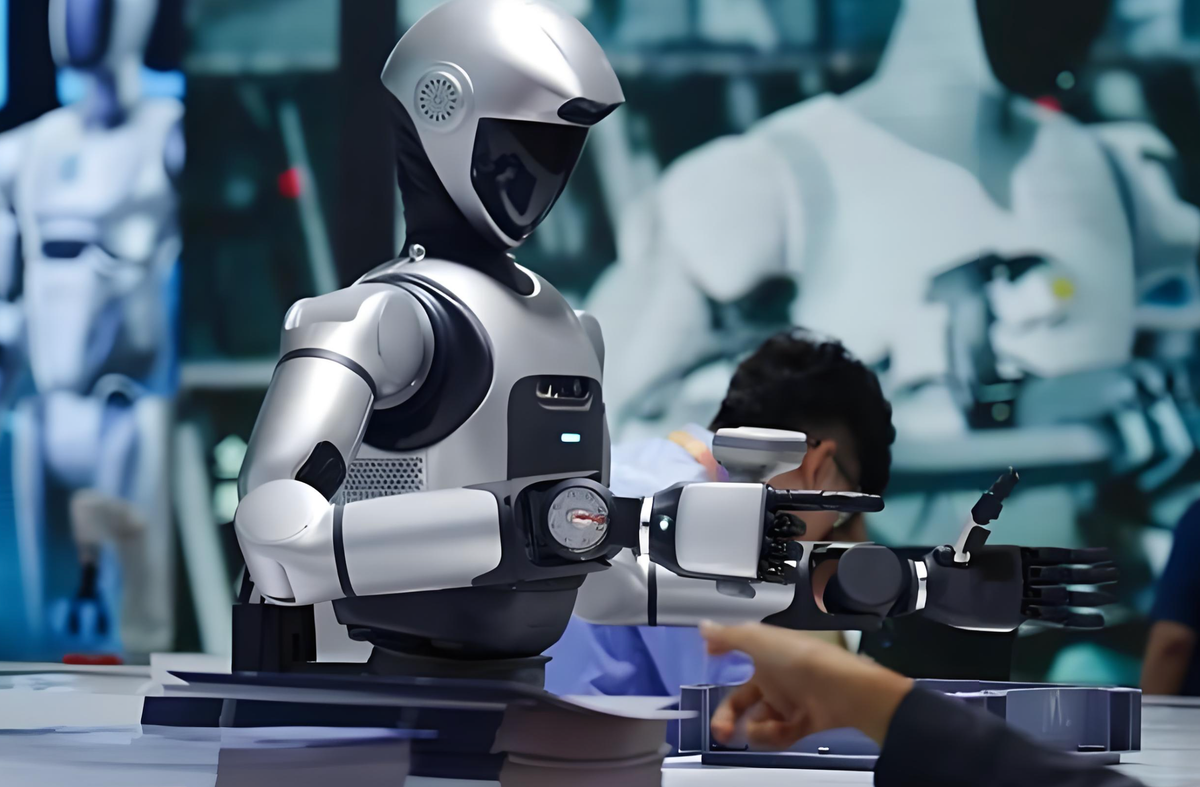
In a note that cuts through the recent hype surrounding humanoid robotics, Goldman Sachs has fired a warning shot for investors rushing into the space. Following an intensive tour of the World Robot Conference (WRC) in Beijing and meetings with nine leading Chinese robotics firms, the bank's analysts concluded that while hardware is iterating at a "surprising" pace, the industry's true "ChatGPT moment" of general-purpose capability remains a distant 2-3 years away, hobbled by a significant data bottleneck.
The August 11th report provides a crucial, on-the-ground perspective that separates engineering prowess from commercial viability, offering a sober outlook for a sector fueled by high expectations and even higher valuations. For investors, the key takeaway is stark: navigate the hype with caution and beware the "product redesign risk" inherent in a rapidly evolving technological landscape.
Stunning Iteration and Unexpected Consumer Demand
Goldman’s team expressed genuine surprise at the velocity of development within China's robotics ecosystem. Compared to their site visits in February and May of this year, the progress was palpable. The firm noted a surge in new products, with over 20 of the 50 humanoid robot exhibitors launching new models in July and August alone.
The performance leap was not merely incremental. According to the report, the improvement in overall product capability was "very notable":
"Overall product performance (whole-body control) has improved significantly vs. our visits in Feb and May, showing 'very notable' improvements in terms of speed and smoothness."
Perhaps more revealing was the shift in audience. Unlike the more academic World Artificial Intelligence Conference (WAIC), the WRC attracted significant traffic from families and general consumers. Goldman sees this as a powerful signal that the addressable market may be larger and more immediate than previously thought, particularly in consumer-facing roles like education, companionship, and entertainment—provided the products are useful, safe, and affordable. The emergence of lower-cost models, like Unitree's R1 at RMB 39,900 and LimX Dynamics' upcoming SA02 at RMB 38,500, underscores this trend.
Pragmatic Industrial Rollouts Trump Sci-Fi Dreams
While consumer interest is budding, the report paints a pragmatic picture of current commercial applications. The bulk of sales today come from two main areas: education, showroom guidance, and stage performances; and providing standardized platforms for developers and scientific research.
The holy grail of manufacturing and logistics is being pursued with a clear-eyed, step-by-step approach. Rather than attempting to replace human workers wholesale on complex assembly lines, companies are targeting specific, well-defined tasks and focusing on non-production line activities to gain a commercial foothold.
"For specific tasks like picking, sorting, assembly and inspection, several companies said success rates are already reaching 80-99.5%, with further improvement focused on long-tail and corner cases... One company said an 18-month payback period is viewed by customers as a reasonable standard to place orders."
This focus on ROI and system-level efficiency—rather than a simple one-to-one comparison with human speed—highlights a mature, business-oriented strategy.
The "ChatGPT Moment": Trapped by Data Scarcity
The most sobering part of Goldman's analysis concerns the timeline for true general intelligence. The consensus view, echoed by industry leaders like Unitree CEO Wang Xingxing, is clear: a robot that can perform general tasks in a completely new environment is at least two to three years away, but likely less than ten.
The primary bottleneck is not hardware, but data.
"The key bottleneck to get there is the accumulation of high-quality real-world data. Some industry players commented that an industrial environment is difficult to simulate, and may take as much as 70-80% of real-world data for effective training."
This data scarcity has led to immense technical uncertainty. The initial belief that a Vision-Language-Action (VLA) model combined with Reinforcement Learning (RL) was the definitive path is now being questioned. The emergence of powerful new models like Google's Veo3, with its superior understanding of real-world physics, has sparked debate over the optimal AI architecture. This uncertainty carries direct financial risk.
Goldman explicitly warns investors: "Given the co-evolution of hardware/software architecture, investors have to be mindful about the potential product redesign risks."
Investor Playbook: Dodge The Hype, Bet On The Picks-And-Shovels
Given the shifting technological sands, Goldman advises investors to avoid the direct hardware players and instead focus on the most stable and predictable part of the value chain. While government subsidies and low-cost models may drive short-term sales, the risk of backing a product that becomes obsolete overnight is high.
The firm's strategic conclusion is to favor key component suppliers with entrenched customer relationships and clear technological roadmaps.
"We believe the actuator assembly has the highest visibility in terms of customer relationship and technology roadmap, given constant product redesign/component competition risks."
Based on this logic, Goldman reiterated its Buy rating on Sanhua Intelligent Controls (Sanhua H/A), citing its strong long-term positioning in the humanoid robot actuator space and forecasting a 19% revenue/net profit CAGR for 2025-2030. In contrast, other component suppliers like Leaderdrive and Moons' were given Neutral ratings, reflecting a balanced risk/reward profile amid greater technical and competitive pressures.