
H1 2026 China Auto Exports Hit 5.1M, Making Overseas Markets the New Growth Engine
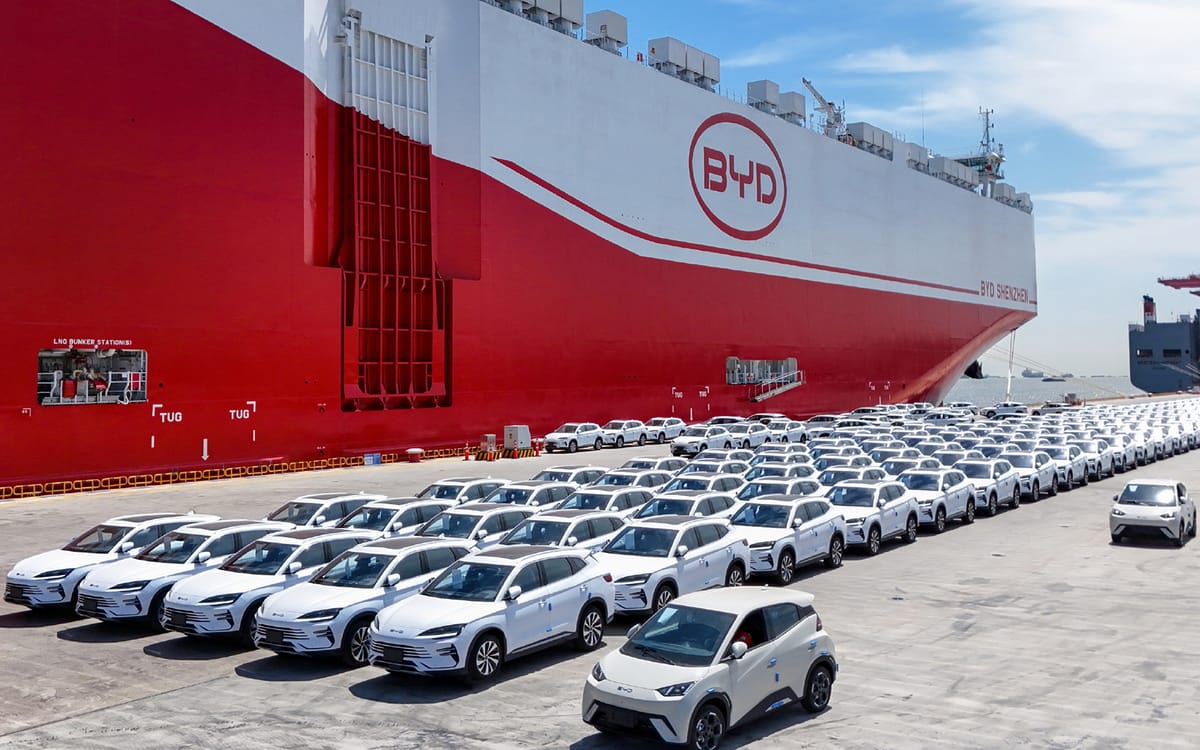
Exports now account for one-third of total vehicle sales as June shipments breach the one-million-unit monthly threshold for the first time, exposing a deepening structural bifurcation between collapsing home demand and accelerating overseas expansion.
China's automotive sector posted first-half 2026 exports of 5.096 million units, up 65.3% year-on-year, as a 23.3% year-on-year contraction in June domestic sales forced manufacturers to treat overseas markets not as a strategic supplement but as a operational lifeline. The divergence is now arithmetically undeniable: exports contributed one-third of total H1 industry volume of 15.017 million units, a structural shift that would have been inconceivable when the industry was debating whether full-year 2024 exports could clear six million units.
June's single-month export figure of 1.037 million units—up 75.1% year-on-year and 11.6% month-on-month—marks the first time China has shipped more than one million vehicles in a calendar month, a milestone that signals the country's export trajectory has moved from cyclical surge to structural baseline. For context, full-year 2024 exports totaled 5.859 million units and full-year 2025 reached 7.098 million; at the current H1 run-rate, a full-year figure approaching or exceeding 10 million units is a credible projection rather than an aspirational target.
Domestic Demand Contracts While Export Volumes Accelerate, Inverting Industry's Growth Calculus
The domestic market registered 9.921 million units in H1 2026, a figure that tells only part of the story. June's 23.3% year-on-year domestic decline is not company-specific deterioration—it reflects aggregate demand destruction following 18 months of price warfare that pulled forward purchases and extended replacement cycles. Consumers are holding cash, waiting for the next price cut that may already have arrived.
China's customs data adds a further dimension: vehicle imports fell to 163,000 units in January–May 2026, down 10.6% year-on-year. The country that spent two decades importing aspirational brands is now a net exporter of automotive product at scale. The reorientation is complete in directional terms; the question is how durable it proves under rising trade friction.
For manufacturers, exports serve a function beyond revenue diversification. Domestic price competition has compressed margins to the point where factory utilization rates are insufficient to absorb fixed costs. Export volume absorbs surplus capacity, reduces per-unit cost, and partially offsets the margin erosion driven by domestic discounting. Chery, Great Wall Motor, and Tesla's Shanghai Gigafactory have each demonstrated that high export dependency is a cost-management strategy as much as a growth strategy.
Plug-In Hybrids Outpace Pure EVs Overseas, Revealing Infrastructure Arbitrage
Disaggregating H1 2026 exports by powertrain reveals a counterintuitive hierarchy. Plug-in hybrid electric vehicles (PHEVs) posted an export-to-total-sales ratio of 37.5%—higher than battery electric vehicles (BEVs) at 28.8%—and grew 140% year-on-year versus BEVs' 110%. In June, new-energy vehicle exports of 523,000 units narrowly surpassed conventional fuel vehicle exports of 514,000 units for the first time, a symbolic inflection point.
The PHEV advantage is structural, not cyclical. In Southeast Asia, Latin America, the Middle East, and sub-Saharan Africa—the primary growth corridors for Chinese vehicle exports—public charging infrastructure remains sparse. PHEVs eliminate range anxiety by retaining an internal combustion engine as backup, making them the pragmatic choice for markets where BEV adoption is constrained by infrastructure rather than consumer preference. Chinese manufacturers, led by BYD and Chery, have effectively executed an infrastructure arbitrage: deploying the powertrain technology that matches destination-market conditions rather than the technology preferred in the home market.
Pure EVs, by contrast, face a ceiling determined by destination-market charging density. Until overseas charging networks reach the density achieved in China's tier-one and tier-two cities, BEV export growth will remain structurally capped relative to PHEV.
Passenger Vehicles Drive Export Concentration; Commercial NEVs Remain Effectively Landlocked
Passenger vehicles accounted for 4.432 million of H1 2026's total exports, representing a 34.8% export-to-sales ratio. Commercial vehicles exported 664,000 units, a 28.9% ratio—and within that segment, new-energy commercial vehicles exported only 54,000 units against 496,000 domestic sales, a 9.8% export ratio that is effectively zero at industry scale.
The commercial vehicle NEV export gap reflects two compounding constraints. On the product side, battery-electric heavy trucks and light commercial vehicles have not yet achieved the payload-to-range performance required for long-haul logistics in markets where route distances and load factors differ materially from Chinese conditions. On the market side, overseas logistics and mining operators lack the policy incentives—subsidies, emissions mandates, procurement preferences—that drove commercial NEV adoption in China. Without a policy analog abroad, the demand pull does not exist. This gap is unlikely to close within a two-to-three year horizon.
Top-10 Exporters Capture 88.5% of Volume, Leaving Little Room for Mid-Tier Players
The top ten exporters shipped 4.511 million units in H1 2026, representing 88.5% of total industry exports. The concentration ratio underscores a structural reality: overseas distribution networks, homologation certifications, and after-sales infrastructure require sustained capital deployment that mid-tier manufacturers cannot match. The barriers to export scale are not tariffs alone—they are the accumulated fixed costs of market entry.
Chery Automobile leads the industry with 939,000 H1 exports, representing 69.2% of its total sales of 1.357 million units—the highest export dependency ratio in the sector. June exports of 190,000 units accounted for 18.3% of the entire industry's monthly shipments. Chery's 71.3% year-on-year export growth on an already-large base reflects two decades of systematic market development across Central Asia, the Middle East, Europe, Latin America, and Africa. Its geographic diversification is the deepest of any Chinese OEM.
BYD exported 792,000 units, a 43.8% export ratio, with primary exposure to Europe, Southeast Asia, Latin America, and Australia. BYD's export figures carry a caveat: shipment data leads local registration data, meaning the H1 numbers reflect vehicles in transit or recently delivered rather than vehicles already in consumer hands. The true demand signal will be visible in destination-market registration data over the following two quarters.
SAIC Motor, Geely Automobile, and Changan Automobile form a mid-tier export cluster with ratios of 34.1%, 34.7%, and 40.7% respectively. Geely's 150% year-on-year export growth is the highest among established domestic OEMs and reflects the accelerating international expansion of its Geely, Lynk & Co, and Zeekr brands. Changan's 40.7% ratio signals a deliberate strategic pivot toward overseas markets under sustained domestic pressure.
Great Wall Motor exported 291,000 units at a 49.9% ratio, with concentrated exposure to Russia, Brazil, and Southeast Asia—markets where its Haval SUV brand has established meaningful dealer networks. The near-50% export dependency makes Great Wall one of the most exposed major OEMs to destination-market policy risk.
Tesla Shanghai Gigafactory produced 468,000 units in H1 2026, exporting 229,000—a 48.9% export ratio. The facility functions as Tesla's primary global export hub, supplying Europe, Asia-Pacific, and other markets outside North America. June exports surged 260% year-on-year, the highest growth rate among the top ten, reflecting both base effects and expanded model availability. The Shanghai factory's dual role—serving China's domestic market while supplying global demand—represents the operational template that joint-venture manufacturers are now evaluating for their own China production bases.
FAW Group, Dongfeng Motor, and BAIC Group remain domestically anchored, with export ratios of 11.1%, 18.6%, and 23.1% respectively. For these three state-owned enterprises, exports remain supplementary to a domestic business that is itself under margin pressure. FAW's 2026 data incorporates Leapmotor following a consolidation of reporting.
Trade Barriers Threaten to Cap Export Momentum as Tariff Walls Rise
The H1 2026 export surge carries embedded risk that the volume figures do not capture. The European Union's anti-subsidy countervailing duties on Chinese-made electric vehicles remain in force, adding 17–35 percentage points to effective tariff rates depending on manufacturer. Multiple destination markets—including Brazil, Turkey, and several Southeast Asian economies—have introduced or are legislating local content requirements and assembly mandates that would require Chinese OEMs to shift from export-based models to in-market production.
BYD's construction of manufacturing facilities in Hungary, Thailand, and Brazil, and SAIC's existing Anting-to-Europe supply chain, represent early-stage responses to this structural pressure. But the capital requirements for meaningful localization are substantial, and the timeline to production scale is measured in years rather than quarters.
The fundamental tension is this: China's automotive industry has become dependent on export volume to absorb domestic overcapacity and compress unit costs, precisely as the destination markets for those exports are erecting barriers designed to force local production. The industry's ability to sustain a 10-million-unit annual export trajectory through 2027 and beyond will depend less on product competitiveness—which is no longer in question—than on the pace and structure of geopolitical accommodation.
Related Coverage:
China's Auto Exporters Shift from Trade to Conquest as Domestic Market Implodes