
He Xiaopeng Details XPeng’s Next Growth Bet Beyond the G9L
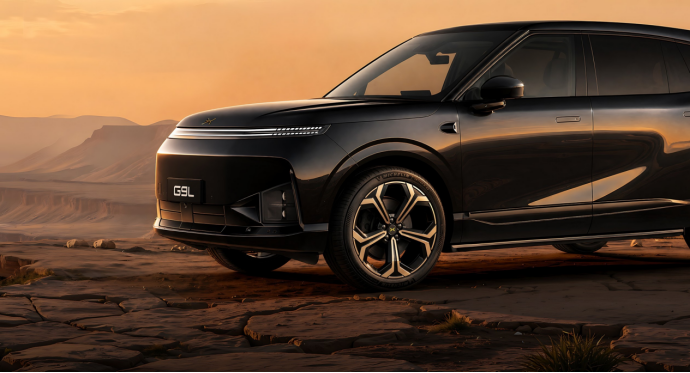
XPeng Chairman and CEO He Xiaopeng has outlined a broader growth strategy beyond the company’s Sept. 17 G9L launch, highlighting intelligent driving, global expansion and humanoid robotics as key areas for the next stage of development. He said XPeng plans to expand its second-generation VLA system into overseas markets as regulations allow, strengthen technology cooperation with international automakers, and achieve mass production of its humanoid robot by the end of 2026, with sales targeted for China in the second quarter of 2027. The strategy points to a gradual shift from exporting vehicles to commercialising the underlying technologies, manufacturing capabilities and supply-chain systems developed through XPeng’s automotive business.
He Xiaopeng Expands the Role of Intelligent Driving Overseas
He identified intelligent driving as one of the main technologies that could help XPeng compete outside China.
The company’s second-generation VLA system, used in the XOS 6.3.0 software version, is now being tested in Europe, according to the interview. He said the latest system does not necessarily represent a dramatic change from the user’s perspective, but that the underlying technology has improved substantially.
He also compared its performance with Tesla Inc.’s FSD, saying that in his own observations the two systems were similar on major roads while XPeng’s system performed better on narrower roads in some European and Australian markets where the full version of FSD is available.
Those comments are He’s assessment and were not accompanied in the source material by an independent side-by-side test. The more important point for XPeng is what comes next: whether the same underlying system can be adapted to very different driving environments without requiring a completely new development process in every market.
He said XPeng may only need a limited amount of local data for further training overseas because of what he describes as the system’s ability to generalize. The company is also combining VLA with VLM technology, with the aim of creating a common technical foundation for different driving environments.
For an automaker entering dozens of countries, that has a direct business implication. The cost of overseas expansion is not limited to exporting vehicles. It also includes adapting intelligent-driving systems to road conditions, traffic behavior, regulations and local usage patterns. A system that can be transferred across markets with less additional training could reduce part of that burden.
He said XPeng expects intelligent-driving regulations in Europe and other markets to gradually open up at different levels, and that the company is participating in discussions around L2 and L3 driving standards.
His conclusion was explicit: over the next two years, he expects XPeng to be among the companies at the top level of intelligent-driving technology globally.
XPeng Links Global Vehicle Sales With Local Production
The G9L remains relevant to that strategy because XPeng developed it from the start as a global vehicle.
According to product matrix general manager Wu Anfei, the G9L was conceived more than three years ago as an original five-seat flagship rather than as a shortened six-seat model. The vehicle was designed for left- and right-hand-drive markets, two- and four-wheel-drive versions, and both pure-electric and range-extended powertrains.
The development program covered 26 countries and regions and accumulated 6.74 million kilometers of global testing, according to the source material. The company said it used extreme-weather testing and additional validation for right-hand-drive markets to raise the reliability baseline of the vehicle.
That lengthy development process is important in the context of XPeng’s overseas expansion because the company is not treating export as a separate phase that begins after a domestic vehicle is completed.
G9L will be introduced in Europe on Oct. 12 at the Paris Motor Show and is planned for rollout across 64 markets. Its first overseas production will take place at the company’s partner facility in Graz, Austria, while XPeng is also operating manufacturing facilities in Indonesia and Malaysia, according to the interview.
The company said global manufacturing standards, supply-chain processes and inspection procedures remain aligned, while individual markets still require changes to meet local rules and consumer requirements. Those adjustments can include energy systems, seating configurations and market-specific accessories.
The significance of that structure is straightforward: XPeng is trying to make the vehicle global at the design and manufacturing stages instead of relying mainly on post-development modifications.
That is also why the G9L is not simply a different seating version of another flagship model. Wu said the company rejected a lower-cost approach that would have involved substantially modifying the existing GX platform because it would have required compromises in handling and would not have provided the same global flexibility.
He Xiaopeng Broadens XPeng’s Overseas Technology Strategy
He also described three capabilities that he expects to become more visible in XPeng’s overseas business from 2027.
The first is intelligent driving, which the company expects to expand internationally as regulations permit.
The second is offline voice interaction. He said this is especially relevant outside China because overseas markets involve more languages and, in some markets, higher data costs. An offline system could therefore reduce reliance on continuous network access.
The third is fast charging. He said XPeng expects its super-fast charging and energy-storage charging stations to begin large-scale deployment globally in 2027 and 2028.
Taken together, the three areas show that XPeng’s overseas strategy is not limited to vehicle distribution.
A car exported to another country carries with it a fixed set of hardware features. Software, voice systems and charging infrastructure can continue to be updated or expanded after the vehicle arrives. That gives XPeng additional ways to maintain a technological connection with overseas customers after the initial sale.
He also pointed to the company’s existing position in Europe. According to his comments, the G9 is priced at about €80,000 to €100,000 in Europe and ranks first in the large pure-electric SUV category in multiple countries.
The company’s stated positioning is based on technology differences rather than price competition. That approach is particularly relevant for a Chinese automaker entering markets where established premium brands already have strong consumer recognition.
XPeng Moves Technology From Internal Use Toward External Sales
Another important part of He’s comments is that XPeng increasingly sees its technology as something that can be used beyond its own vehicles.
The company has already demonstrated this direction through its cooperation with Volkswagen. In the interview, He discussed intelligent-driving systems, electronic architecture and related technologies as capabilities that can support broader commercial cooperation.
This matters because vehicle manufacturing and technology services have different business characteristics.
Selling more vehicles requires factories, components, logistics and sales networks to scale with volume. Technology services can potentially be sold to other manufacturers without requiring XPeng to manufacture the entire vehicle itself.
The interview therefore points to two different ways for XPeng to expand internationally. It can sell complete vehicles through its own brand, or it can allow other manufacturers to use technologies developed by XPeng.
The G9L is useful in both cases. For consumers, it is a flagship product. For potential partners, it serves as a visible example of the technologies that XPeng is trying to develop and commercialize.
That distinction may become increasingly important as competition in the Chinese EV market moves beyond vehicle specifications alone.
He Xiaopeng Pushes the Robot Toward Mass Production
He’s comments on humanoid robots were more cautious than the company’s discussion of its cars, but they included a concrete timetable.
XPeng plans to achieve robot mass production by the end of December 2026, then begin selling robots in China in the second quarter of 2027 before entering overseas markets.
He explained the company’s relatively limited public exposure of its robot by pointing to the difficulty of turning demonstrations into products. In his view, showing a robot completing a task has limited commercial value unless the system can also be engineered for stable operation and mass production.
He compared the current stage of XPeng’s robot business with the company’s early automotive development. He said 2026 is similar, in some respects, to XPeng’s 2018 period, when the company unveiled the G3 in December before beginning deliveries in April of the following year.
The analogy places the robot business at an early productization stage rather than at the stage of a mature commercial business.
That distinction matters because the company is now moving from research to manufacturing.
XPeng Rebuilds Its Robot Supply Chain Through Vertical Development
The largest challenge He described is not artificial intelligence alone. It is the interaction between the robot’s hardware, software, mechanical design and supply chain.
He said XPeng is developing most of those areas internally because the existing supply chain cannot consistently meet its requirements.
A small hardware change can affect multiple other systems. He gave the example of a camera mounted in the robot’s head. The camera angle influences how the robot positions its head, which can then affect hand movements, leg movements, waist movements and full-body control.
He also cited a handshake as a practical example. A human can look directly at another person while extending a hand, but a humanoid robot needs its visual and mechanical systems to coordinate that same movement. A poorly positioned camera can force the robot to tilt its head, creating restrictions elsewhere in the body.
The engineering lesson is that the robot cannot be developed as a collection of independent components.
That is why XPeng is taking a more vertically integrated approach. He said the company wants robot joints that are thin, safe, durable and powerful, but current suppliers do not fully meet those requirements. As a result, XPeng is redesigning parts of the supply chain itself.
The approach is demanding, but it also connects the robot business directly with lessons from the automotive industry.
He compared robot development with intelligent vehicles, where the quality of the vehicle platform, chassis, computing power, wiring and other hardware determines what software can ultimately achieve. In the same way, XPeng believes the robot’s physical architecture has to be developed together with its control and AI systems.
XPeng Tests a New Business Model Through Its Own Retail Network
He also described a commercial model that begins with XPeng’s existing operations.
Rather than designing a general-purpose robot first and then searching for suitable applications, he said XPeng wants its robot to operate directly within the company’s own business system.
One example is the sales network.
A robot could be deployed in an XPeng showroom, interact with customers and potentially participate in vehicle sales. That would give the company an immediate operating environment rather than requiring it to build a separate customer network for the robot business.
The approach also creates a practical testing ground. XPeng would be able to observe how the robot performs in a real commercial environment, identify hardware and software problems and feed those lessons back into subsequent products.
That could eventually connect the company’s automotive and robotics businesses more directly.
For now, however, the robot remains a development project with a stated production target rather than an established revenue stream. The company’s immediate test is whether it can move from engineering prototypes to a repeatable manufacturing process before the end of 2026.
XPeng Expands the Question From Cars to Capabilities
The key takeaway from He Xiaopeng’s post-launch comments is that XPeng is trying to build businesses around capabilities that sit underneath the vehicle itself.
The G9L demonstrates the company’s approach to global product development. Its intelligent-driving system is intended to travel across markets. Its electronic and computing technologies can potentially be offered to other automakers. Its manufacturing and supply-chain experience is being applied to humanoid robots.
The strategy is still under development, and several of its most ambitious targets lie ahead: broader international deployment of advanced intelligent driving, large-scale overseas charging infrastructure from 2027 onward, and robot mass production by the end of 2026 followed by sales in 2027.
But the direction is now more clearly defined.
The Sept. 17 G9L launch established the product. The subsequent discussion with He Xiaopeng explains the larger strategy: use the car business to develop technologies, use global markets to expand those technologies, and use manufacturing capabilities to bring them into new product categories.
For XPeng, the next stage is therefore not simply about launching another flagship model. It is about whether the engineering capabilities accumulated through vehicles can be turned into multiple businesses with customers beyond the driver sitting behind the wheel.
Related Coverage:
XPeng Intensifies Family SUV Push With Official G9L Launch
XPeng Takes Humanoid Robots From Prototype to Production With an 80%-Automated Line
XPeng’s New VLA Pushes Its Physical AI Ambitions Beyond Cars