
Honor Unveils 'Self-Evolving' AI in New Magic8 Smartphone, Challenging Rivals
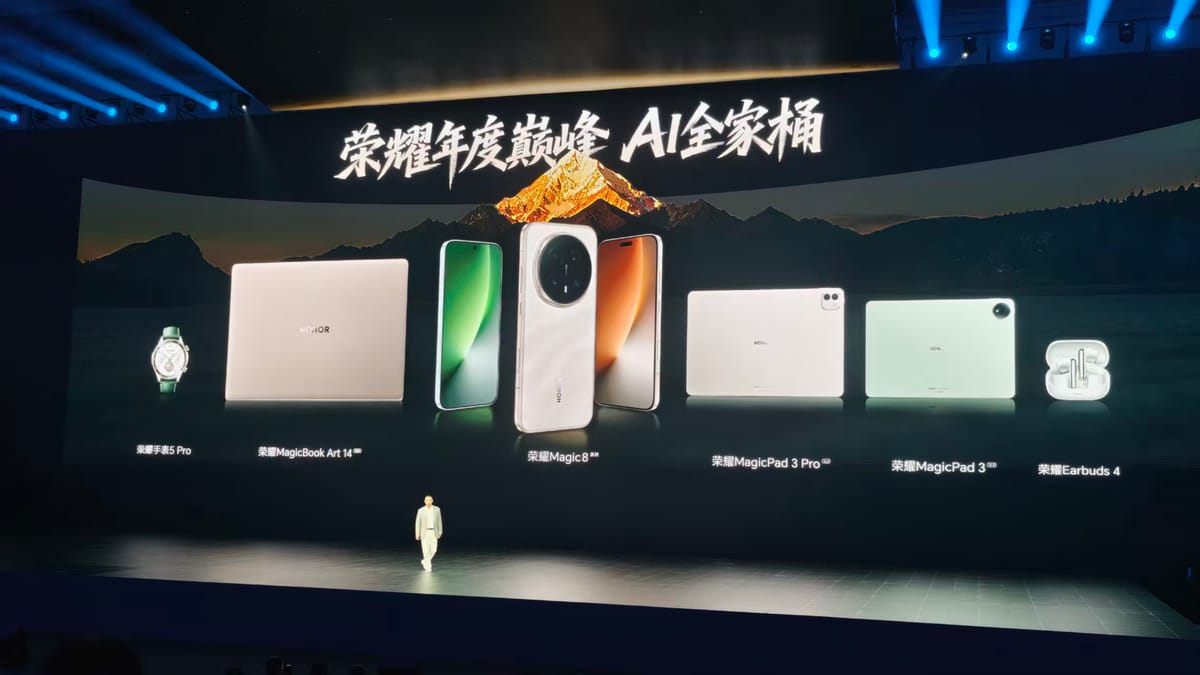
Honor is doubling down on artificial intelligence with its latest flagship smartphone, embedding what the company calls a “self-evolving” AI into the core of the device as it escalates its competition with Apple and domestic rivals in China’s high-end market.
At a launch event in Beijing on October 15, Honor unveiled its Magic8 series, powered by the new MagicOS 10 operating system. The company positioned the device not as a traditional smartphone but as an “AI Phone,” built around its upgraded Magic large model 3.0, which enables the device’s AI to learn new tasks independently.
The central feature is a revamped AI assistant, YOYO, designed to act as a proactive “partner” for users in daily scenarios, from securing shopping discounts and planning travel to generating business reports. The aggressive push into on-device AI signals an intensified battle for dominance in the smartphone market, placing pressure on competitors including Xiaomi and Apple.
Underscoring its ambition, Honor announced a starting price of 4,499 yuan ($634) for the Magic8 and previewed a futuristic concept "Robot Phone" slated for a 2026 debut. The company’s competitive strategy was made clear as it directly compared the performance and pricing of its standard Magic8 model against the high-end Pro versions of its rivals' flagships.
A ‘Self-Evolving’ AI Partner
Honor is betting that the future of smartphones lies in AI that moves beyond simple voice commands to become an integrated and autonomous entity. According to CEO Li Jian, the AI in the Magic8 series is a “living” system that can self-reflect and iterate. At the event, the company demonstrated the AI learning to play a card game from scratch, improving its win rate from zero to over 40% after tens of thousands of internal simulations.
The YOYO assistant functions as a versatile partner for users. In e-commerce, it can visually scan items in a shopping cart to find and apply coupons, with a live demonstration showing a 600 yuan price reduction. For dining, it can recommend a restaurant’s signature dishes and even determine if a menu item is pre-cooked based on a user’s prior search history for fresh food. The AI also extends to health and productivity, with capabilities to estimate the calorie content of a meal from a photo and generate trend analysis reports based on a single voice command.
New AI Models and Cross-Platform Connectivity
Powering these features is the new Magic large model 3.0, which has undergone three iterations since 2023. The system combines on-device and cloud-based models and has achieved L3-level agent intelligence certification from the China Academy of Information and Communications Technology (CAICT), signifying a high level of generalization capability.
Honor detailed several underlying technical advancements, including its on-device Vision Large Model (MagicVL), which it claims improves inference speed by 25% and reduces power consumption by 25%. A new system-level MCP architecture allows the YOYO assistant to integrate with and execute tasks across over 80% of the phone's system, an ecosystem that now supports over 4,000 smart agents.
Significantly, Honor announced its platform-agnostic Honor Unbordered Smart Connection, enabling seamless connectivity and file transfers between its phones and devices from all other brands, including Apple's iPhones, Macs, and Apple Watches, as well as any Windows PC.
AI-Enhanced Imaging and Chipset Optimization
AI has been deeply integrated into the Magic8’s core hardware functions, including its camera and processor. The device’s imaging system uses AI models with billions of parameters to enhance photography. This includes a 200-megapixel telephoto lens and an AIMAGE engine that utilizes a Vision Transformer (ViT) model for superior low-light performance. The company claims its AI-driven stabilization system achieves an industry-leading CIPA 5.5 rating.
On the performance front, Honor stated that its collaboration with Qualcomm in a joint lab has enabled deep optimization of the Snapdragon chipset. The company presented benchmark scores showing the Magic8 outperforming a competitor’s device equipped with the same chip. AI is also used to manage graphics rendering to reduce frame rate jitters in gaming and to optimize power management, which Honor claims gives the Magic8 21% remaining battery life in a stress test where rivals were depleted. A specialized "AI Ticket-Snatching Acceleration" feature also optimizes network connectivity for time-sensitive online purchases.
Aggressive Pricing and Market Positioning
Honor's launch event was marked by direct comparisons to its primary competitors. CEO Li Jian stressed that while "others are busy benchmarking against the iPhone, Honor is making a self-evolving AI native phone." The Magic8 Pro's camera capabilities were benchmarked against the Xiaomi 15 Ultra and iPhone 17 Pro Max. Furthermore, the standard Magic8 was priced against the Xiaomi 17 series' Pro version, signaling an aggressive move to capture market share.
The event's strong focus on AI stands in contrast to more hardware-centric launches from rivals in recent months. By framing the Magic8 as a foundational "AI Phone" and teasing a robotic form factor for the future, Honor has clearly defined its strategy and raised the stakes in the ongoing smartphone AI race, awaiting a response from both its Android peers and Apple’s anticipated AI offerings for the Chinese market.