
Honor's Robot Phone Sells Out in Hours as China's Smartphone War Turns Robotic
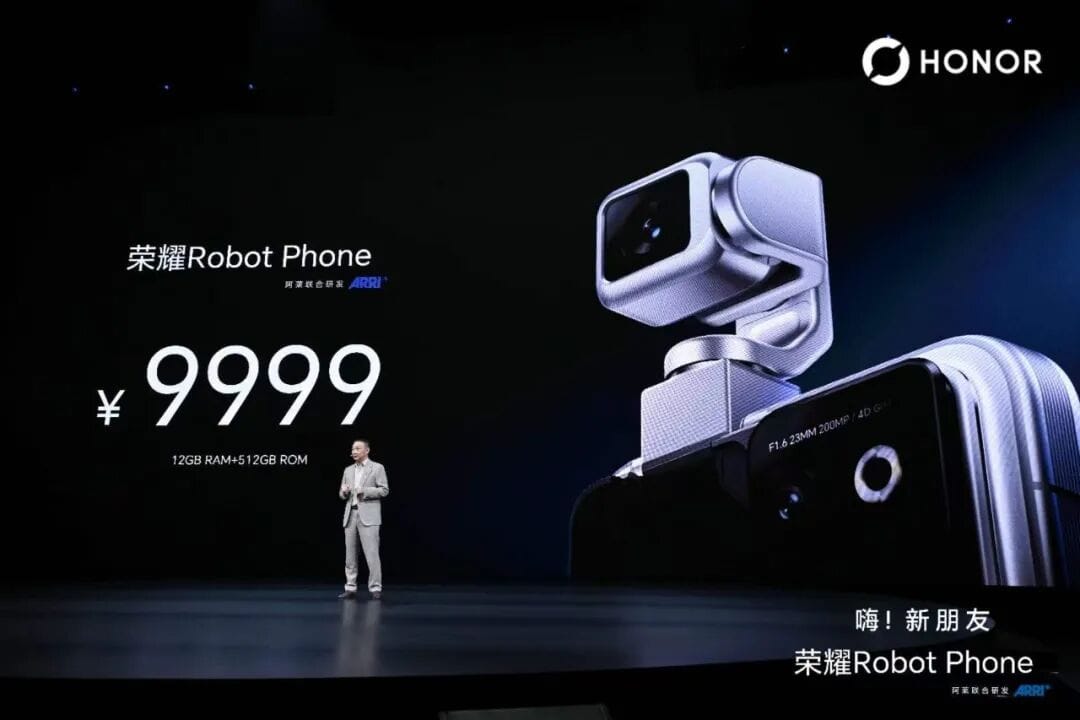
Honor launched the world's first robotics-grade smartphone on August 12, 2026, priced from RMB 9,999 (US$1,389), and watched pre-sale inventory evaporate within hours — a debut that redraws the competitive boundary between consumer electronics and embodied AI hardware.
The sell-out, observed simultaneously across major Chinese e-commerce platforms on launch day, caught even Honor's own distribution network off-guard. CEO Li Jian disclosed in a post-launch interview that demand for priority purchase codes was overwhelming: a prominent film director requested 14 units in a single ask, a photography-focused entrepreneur sought 10, and at least one overseas buyer placed an inquiry for 20 devices. The anecdotes, while anecdotal, point to an unusually broad buyer profile spanning professional creatives, corporate buyers, and cross-border consumers — a demand mix that typically precedes sustained volume momentum rather than a one-day spike.
The launch also carries strategic signaling value. Honor's decision to anchor the Robot Phone at the RMB 9,999–12,999 (US$1,389–US$1,805) tier — directly challenging Apple's iPhone 17 Pro range and Huawei's Mate 70 RS in China's ultra-premium segment — represents the most explicit declaration yet of Honor's post-independence ambition to compete on hardware innovation rather than price.
Four Degrees of Freedom Redefine What a Smartphone Body Can Do
The Robot Phone's engineering centerpiece is Honor's proprietary titanium-alloy 4-degree-of-freedom (4D) gimbal system — a mechanical assembly integrating more than 100 precision components, manufactured through over 60 specialized processes, and protected by more than 100 self-developed patents. The system delivers robot-grade mechanical articulation to a device weighing 248 grams with a 9.59mm metal unibody chassis, a balance of mass and mechanical complexity that Honor's engineers describe as the most precise mechanical structure benchmark in the handset industry.
The practical implication for investors tracking the smartphone supply chain is significant. A titanium-alloy gimbal of this specification — achieving high torque, high-speed response, and miniaturization simultaneously — requires a precision manufacturing ecosystem that few contract manufacturers can currently support at consumer-grade yields. This creates a near-term moat, but also a production bottleneck that likely explains the rapid sell-out.
Honor's H1 Chip Challenges Qualcomm's Imaging Dominance
Alongside the mechanical system, Honor debuted the Yuguang H1, its first fully proprietary AI Signal Processor (AISP) chip custom-designed for mechanical gimbal video workflows. The chip's specifications are aggressive by any benchmark: 18.8 TOPS/W core energy efficiency density, native 14-stop cinematic dynamic range, and an 8dB signal-to-noise ratio improvement over prior-generation processing.
More strategically, the H1 natively supports ARRI LogC3 encoding and AWG3 cinema wide color gamut — the same color science standard used in ARRI professional cinema cameras. This marks the first time a consumer handset has landed cinema-origin color recording standards without post-processing conversion, a capability that directly targets the growing cohort of professional video creators who currently carry both a smartphone and a dedicated cinema camera. Honor simultaneously confirmed a co-development partnership with ARRI, the Munich-based cinema camera manufacturer, with further joint innovations slated to appear in the upcoming Honor Magic9 series.
The H1 works in tandem with Qualcomm's Snapdragon 8 Elite Gen5, Honor's own C1 RF chip, and E2 power efficiency chip — a four-chip architecture designed to distribute imaging compute load and sustain 4K recording without thermal throttling. The triple rear camera array — a 1/1.28-inch 200-megapixel gimbal primary sensor, a 50-megapixel ultrawide, and a 1/1.4-inch 200-megapixel periscope telephoto — is individually tuned to draw on the H1's full compute budget.
Agentic OS Positions Honor Inside China's AI Platform Race
Beyond hardware, the Robot Phone ships with Honor's Agentic OS, a multimodal AI operating system designed around what Honor terms a "companion" interaction paradigm. The system debuts YOYO Pro mode, deeply integrated with Alibaba's Qwen large language model, enabling extended task-chain execution and cross-ecosystem device coordination.
The Alibaba integration is the more consequential detail for platform watchers. It signals that Honor — unlike Huawei, which is building a closed AI stack — is pursuing an open-model partnership strategy, aligning itself with China's dominant cloud AI provider. For Alibaba Cloud, the Robot Phone represents a premium hardware distribution channel for Qwen at a moment when the LLM market is consolidating around device-native deployment.
Impact Assessment: Supply Chain, Competitive Moat, and the Premium Ceiling
Three structural questions will determine whether the Robot Phone's debut translates into sustained market share gains:
Supply ramp speed. The 100-component titanium gimbal system is a precision manufacturing challenge at scale. If Honor cannot resolve yield constraints within 60–90 days, early sell-out momentum risks converting into consumer frustration and gray-market price inflation.
Competitive response timeline. Neither Apple nor Samsung has announced a comparable mechanical actuation system for 2026 flagship cycles. Huawei's Pura 80 series, expected later this year, is widely anticipated to compete on satellite communication and Kirin chip performance rather than mechanical robotics. Honor has a window, but it is not indefinite.
Premium ceiling validation. The RMB 9,999 price point is the highest Honor has ever set for a consumer device. Sustained sell-through at this tier — rather than a single launch-day spike — would validate CEO Li Jian's stated strategy of pursuing youth-oriented premiumization as Honor's core growth vector heading into 2027.
The Robot Phone is not merely a new SKU. It is Honor's most explicit argument that the next form-factor inflection in smartphones is mechanical embodiment, not foldability — and that China, not Cupertino or Seoul, will define what that looks like.
Related Coverage:
Honor Bets on 'Robot Phone' to Reclaim Premium Ground — But Pre-Orders Don't Pay Bills