
Huawei and GAC Accelerate L3 Autonomous Driving with High-Speed Road Tests
China’s push toward conditional automated driving is gathering momentum as a key partnership between Guangzhou Automobile and Huawei advances into high-speed testing. The collaboration marks a significant step toward the commercial deployment of Level 3 (L3) autonomous systems, signaling the technology is maturing enough for regulatory approval in complex driving scenarios.
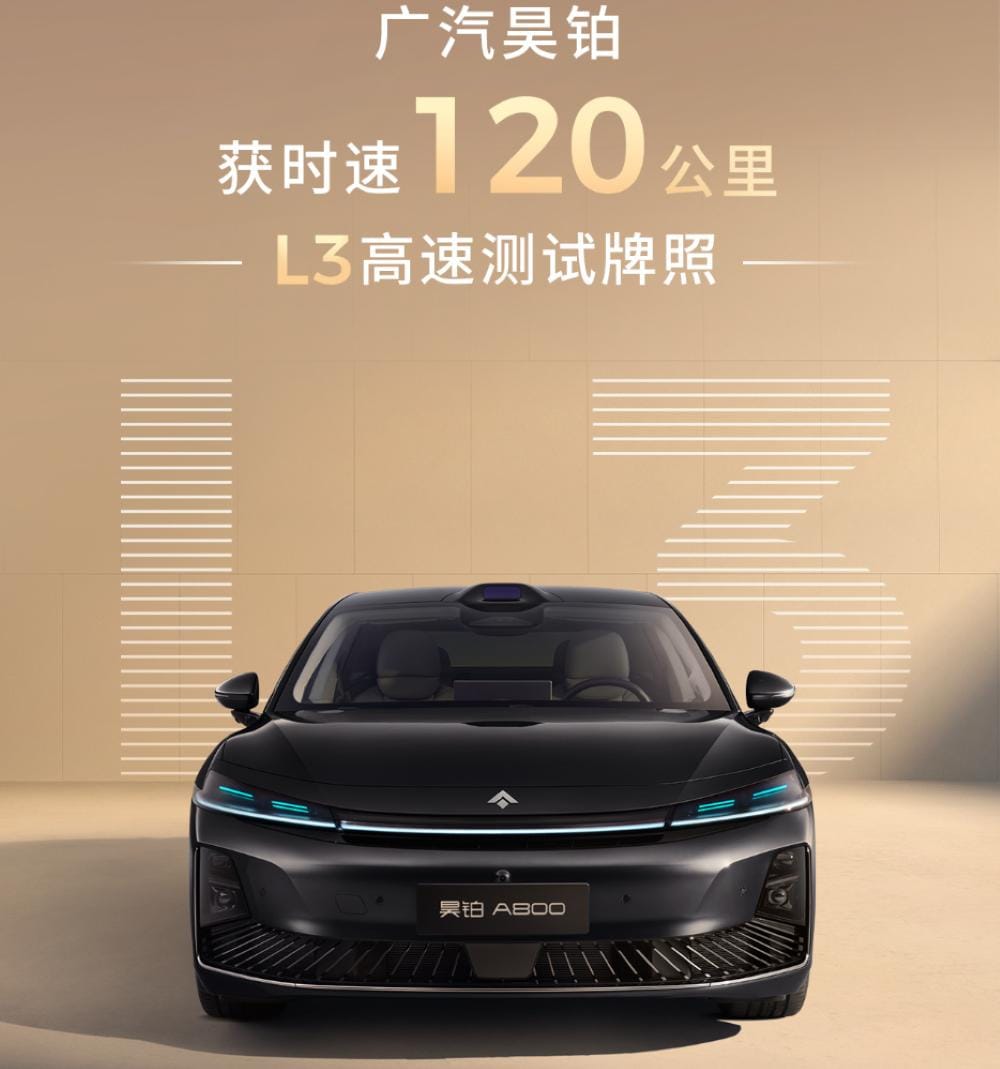
GAC’s premium EV brand, Hyper, announced on Nov. 18 that it had secured a license for L3 autonomous driving road tests restricted to specific highway scenarios at speeds up to 120 kilometers (75 miles) per hour. On Nov. 19, the company released footage of its Hyper A800 sedan navigating traffic on the Guang'ao Expressway, showcasing a "hands-off" driving capability enabled by Huawei’s latest Qiankun ADS 4 system.
The development highlights the rapid convergence of policy support and technological readiness in the world’s largest auto market. The test vehicle, the Hyper A800, utilizes a sophisticated sensor suite involved in Huawei’s architecture and is scheduled to debut at the Guangzhou Auto Show on Nov. 21. This test makes the automaker one of the first in the country to gain approval for L3 testing at highway speeds limit.
This milestone follows a series of regulatory updates in 2025 designed to pave the way for mass adoption. With the Ministry of Industry and Information Technology (MIIT) recently clarifying technical standards for conditional automation, industry executives now project large-scale commercialization of highway L3 systems could begin as early as 2026.
High-Speed Validation
The recent road tests utilized the Hyper A800, a sedan developed jointly by GAC and Huawei. According to video footage released by the automaker on social media, the vehicle successfully operated on the G0425 highway. The system interface displayed an "L3" activation button, which, once engaged, allowed the driver to remove their hands from the steering wheel while the car managed speed and steering adjustments.
Wang Daihan, head of L3 autonomous driving access at GAC Group, stated that the vehicle has obtained a testing license from Guangzhou specifically for open roads allowing speeds up to 120 km/h.
The technical foundation of the vehicle relies on Huawei’s Qiankun ADS 4. The system features eight layers of redundancy covering computing, communication, power, steering, and braking to ensure safety during automated operation. The sensor array consists of 34 high-precision units, including 4D millimeter-wave radar, high-definition cameras, and LiDAR (Light Detection and Ranging) systems.
Regulatory Framework Tightens
The acceleration in corporate testing coincides with a clearer legal framework established by Beijing this year to support the intelligent connected vehicle sector. On Sept. 17, 2025, the MIIT released a draft for mandatory national standards on combined driver assistance systems. The document explicitly defined L3 as a "conditional automated driving system" where the user can fully disengage from driving tasks under specific conditions but must remain receptive to takeover requests.
Prior to this, on Sept. 13, eight government departments, including the MIIT and the Ministry of Public Security, issued a work plan for the auto industry spanning 2025 to 2026. The directive emphasized promoting pilot access for intelligent connected vehicles and conditional approval for L3 model production, alongside improvements to insurance and traffic safety regulations.
Commercial Roadmap
Industry stakeholders are aligning their product roadmaps with these regulatory projected timelines. Huawei’s Intelligent Automotive Solution BU CEO, Jin Yuzhi, officially launched the ADS 4 system on April 22, 2025, positioning the Ultra flagship version specifically for commercial highway L3 applications.
Looking ahead, executives are forecasting rapid scaling. Li Wenguang, President of the Intelligent Driving Product Line at Yinwang—Huawei's intelligent car component unit—stated on Nov. 9 that the company expects to achieve large-scale commercial use of highway L3 systems by 2026. Li further projected that pilot programs for urban Level 4 (L4) autonomy would commence the same year, with unmanned trunk logistics potentially becoming commercially viable by 2028.