
Huawei Launches Six-Vehicle Offensive Against Xiaomi's EV Market Position
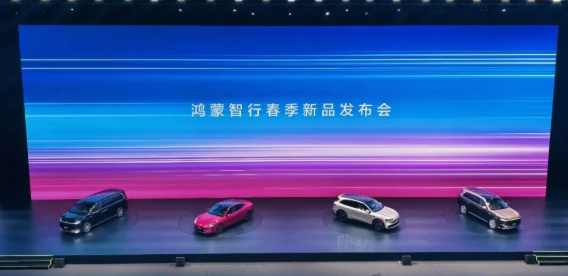
Huawei's automotive alliance AITO Smart delivered a strategic blow to rival Xiaomi on April 22, unveiling six new electric vehicles in a coordinated product launch that directly challenges Xiaomi's SU7 sedan and YU7 SUV across multiple price segments.
The technology giant's Terminal BG Chairman Richard Yu positioned the new Shangkai Z7 series and Aito M6 as what analysts are calling a "pincer movement" against Xiaomi's two-year grip on the RMB 210,000-300,000 (US$29,170-41,670) segment. The launch marks an escalation of competition between two former smartphone rivals now battling for dominance in China's increasingly crowded intelligent vehicle market.
Precision Pricing Strategy Targets Xiaomi's Core Lineup
AITO Smart's Shangkai Z7 sports sedan enters at RMB 219,800 (US$30,530), undercutting Xiaomi's SU7 by just RMB 100. The wagon variant Z7T starts at RMB 229,800. The revamped Aito M6 spans RMB 259,800-299,800 across extended-range and battery-electric versions, directly overlapping with Xiaomi's YU7 family SUV pricing of RMB 240,000-280,000.
Industry observers note Huawei's decision to standardize 896-line dual-pathway lidar sensors across both model lines—a component typically reserved for premium trims costing RMB 100,000 more—represents what Yu called "brutal" cost discipline to match Xiaomi's value proposition while maintaining technological superiority.
Hardware Differentiation Centers on Autonomous Driving Capabilities
The competitive fulcrum lies in advanced driver-assistance systems. Shangkai Z7's full-series inclusion of Huawei's Qiankun ADS 4.1 platform and 896-line lidar contrasts with Xiaomi SU7's 192-line system. During the presentation, Yu demonstrated night-time obstacle avoidance at 120 km/h, emphasizing detection advantages: "Systems without lidar would have collided."
Xiaomi maintains an edge in straight-line acceleration—the SU7's quad-motor setup achieves 0-100 km/h in 2.78 seconds versus Z7's 3.44 seconds—but Huawei counters with range efficiency. The Z7's 100 kWh ternary lithium battery delivers 905 km CLTC range and 600 km charge in 10 minutes via 800V architecture, exceeding SU7's 830 km maximum.
Yu acknowledged the cost tradeoff: "100 kWh ternary lithium packs cost over RMB 14,000 (US$1,945) more than equivalent LFP batteries. Margins are tight."
Extended-Range Powertrain Creates SUV Segment Asymmetry
The Aito M6's dual-powertrain strategy exploits Xiaomi YU7's battery-only limitation. The extended-range variant achieves 1,605 km total range with 355 km pure-electric capability and 5.9L/100km fuel consumption—addressing charging infrastructure gaps that constrain YU7's 800 km ceiling.
Interior specification also diverges: M6 standard equipment includes dual zero-gravity seats, rear 17.3-inch 3K displays, and compressor refrigeration—features Xiaomi reserves for higher trims. Market data shows 70% of M6 pre-orders come from post-1990 buyers, directly contesting YU7's family-vehicle positioning.
Ecosystem Lock-In Battles Intensify Beyond Vehicle Hardware
The product offensive extends a deeper conflict between competing technology ecosystems. Xiaomi leverages CEO Lei Jun's 20-million-follower social media presence and integrated "human-vehicle-home" connectivity via Pengpai OS, while Huawei deploys its 5,000+ retail locations and HarmonyOS 5.0's seamless device handoff to convert smartphone users.
Huawei's celebrity strategy shift signals demographic targeting: hiring actor Xiao Zhan as Shangkai spokesperson and offering 10 exterior colors with customizable themes aims to shed the brand's "mature business user" image and capture Gen-Z buyers—Xiaomi's demographic stronghold.
Multi-Brand Proliferation Risks Internal Cannibalization
Beyond the six vehicles launched April 22, Yu previewed the Zhijie V9 MPV at RMB 399,800 (US$55,530) and refreshed Aito M9 flagship starting at RMB 499,800, with an extended-wheelbase variant at RMB 669,800—creating a 13-model lineup spanning RMB 200,000-700,000.
The rapid expansion across four sub-brands (Aito, Zhijie, Xiangjie, Shangkai) under the AITO Smart umbrella raises questions about brand coherence and resource allocation. Analysts note the Z7's stage presence throughout the M6 presentation—a symbolic reminder that Huawei's multiple marques may eventually compete for the same customer base.
The parallel to the companies' smartphone rivalry is instructive: after years of parameter-based competition, both pivoted to ecosystem differentiation. Whether that playbook translates to automotive's longer purchase cycles and higher capital intensity will determine if this latest offensive reshapes China's EV hierarchy or merely redistributes market share among technology incumbents.
Related Coverage:
Huawei Escalates EV Price War with Sub-$33,000 LiDAR-Equipped SUVs; Standardizes ADS 4.1