
CATL vs BYD: Chemistry Wars Go Infrastructure
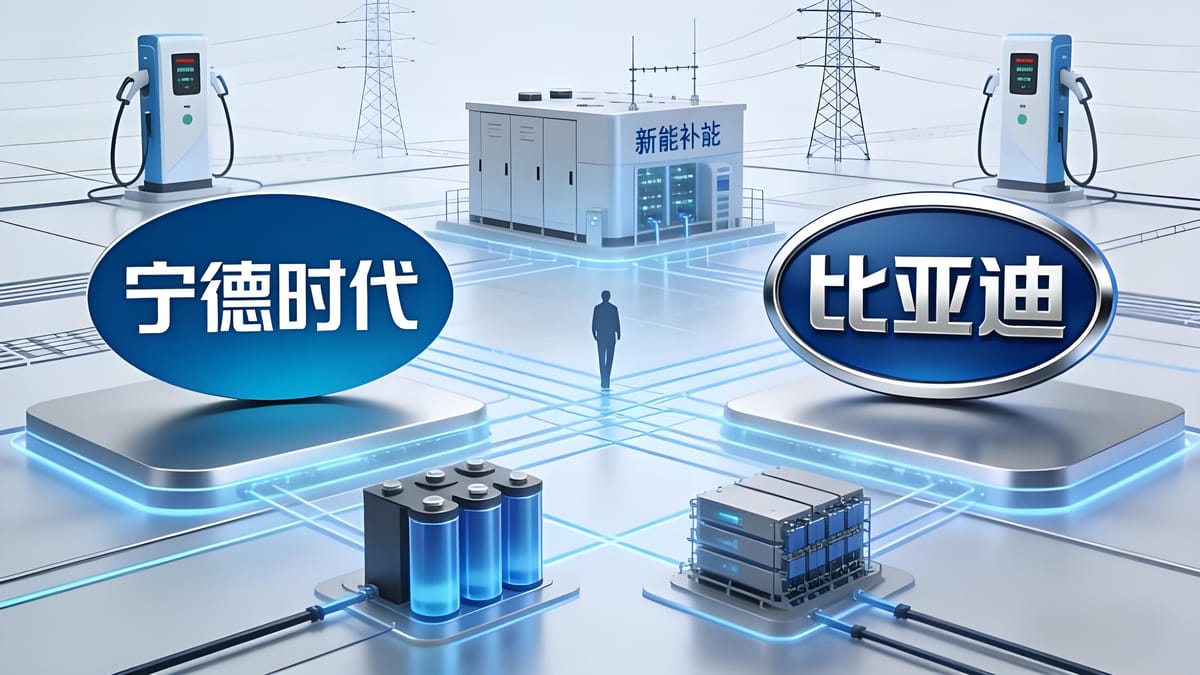
CATL's April 21 technology showcase crystallized a strategic dilemma facing battery suppliers in an increasingly vertically-integrated EV market: compete head-to-head on BYD's chosen battlefield of ultra-fast LFP and captive infrastructure, or double down on chemistry diversity as a competitive moat.
The world's largest battery maker chose both—unveiling six battery platforms while committing to 4,000 hybrid charging-swapping stations by year-end 2026. Yet this dual strategy exposes fundamental tensions between CATL's supplier business model and BYD's integrated approach that may reshape competitive dynamics across the $680 billion global EV battery market.
The Vertical Integration Problem CATL Cannot Solve
BYD's February ultra-fast charging offensive weaponized vertical integration: proprietary Blade cells optimized for proprietary vehicles charged at proprietary 20,000-station network. By late April, 5,356 stations operational across 311 cities created a closed ecosystem no supplier can replicate.
CATL's response—a third-generation Shenxing LFP matching BYD's 10C charging rates while claiming superior 0.25 milliohm internal resistance—addresses only the technology dimension. The harder challenge lies in deployment cadence and performance validation across fragmented automaker customers.
"CATL faces what I call the 'common standard penalty,'" notes a Shanghai-based automotive strategy consultant who requested anonymity. "BYD controls the entire validation chain. CATL must prove Shenxing performance across perhaps 15 different vehicle platforms, each with unique thermal management and charging protocols."
This explains why CATL CTO Gao Huan emphasized cell-level specs (3:44 for 10-80% charge, 6:27 for 10-98%) without naming specific vehicle models achieving these metrics. BYD, conversely, demonstrated second-generation Blade charging in production Seal and Han vehicles during February's launch.
The infrastructure dimension amplifies this asymmetry. BYD's stations serve exclusively BYD vehicles—simplifying protocol optimization and eliminating compatibility risks. CATL's hybrid charging-swapping network must accommodate multiple automakers' systems, diluting the seamless experience that fast-charging adoption requires.
Material Diversity as Strategic Hedge—or Defensive Necessity?
CATL's loudest shot across BYD's bow came from Gao's declaration that "any pure EV above RMB 250,000 ($34,700) using LFP is effectively downgrading customers." The statement positions ternary lithium as premium technology, implicitly attacking BYD's flagship Seal (RMB 179,800-289,800) and Han (RMB 179,800-329,800) as compromised products.
The third-generation Qilin ternary battery's specs support this narrative: 280 Wh/kg gravimetric density versus LFP's ~160 Wh/kg theoretical ceiling delivers 255 kg weight savings on equivalent-range packs—meaningful for performance metrics (0.6s faster 0-100 km/h, 1.44m shorter braking) that luxury buyers prioritize.
Yet this chemistry advocacy reveals CATL's vulnerability. Where BYD's LFP standardization drives manufacturing scale and cost advantages, CATL maintains parallel production lines for LFP, ternary, high-nickel condensed-state, sodium-ion, and hybrid chemistries—each requiring distinct equipment, supply chains, and quality protocols.
"CATL's material diversity is simultaneously strength and burden," observes Dr. Li Zheng, senior analyst at Beijing-based EV research firm Automotive Foresight. "They capture more market segments but sacrifice the learning curve benefits BYD extracts from LFP focus. The question is whether premium margins on ternary offset the scale penalty."
Financial metrics suggest growing tension. CATL's Q1 2026 gross margin compressed to 21.3% despite maintaining 37% global market share, per SNE Research estimates. BYD's in-house battery costs, though not disclosed separately, benefit from full-stack integration eliminating supplier markups—a structural advantage no material innovation can overcome.
The Infrastructure Paradox: Swapping as Charging Cover?
CATL's pivot from pure battery-swapping to "ultra-charging-swapping integration" signals pragmatic acknowledgment that swapping alone cannot counter BYD's charging network effect. Yet the hybrid model introduces new contradictions.
Subsidiary Shidai Dianfu deployed nearly 1,000 swapping stations in 2025—impressive velocity exceeding NIO's 600 annual additions. Retrofitting these with Shenxing ultra-fast chargers plus building 3,000 additional hybrid sites by December 2026 represents RMB 12-15 billion capital commitment ($1.67-2.08 billion at current exchange), estimate industry sources.
The economic logic depends on multi-brand utilization. Integration manager Yang Jun's claim of 85% equipment utilization versus 33% for conventional fast-charging assumes standardized battery interfaces across CATL's six announced automaker partners (Changan, Chery, GAC, Seres, SGMW, BAIC). Yet these manufacturers' competing product strategies—and reluctance to cede battery architecture control—historically blocked swapping standardization.
"CATL's 100,000 shared charging-swapping point target by 2028 requires automakers to adopt CATL's 20-series and 26-series standardized packs," notes the Shanghai consultant. "That's essentially asking them to become battery integrators rather than designers—directly contradicting their differentiation strategies."
BYD faces no such coordination problem. Its stations serve only BYD vehicles, simplifying investment payback calculations and user experience optimization. This structural advantage may matter more than CATL's technical edge in cell-level charging speeds.
Follower or Leader? The Strategic Timing Question
A subtle but significant pattern emerges from recent competitive moves: BYD increasingly sets the agenda while CATL responds. Blade battery's 2020 launch forced industry-wide LFP reassessment. February 2026's ultra-fast charging announcement triggered CATL's April showcase. Even CATL's condensed-state battery, despite superior 350 Wh/kg density, arrives as counter-positioning to BYD's LFP narrative rather than proactive market creation.
This reversal carries implications beyond competitive optics. In batteries, first-mover advantages compound through manufacturing learning curves, supply chain lock-in, and installed base effects. BYD's 5,356 operational fast-charging stations create network effects attracting new buyers, who generate utilization data improving subsequent station placement and performance optimization—a flywheel CATL's fragmented customer base cannot easily replicate.
"The real question is whether CATL's technology portfolio can substitute for BYD's integration velocity," observes Dr. Li. "Sodium-ion volume production by Q4 2026 and condensed-state 1,500 km range represent genuine innovation leadership. But commercialization speed depends on automaker adoption cycles CATL doesn't control."
Divergent Paths, Uncertain Outcomes
The CATL-BYD rivalry increasingly resembles platform competition more than product comparison. BYD's closed ecosystem optimizes for internal coherence and rapid iteration. CATL's open platform strategy maximizes flexibility and market coverage but accepts coordination costs and delayed implementation.
Neither approach guarantees victory. BYD's vertical integration creates lock-in risks if battery technology shifts unexpectedly—CATL's sodium-ion or solid-state breakthroughs could strand BYD's LFP-optimized infrastructure. Conversely, CATL's supplier model faces margin compression if automakers pursue in-house battery development, as Tesla and increasingly Chinese startups have done.
The infrastructure dimension may prove decisive. Fast-charging networks exhibit classic platform dynamics with winner-take-most outcomes. BYD's 20,000-station target and current 27% completion rate versus CATL's zero operational ultra-fast charging sites (swapping stations now being retrofitted) suggests first-mover advantage accumulation.
Yet CATL's partnerships with six major automakers and claims of 13 percentage point efficiency advantages in hybrid charging-swapping stations position it as infrastructure-as-a-service provider rather than vertically-integrated operator—potentially a more sustainable model if multi-brand standardization materializes.
The technical capabilities gap has narrowed to marginal differences—both companies can deliver sub-10-minute charging. The strategic gap in go-to-market execution and business model coherence may determine who ultimately defines the industry's direction.
Related Coverage:
CATL Unveils Four Battery Systems Targeting 6-Minute Charging and 1,500km Range