
JD.com Goes Overseas, PDD Moves Upstream as China’s E-Commerce War Evolves
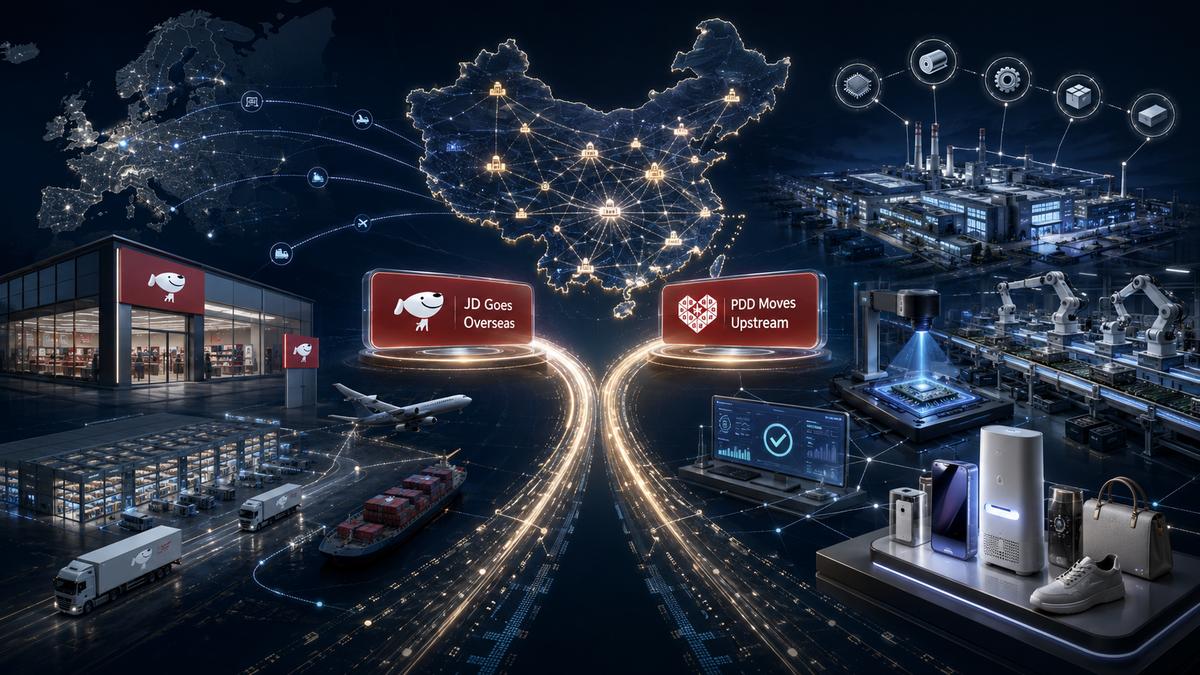
Two of China's largest e-commerce platforms are pivoting in opposite directions — and converging on each other's strengths — as slowing domestic growth and margin pressure force a fundamental rethink of competitive strategy.
JD.com is replicating its direct-retail model in Europe through a €2.2 billion acquisition of German electronics giant Ceconomy, while PDD Holdings is channeling RMB 100 billion (US$13.9 billion) over three years into an upstream supply-chain initiative called Xin Pinmu. The strategic crossover is striking: JD is borrowing from PDD's cross-border playbook, while PDD is attempting to build the merchant-side infrastructure that JD has spent two decades constructing at home.
The divergence signals a broader structural shift in China's e-commerce landscape. After more than two decades of channel-centric competition — from Taobao's marketplace disruption to live-commerce and instant delivery — analysts and executives alike increasingly argue the next battleground is product quality and supply-chain differentiation, not logistics speed or traffic acquisition.
Slowing Margins Force Both Platforms to Confront Structural Weaknesses
The strategic urgency is not philosophical — it is financial.
JD.com generated RMB 1.3 trillion (US$180.6 billion) in revenue in 2025, ranking first among China's private enterprises by top line. Yet net profit came in below RMB 20 billion (US$2.8 billion), implying a net margin of roughly 1.5%. Even stripping out heavy investment in food-delivery operations last year, JD's normalized net margin hovers in the low single digits — a stark contrast to the double-digit profitability posted by Tencent, Alibaba, Meituan, Kuaishou, and NetEase.
The core problem: JD's asset-heavy, direct-retail model — built on a 900,000-person workforce and a proprietary logistics network — has not translated into a durable moat. Alibaba and ByteDance's Douyin have steadily eroded JD's dominance in consumer electronics and appliances, the categories it once owned outright. With domestic share under structural pressure, international expansion has shifted from an option to a necessity.
PDD's situation is different in character but equally pressing. The company's Q1 2026 results showed revenue of RMB 106.2 billion (US$14.8 billion), up 11.0% year-on-year — a sharp deceleration from the triple-digit growth rates that defined its earlier trajectory. Non-GAAP net profit attributable to shareholders reached RMB 14.1 billion (US$1.96 billion), with net margin at 13.2%, down 4.5 percentage points year-on-year, missing consensus estimates on both lines.
The data confirms what competitive dynamics have been telegraphing: PDD's extreme-low-price positioning is losing traction as Chinese consumers increasingly prioritize value-for-quality over absolute price minimums. Duoduo Maicai, PDD's community group-buying arm, has failed to emerge as a credible second growth engine, constrained by structural inefficiencies in fresh-food logistics and the rise of instant-retail competitors.
JD Deploys JoyBuy and JoyExpress to Replicate Its Domestic Edge in Europe
JD's European push is the most concrete expression of its overseas ambitions to date.
In mid-2025, JD acquired Ceconomy — the entity spun out of Media-Saturn Holding that operates the MediaMarkt and Saturn retail chains — for €2.2 billion. The deal handed JD physical retail presence across more than 1,000 stores in Germany, France, and other European markets, with annual sales exceeding €20 billion. The acquisition provides the offline anchor that JD's direct-retail model requires.
Running parallel is JoyExpress, JD's international logistics arm, which has activated delivery networks across the Middle East and multiple European countries, offering same-day or next-day fulfillment — a direct transplant of JD's domestic logistics proposition. JoyBuy, the consumer-facing online retail platform, launched in Europe in early 2026 with consumer electronics and home appliances as its lead categories.
The initial results suggest product-market fit. During a recent European heatwave, JD partnered with Midea to push split air-conditioning units through the JoyBuy platform, capturing demand that legacy European retailers were ill-positioned to fulfill at speed.
The structural thesis is straightforward: European e-commerce remains fragmented and logistics-constrained relative to China. JD is betting that the same operational advantages — direct procurement, owned last-mile delivery, guaranteed authenticity — that differentiated it in China can be repriced for European consumers willing to pay for reliability.
The execution risk is equally clear. JD's asset-heavy model generates thin margins even in China, where the infrastructure is fully amortized. Replicating it in Europe means absorbing fresh capital expenditure against an uncertain revenue ramp. The classic trilemma of growth speed, service quality, and profitability will reassert itself in unfamiliar regulatory and labor-cost environments.
PDD Launches Xin Pinmu to Rebuild the B-Side Infrastructure It Never Built
PDD's Xin Pinmu initiative represents a more fundamental strategic repositioning.
Formally launched in March 2026, Xin Pinmu operates through two newly incorporated entities — Shanghai Xin Pinmu Hongqiao E-Commerce and Shanghai Xin Pinmu Pudong E-Commerce — with combined registered capital of RMB 15 billion (US$2.1 billion). Total planned investment over three years stands at RMB 100 billion (US$13.9 billion).
The operating model centers on a buyout-and-exclusive-distribution structure, under which Xin Pinmu takes inventory risk directly rather than acting as a marketplace intermediary. Initial focus categories include apparel, home goods, and outdoor products, with sales expected to begin in Q3 2026. PDD Co-CEO Zhao Jiazhen has framed the ambition bluntly: build another PDD in three years.
The strategic logic connects to PDD's global channel position. Temu, PDD's cross-border platform launched in North America in 2022, reached GMV of US$90–95 billion in 2025 and is approaching breakeven in 2026. Temu's differentiation — entering the highest-value consumer market in the world when peers were targeting Southeast Asia and Africa — established PDD as the only Chinese e-commerce operator with genuine scale in North America.
Xin Pinmu is designed to leverage that channel by branding Chinese supply-chain goods rather than simply aggregating them. The shift from PDD's earlier "Billion-Dollar Subsidy" consumer-side promotions to "Trillion-Dollar Merchant Support" signals a deliberate rebalancing: PDD is now investing in the upstream producer ecosystem that it previously treated as a commodity input.
The competitive precedent, however, is sobering. SHEIN has already executed a version of this model in fast fashion to a degree that few competitors have matched. Extending the Xin Pinmu thesis to harder categories — where supply chains are less standardized and brand equity is more entrenched — will require differentiation that neither SHEIN nor Shopee has demonstrated at scale.
Channel Wars Ending; Product Differentiation Defines the Next Cycle
The strategic moves by both companies reflect a structural inflection point in China's e-commerce industry.
Since Taobao's founding in 2003, competitive advantage in Chinese e-commerce has been defined by channel innovation: marketplace aggregation, brand onboarding acceleration, social-viral distribution (PDD's "slash-a-price" mechanic), content-commerce integration (Douyin), and instant delivery (Meituan). Each wave created a new entrant and forced incumbents to adapt.
That cycle has run its course. Douyin's live-commerce format has commoditized product discovery. Instant retail has compressed the logistics advantage that JD spent a decade building. Price wars, prosecuted aggressively from 2022 through 2024, damaged merchant economics without producing durable consumer loyalty.
The next competitive axis is product quality and supply-chain transparency — a dynamic reinforced by China's policy push against "involution", the consumer-upgrade trend, and the imperative for Chinese brands to move up the global value chain. The companies that can efficiently match verified-quality goods to specific consumer demand contexts — rather than simply offering the lowest price or the fastest delivery — will capture disproportionate value in the next cycle.
Both JD and PDD are making that bet. JD is extending a supply-chain model it already operates at scale; PDD is building one from scratch. The irony of their convergence — two platforms with historically low user overlap, built on opposing commercial philosophies, now replicating each other's core competencies — is the clearest possible signal that the channel era is over.
Whether either succeeds depends on execution in markets where neither has yet been tested at full scale. For investors, the more immediate question is whether the capital being deployed into these long-horizon initiatives will weigh on near-term earnings at a moment when both stocks are already pricing in decelerating growth.
Related Coverage:
China's Four E-Commerce Giants Diverge on Global Strategy as Growth Slows