
XPeng MONA L03 Scores 46K Orders as China’s EV Playbook Goes Europe
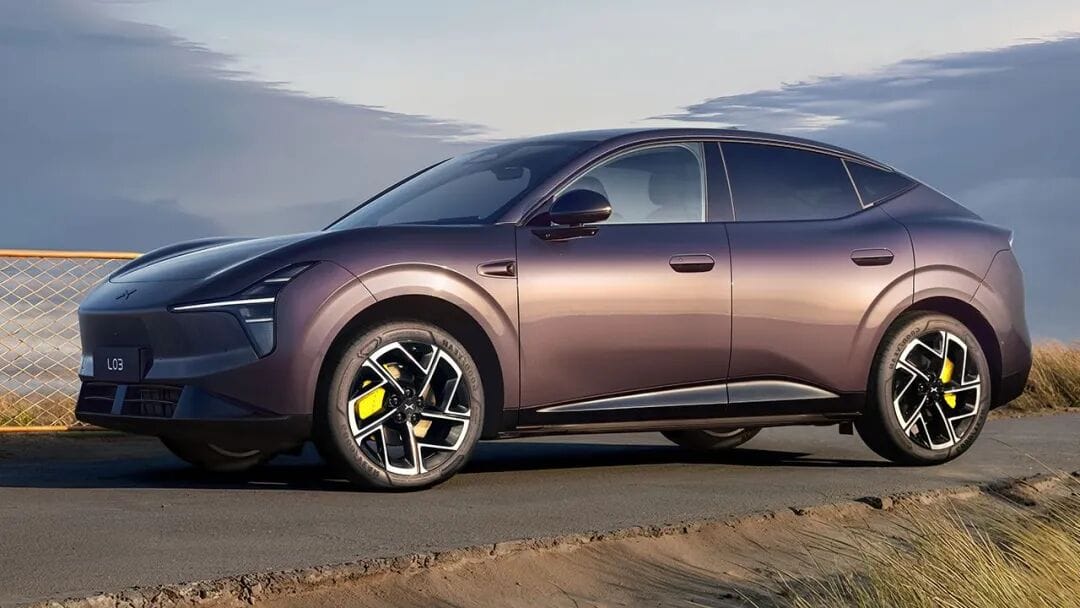
XPeng debuted its first globally positioned electric vehicle in Munich on Wednesday, securing 46,000 firm orders within 60 minutes of launch — a demand signal that simultaneously validates the model's appeal and raises the stakes for the company's most ambitious overseas bet to date.
The MONA L03, the inaugural model in XPeng's MONA sub-brand, went on sale across 65 countries on July 16, 2026, priced at €35,600 (approximately RMB 275,900, or US$38,300) in Germany — more than double its domestic starting price of RMB 123,800–156,800 (US$17,200–21,800). That pricing gap is not a miscalculation; it is the central arithmetic of XPeng's European margin strategy, and the opening-hour order velocity suggests the market is, at least initially, absorbing it.
Chief Executive He Xiaopeng delivered the entire keynote in English — his first such attempt — after arriving in Munich 24 hours late due to a passport mix-up, a detail he disclosed candidly to reporters. The unscripted moment inadvertently reinforced the brand narrative he spent the next 90 minutes constructing: a Chinese technology company betting its credibility on transparency and product accountability.
Repositioning Xpeng as a "Physical AI" Platform, Not Just a Carmaker
Before a single vehicle specification was shown, He devoted half the presentation to answering a foundational investor question: what kind of company is XPeng in 2026?
The answer — "Physical AI" — is a strategic frame He has deployed domestically for nearly a year, but Wednesday marked its first formal export to a Western audience. The architecture spans three verticals: AI-enabled passenger vehicles with cumulative global sales now exceeding 1.2 million units across a 1,200-store network in 65 markets; flying cars, for which XPeng holds more than 7,000 advance orders and has commissioned the world's first factory with planned annual capacity of 10,000 units; and humanoid robotics, backed by eight years of development, targeting commercial deployment in 2027.
The framing matters for investors because it repositions XPeng's valuation logic away from a pure EV volume story — where Chinese domestic competition is brutal and margins are compressed — toward a platform narrative with multiple long-duration growth vectors. Whether European institutional buyers accept that framing will be tested in earnings calls over the coming quarters.
To accelerate brand recognition, XPeng enlisted German fitness influencer Pamela Reif — whose workout videos went viral on Chinese platform Bilibili during the pandemic and who recently opened a Sina Weibo account — as the MONA L03's experience ambassador. The choice reflects a deliberate dual-market strategy: a face already trusted in Germany that also carries organic credibility in China.
Dual-Powertrain Architecture Targets Infrastructure Gaps Across 65 Markets
The MONA L03 launches in both battery-electric and extended-range electric (EREV) configurations — a combination that reflects a strategic pivot He traced back to field visits to Mexico in 2022 and Africa in 2023.
The BEV variants offer CLTC-rated ranges of 525 km, 625 km, and 650 km, with DC fast-charge times of 19.1 minutes from 10% to 80%. The EREV model carries a 37.2 kWh battery pack, delivers 315–325 km of electric-only range, and extends to a combined 1,330–1,380 km — a figure designed to neutralize range anxiety in markets where public charging infrastructure lags China and Western Europe by what He described as "more than 10 years."
The EREV decision drew pointed questioning from overseas media: does adding a combustion-assisted powertrain dilute XPeng's identity as a pure-EV innovator? He's rebuttal was pragmatic rather than defensive. "Pure electric is the ultimate answer," he said, "but extended range is a realistic choice to serve users in countries with different infrastructure levels — not a compromise." For investors tracking XPeng's total addressable market, the EREV architecture effectively unlocks emerging-market volumes that a BEV-only lineup could not capture.
ADAS Localization Emerges as the Highest-Margin Differentiator
The most strategically significant element of the Munich launch was not the powertrain or the price point — it was XPeng's decision to lead with advanced driver-assistance systems (ADAS) in a market where European OEMs have historically treated such features as secondary selling points.
XPeng's VLA 2.0 system was demonstrated on European roads handling roundabouts, unprotected left turns, narrow-lane oncoming traffic, and construction detours. Critically, the system has been trained to recognize European-specific traffic signage and, according to XPeng's Head of General Intelligence Center Liu Xianming, to accommodate local parking conventions — specifically the European preference for nose-in parking rather than the reverse-entry method common in China.
The cultural localization extends to pedestrian and cyclist priority rules. He noted that in China, pedestrians at unsignalized intersections typically wait for vehicles; in Germany and much of Western Europe, the inverse is legally and socially enforced. Failing to yield triggers immediate confrontation. XPeng's training pipeline must therefore ingest local behavioral data at scale before the system can be trusted in daily European use — a moat that takes time to build but becomes durable once established.
He set a concrete regulatory milestone: he expects the EU's DCAS (Driver Control Assistance Systems) framework to be finalized in Q1 2027, and expressed confidence that XPeng could be the first global brand to achieve DCAS-compliant ADAS deployment at that point. If accurate, first-mover status in EU-certified autonomous assistance would represent a meaningful competitive advantage over both legacy European OEMs and rival Chinese entrants.
Factory Footprint Signals Deeper European Commitment — and a VW Opening
XPeng's current European manufacturing presence consists of an assembly partnership with Magna Steyr in Austria, where the G6 and G9 models are already produced. He disclosed that XPeng has been in active discussions since 2025 regarding additional factory locations, with site selection focused on southern and southeastern Germany.
More notable was an unsolicited signal about Volkswagen AG. Volkswagen holds a strategic stake in XPeng, a relationship established in 2023. He said Wednesday: "I actually look forward to exploring different new cooperative relationships with our shareholder Volkswagen. XPeng is a very open company, and we are happy to explore whether there are new cooperation opportunities with different companies, including Volkswagen."
The comment, offered in a media roundtable rather than prepared remarks, suggests XPeng may be positioning for a deeper integration with the German automaker — potentially spanning manufacturing, technology licensing, or distribution — at a moment when Volkswagen itself is under structural pressure to accelerate its EV transition and reduce development costs.
Trust, Not Specs, Defines the Long Game
XPeng has delivered more than 60,000 vehicles in Europe to date, yet brand recognition outside enthusiast circles remains limited. Pre-launch conversations with European automotive journalists revealed a split verdict: design and interior quality drew consistent praise, with several observers suggesting the MONA L03 competes credibly against entry-level BMW, Mercedes-Benz, and Audi (BBA) offerings; handling dynamics, however, drew skepticism from German testers accustomed to autobahn-grade chassis tuning where there is no speed limit.
XPeng has stated a target of generating more than 20% of global sales from overseas markets by 2027, with Europe as the primary driver. Achieving that threshold from a current base that is overwhelmingly domestic will require sustained execution across product, regulatory compliance, after-sales infrastructure, and — most critically — the kind of cultural fluency that cannot be reverse-engineered from a product specification sheet.
The 46,000 first-hour orders are a strong opening data point. They are not, by themselves, evidence that XPeng has solved the harder problem: converting first-time Chinese EV buyers in Europe into repeat customers who recommend the brand to their neighbors. That conversion rate, measured over the next 18 to 24 months, will be the more consequential metric for analysts assessing whether XPeng's European chapter is a durable growth story or a well-executed launch event.
Related Coverage:
XPENG's MONA L03 SUV Signals a Strategic Pivot: From Cost Cutter to Supply Chain Architect