
JD.com’s Auto Venture Is About Controlling the Interface, Not Building the Car
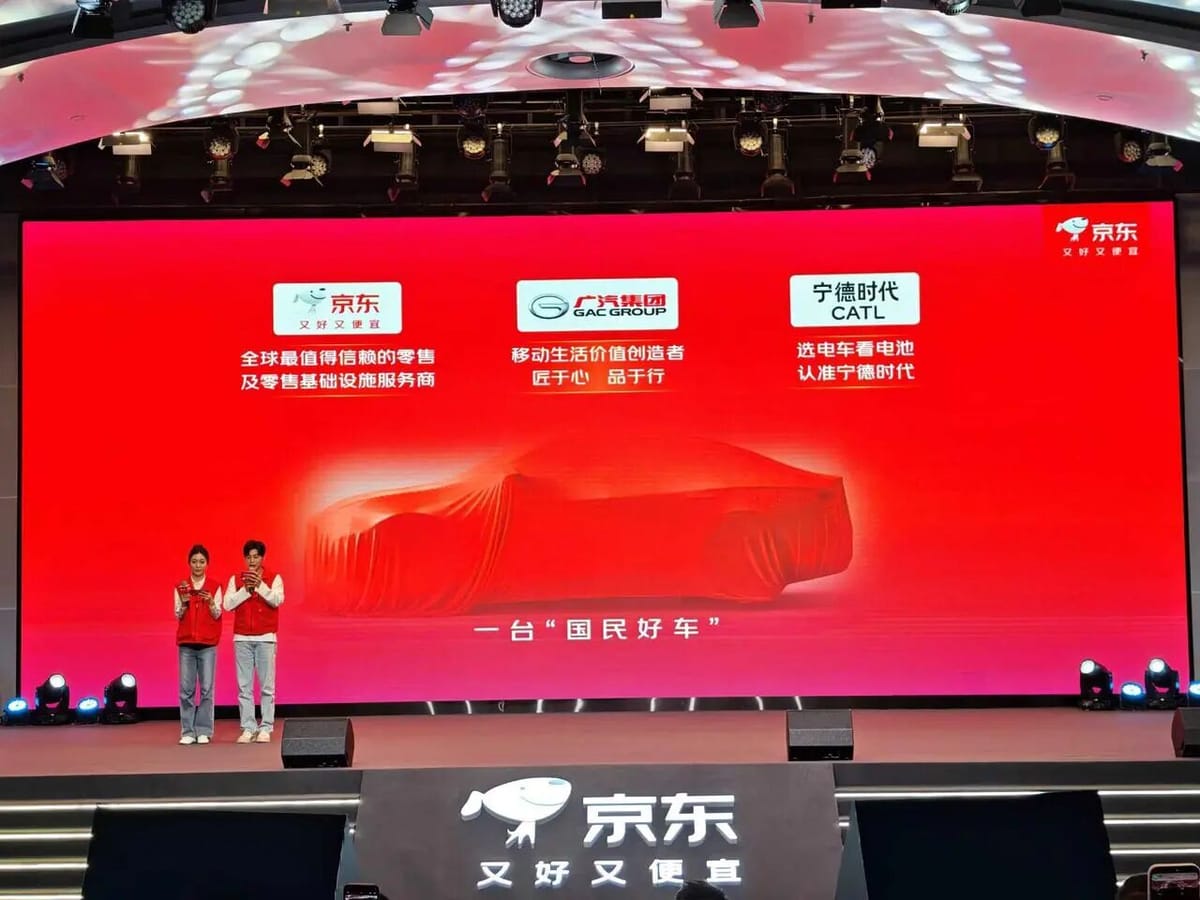
JD.com Inc. is venturing into the automotive world without building a single car, a strategic gambit aimed at controlling the industry’s next major consumer gateway and reshaping its supply chain in China.
The e-commerce giant announced on Oct. 14 that it is partnering with Guangzhou Automobile Group and Contemporary Amperex Technology, or CATL, to launch a mass-market electric vehicle dubbed the “national good car.” The vehicle, set for a debut on Nov. 11, marks a significant strategic pivot for JD.com.
In the collaboration, JD.com will not be involved in manufacturing. Instead, it will lead product co-creation, provide user consumption insights, and serve as the exclusive online sales platform, according to media reports. The vehicle is expected to be a battery-swap variant based on a platform from GAC’s Aion electric car brand.
This move signals JD.com’s ambition to evolve from a simple sales channel into an influential player shaping product definition from the top down. For investors, the initiative is more than a marketing campaign; it’s a calculated response to slowing growth in its core e-commerce business and shifting user demographics, betting on the high-value, long-cycle automotive category to secure its next growth anchor.
Why Now: Seeking a New Anchor for Traffic
JD.com’s entry into the auto sector is a deep-seated adjustment to its business model, driven by the urgent need to counter a growth bottleneck.
The company’s core high-margin categories, such as 3C electronics, are experiencing slowing growth, while its general merchandise business faces intense price competition from rivals like PDD Holdings Inc., according to Li Hang, a veteran e-commerce industry insider. Meanwhile, content platforms like Douyin are reshaping consumer behavior with “interest-based e-commerce,” creating a twofold challenge of user drain and rising traffic acquisition costs for JD.com. The automobile, as the next “super portal” after the smartphone, offers a high-value, high-involvement category that can serve as a new anchor for the platform.
Furthermore, the consumer logic for new energy vehicles aligns well with JD.com’s user base. “JD.com’s typical user profile leans toward rational, research-driven consumption,” Li added. The long decision-making process, dense information requirements, and extended service cycle of EV purchases fit this profile perfectly. Peng Deyu, a prominent industry commentator, noted that JD.com is no longer content with just “selling existing cars” but wants to “participate in defining what car the user wants” through platform-led reverse customization.
The partnership will also disrupt the traditional model of purchasing a “bare car,” according to a report by Nanfang Media Group. Instead, it offers an “all-in-one” service concept where consumers can choose from various packages, such as custom wraps or pre-installed accessories. JD Auto aims to build a comprehensive ecosystem covering the entire vehicle lifecycle, leveraging its network of nearly 3,000 car maintenance shops and over 40,000 partner locations.
A Three-Party Game: A Mix of Cooperation and Competition
While the partnership appears to be a powerful alliance, a closer look at the motivations of JD.com, GAC Group, and CATL reveals a complex dynamic of cooperation, competition, and strategic probing.
According to Li Rui, executive director at Qishijie Management Co., JD.com’s goal is to control the user entry point and consumer narrative without the heavy capital expenditure of manufacturing. By leading user preference surveys on appearance, features, and price, JD.com positions itself as a platform that “lets users define the product.” The ultimate prize is to create a closed-loop automotive ecosystem on its platform, capturing “all of a user’s spending on a vehicle.”
For GAC Group, the collaboration serves as a low-cost way to move inventory and refresh its brand. The vehicle is a battery-swap version of the GAC Aion UT, a compact electric hatchback launched in February 2025 with an official guide price starting from 69,800 yuan (about $9,700), a person close to GAC Aion told China Business Network. Wu Yuxing, a brand strategy expert, said GAC aims to leverage JD.com’s online reach to connect with younger consumers but will likely defend its control over vehicle delivery and after-sales service.
CATL is participating through its battery-service subsidiary, Contemporary Amperex Service Technology, with the aim of accelerating the adoption of its Battery-as-a-Service (BaaS) model. “This partnership helps CATL move beyond its role as a mere supplier and transition into an energy solutions platform,” said Peng.
Risks of the Platform Model: A Test of Brand and Service
Despite its “asset-light” approach, JD.com’s foray is not without significant risks. By taking the lead in defining the product, the company inevitably places its brand and operational capabilities on the line.
The first challenge is “brand promise risk.” Wu noted that even though JD.com is not the manufacturer, consumers will deeply associate the car with the JD.com brand. Any delays in delivery, quality issues, or service failures could be perceived as a “JD.com failure,” especially given the high expectations set by the “national good car” moniker.
Second, the complex and service-heavy nature of the automotive industry presents a major test. “From test drives and delivery to maintenance and insurance claims, vehicle ownership is a chain built on heavy service and strong trust,” Peng pointed out. JD.com’s platform mindset, which prioritizes scale and data, must prove it can translate into a reliable and robust offline service system.
Finally, the ambiguous control structure in the three-way partnership creates potential risks. A lack of clarity on who leads the project’s pace, product lifecycle, and marketing strategy could lead to internal friction and compromise the user experience if disagreements arise. For JD.com, the ultimate challenge is not just selling its first car successfully, but whether it can replicate this model and build a scalable, sustainable automotive ecosystem.