
Leapmotor Confirms Cost-Based Pricing for Premium D-Series, Targets 500,000 Sales in 2025
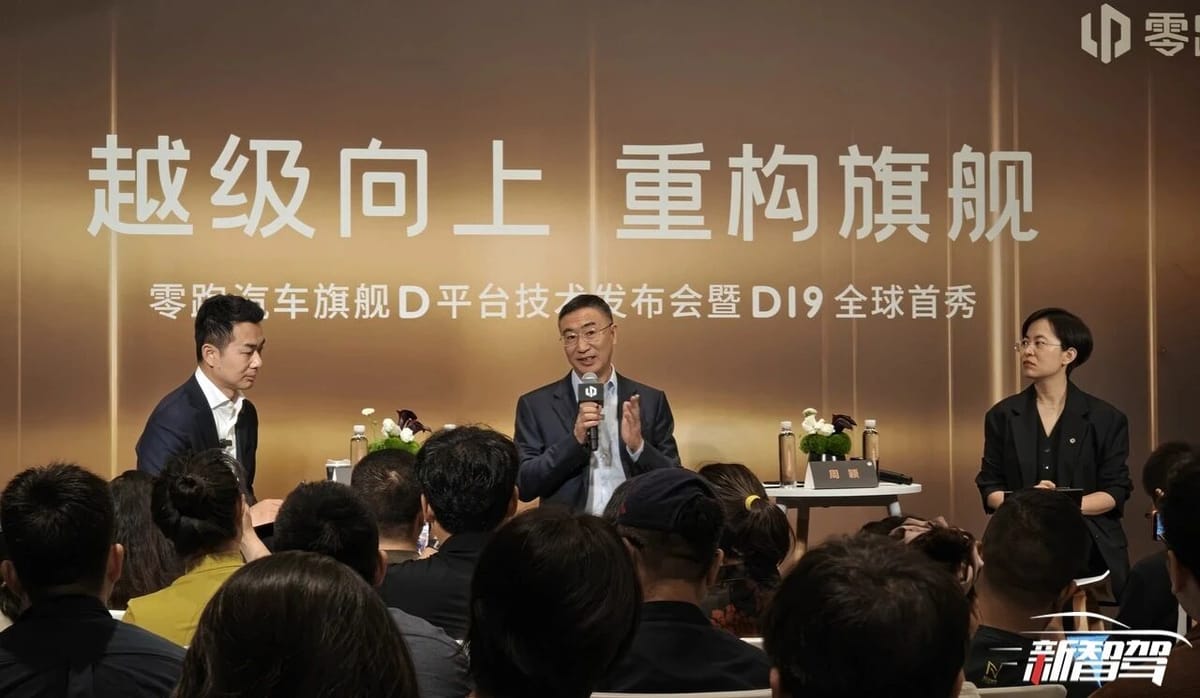
Hangzhou-based electric vehicle maker Zhejiang Leapmotor Technology is on track to surpass its annual sales target of 500,000 units in 2025, the company announced. During a media briefing on October 17, Founder, Chairman, and CEO Zhu Jiangming detailed the strategy for Leapmotor's new D-platform, a move designed to push the brand into the premium vehicle segment with its flagship D19 SUV.
Despite entering the highly competitive premium market, Leapmotor will adhere to its core philosophy of being "good but not expensive," continuing its cost-based pricing strategy rather than chasing high profit margins. This approach, underpinned by the company's extensive vertically integrated R&D, is a noteworthy strategy as it challenges the luxury-focused positioning of many rivals and relies on achieving scale to drive profitability. The company also confirmed it would launch an additional two to three D-series flagship models and two new A-series models in 2026.
The following is a transcript of the conversation with Leapmotor Founder, Chairman, and CEO Zhu Jiangming; Senior Vice President Cao Li; and Vice President Zhou Ying, edited for clarity.
Q: Will Leapmotor change its brand positioning with the D-platform? What impression does the brand want to leave on consumers going forward? What are the key actions? And why choose Kris Phillips as an endorser?
Zhu Jiangming: Leapmotor's brand positioning has not changed with the launch of the D-series. The D-series does not mean Leapmotor is transitioning into a premium brand. Leapmotor remains a single brand, and its various series are not positioned as luxury. We have always adhered to the philosophy of "good but not expensive," and the D-series is not intended to pursue high profits or a luxury brand positioning.
The D-series is Leapmotor's high-end product line, representing top-tier specifications and flagship performance. We are committed to achieving "what others don't have, and what others have, we do better" in technology, making the D-series an industry benchmark. At the same time, we stick to the principle of "luxurious products, not luxurious prices," which has always been Leapmotor's style.
Regarding the pricing strategy, there's no mystery. The D-series will follow Leapmotor's consistent style, in line with the B-series and C-series, pricing based on cost rather than pursuing higher gross margins. We hope Leapmotor can form a distinctive and unique style in its brand positioning and product pricing.
Q: The industry is generally optimistic about Q4 of this year, but worries about increased pressure next year after subsidies are phased out. What are Leapmotor's expectations for next year? How will you maintain high-speed growth?
Zhu Jiangming: Leapmotor is quite optimistic about the fourth quarter. Our orders are all very normal and have met our expectations. Therefore, we believe the 500,000-unit target set by Leapmotor last year can be achieved ahead of schedule for the full year of 2025.
We are also full of expectations for 2026. In addition to the very competitive B-series, Lafa5, and C-series that have already been released, we will launch two to three products from the D-series announced last night, as well as two products from the A-series. 2026 will be a major product year for Leapmotor, and I believe Leapmotor's overall sales growth is predictable.
Q: Leapmotor's latest delivery volume for September has exceeded 60,000 units. If this delivery volume belonged to a competitor, its stock price would surely skyrocket. So, Mr. Zhu, do you feel Leapmotor is currently undervalued?
Zhu Jiangming: Market pricing certainly has its logic. As for whether we are undervalued or overvalued, that is for investors to judge. Leapmotor just strives to do a good job with its products and performance. The stock price is for the capital market to decide, and Leapmotor will not deliberately try to maintain its stock price.
Q: Leapmotor's VLA is about to be deployed in vehicles. How do you judge the necessity of VLA? What is the parameter scale of Leapmotor's VLA model currently? How does Leapmotor solve the most basic latency issues?
Zhu Jiangming: Whether it's a VA or VLA depends more on whether you are looking at the present or the future. From the current stage, although you have more computing power with a VLA, the overall effect you achieve in intelligent driving is not vastly different from a VA. But as technology matures and develops in the future, reserving more computing power resources will certainly be more beneficial for future product upgrades.
Q: How does Leapmotor ensure the use of top-tier suppliers while also guaranteeing the vehicle's cost price?
Cao Li: We are able to partner with top-tier suppliers and achieve top-tier configurations. The key is that Leapmotor does not rely entirely on partners and suppliers. We have always emphasized our vertically integrated R&D. The core architecture and the core technologies for joint matching work with suppliers belong to Leapmotor. Therefore, we can quickly get suppliers to cooperate and create the most suitable settings and configurations for system performance. This is Leapmotor's advantage. We use top-tier configurations and technologies on the D-platform while controlling costs very well. When suppliers see our technical strength and growth potential, they are willing to enter into strategic cooperation with us, are optimistic about Leapmotor's future, and work to maximize cost-efficiency.
Zhu Jiangming: I'll add one more point. We also achieve an excellent cost structure through a great deal of innovation. For example, the integrated electric drive and generator system we jointly developed with ZF uses one motor for both power generation and four-wheel drive functions. This technological integration has resulted in a weight reduction of several dozen kilograms and eliminated one electric drive and its controller, saving several thousand yuan in costs. There are many similar innovations. Through technological innovation, we achieve a good cost structure without sacrificing performance or function, which is the main reason Leapmotor can control product costs well.
Q: Congratulations on Leapmotor taking the top spot in deliveries last month. People joke that "Leapmotor has finally become the big brother." How does it feel to be the "big brother"?
Zhu Jiangming: I'd like to borrow a quote from Mr. Ren Zhengfei: "Never focus on success, but always on problems and difficulties." We are not yet qualified to talk about being a "leading player." In fact, NIO Inc., XPeng Inc., Li Auto Inc., NETA Auto, and WM Motor have all been number one at some point. A temporary lead is normal. The auto industry is a long marathon, and it's uncertain who will reach the finish line. Only by continuously working hard to correct our shortcomings and leverage our strengths can we make it to the end.
Cao Li: Leapmotor has never positioned itself as number one or the "big brother." Leapmotor has always been very pragmatic and low-key. Our long-term goal is to make good products and provide excellent delivery and service to our users. Our ultimate goal is to be a world-class global new energy vehicle company. This is the goal Leapmotor is working towards step by step. As for being number one, I think we need to look at the long term.
Q: Was the choice of Kris Phillips as Leapmotor's first brand ambassador your personal final decision, Mr. Zhu?
Cao Li: The selection of a brand ambassador follows the same decision-making mechanism as our other internal decisions. We went through several rounds of thorough discussions about which ambassadors would match Leapmotor and align with our brand character. Many options were listed, and after full discussion, everyone unanimously agreed that Kris Phillips was an excellent choice. Of course, Mr. Zhu is also a big fan of Kris Phillips.
Q": Leapmotor has always had an image of being a "meticulous, engineering-driven company." Why did you make the unprecedented move of hiring a brand ambassador this time? Why this change in marketing, and what empowerment does Leapmotor hope this endorsement will bring to the brand?
Cao Li: Being meticulous and hiring a brand ambassador are not conflicting. While we are meticulous, we also need to enhance the efficiency of our marketing communications. So, at this stage for Leapmotor, especially for the communication of the D-series, hiring an ambassador can resonate with many users. Seeing an excellent artist and star who aligns with the spirit of Leapmotor helps to better communicate our car-making philosophy. Therefore, this is actually a more efficient approach.
Zhou Ying: To add a bit, everyone at the event yesterday could feel Mr. Kris Phillips' professionalism, dedication, profound strength, and low-key nature. Last night, Mr. Phillips delivered his understanding of Leapmotor almost entirely without a script, and you could feel his entire presentation was very much in tune with Leapmotor's low-key style and pursuit of qualities honed over time. So, whether from external feedback or internally, Mr. Phillips was a very suitable choice.
Q: The three-motor system with dual vector motors is usually used in performance cars and sports cars. Now it's on the D19. Did Leapmotor reach a technological milestone, or is it just a perfect fit for the D19 model?
Cao Li: From a product perspective, as a flagship model, the D19 needs to have the handling feel befitting a flagship in terms of vehicle mass, weight, and handling. The application of a three-motor system (including a vector motor) allows for better control of the torque at each wheel. For example, it provides more precise control in ultra-stable states, turning radius control, slippery road handling, and some extreme conditions, and it also helps in recovery scenarios.
The D19 is a large SUV, and users might use it in special scenarios. While they may not be doing heavy off-roading, it might involve light off-roading or complex road conditions. Today's flagship SUVs are mostly family vehicles, not specialized for enthusiasts to go off-roading in the Gobi Desert. Therefore, in daily use, as a full-size, large-volume SUV, it must have the experience of a luxury vehicle.
The three-motor system is not merely "showing off technology" but a core technical configuration required by the product's positioning and user experience. This reflects Leapmotor's consistent product definition philosophy: meticulous, pragmatic, and grounded, with every technical point serving the real needs of the user. Moreover, because Leapmotor has always insisted on in-house R&D and manufacturing, we can control quality and cost with the same configuration.
Zhu Jiangming: Leapmotor has the capability to push electric drive performance to the extreme. The failure rate of the electric drive systems in our delivered vehicles is very low. Last year's overall electric drive system failure rate can be counted in single digits, which is a core advantage for Leapmotor.
In terms of technical implementation, we use a "dual vector electric drive" solution, where one controller simultaneously controls two electric drives, achieving an extremely small Y-axis height and a compact volume. At the same time, the stator-rotor structure of the electric drive system in the D19 is shared with B-series models (like the B10, B01), further optimizing the cost structure.
This modular and shared design reflects our technological accumulation and cost control. We can control the cost of the "dual vector electric drive" very well. Although the dual vector electric drive structure is more complex than a traditional single rear-drive system, it is far superior in terms of performance, efficiency, and handling. Therefore, we will extensively apply dual vector electric drive technology in future B-series models.
Q: Yesterday, Ms. Zhou said, "The 9-series has inconsistent standards and varied configurations, yet it is the most fiercely contested battlefield for luxury." How will the D19 participate in this "9-series battle" from the perspectives of strategy, product, and marketing?
Zhu Jiangming: I actually answered this in the first question. Our D-series is not a luxury car; it is Leapmotor's D-series. We just made the configuration very high, and that's its positioning. We view the D-series and C-series similarly, except the D-series has higher configurations, larger dimensions, and better performance. It is a series of products from Leapmotor.
Leapmotor does not position itself as a luxury brand, nor is it a luxury good. It provides a product with a higher configuration. We hope to appeal to users who have a pursuit of quality, rather than users who solely chase brand labels. Leapmotor does not distinguish between luxury and non-luxury, but rather by the level of configuration and product size, that's all. This is easier to understand.
Of course, our "'9-series' product" is meant to benchmark against the configurations, handling, performance, texture, and design of all 9-series models currently on the market. We hope to become the best among them. Of course, whether we can become the best depends on our own efforts.
Q: Leapmotor achieved one million vehicle sales in ten years and has now launched the new D-series. Mr. Zhu, what methods did you use to help us achieve this one-million-unit performance? How did we achieve this result? What pressures are you currently feeling with the launch of the D19?
Zhu Jiangming: The speech I gave yesterday was written by me, word for word, and I've already summarized it very clearly. Why did we achieve such sales results? It's through technical innovation and our vertically integrated R&D and manufacturing. Our technical foundation is very solid. It is because of this technological accumulation that we could form the technical capabilities of the D-series platform and enter the next stage to make better products.
I don't think it's that difficult for the D-series to succeed. The key still lies with the products themselves — whether the D19, D21, and other products have enough product power to satisfy consumers and make users willing to pay for them.
So, Leapmotor's strategy is simple: concentrate our technical capabilities, make good products, and then offer a fair price. No matter what, as long as the product is good enough, it will definitely sell well, and users will definitely accept it. This is the strategy we have consistently followed in the past, present, and future.
Zhou Ying: Yesterday in Mr. Zhu's PPT, the answer to that question was already there. As for how we reached one million units, the PPT summarized it in 16 characters: "technical innovation, resource cultivation, high efficiency and agility, and rapid iteration."
I believe for the upcoming fourth-generation products, and for our charge towards the next one million units, the key is really two words: one is "vision," meaning what we want to achieve with our products; the other is "commitment," meaning we must build our reputation to be good enough. These 16 characters plus these 4 characters, a total of 20, basically answer this question.
Q: Leapmotor previously said the D19's price might be between RMB 225,000 to 300,000 (approximately US31,250toUS31,250toUS41,670). But now the 9-series competition is very fierce. Is it possible for the D19's price to drop to around RMB 200,000? Also, you mentioned "large battery, small fuel tank." Can you share how Leapmotor solved this issue?
Cao Li: Regarding the price, you can't simply say, "I must price this car below 200,000 yuan." That's not rational. We have to look at the configuration. If we compare it with competitors, we need to see if we are in the same configuration tier. When compared on a level playing field, Leapmotor's price will definitely be the most competitive.
Moreover, if the cost is close to 300,000 yuan, but you want to sell it for 180,000 yuan, that's obviously unreasonable. As you all saw yesterday, the high-end configuration of Leapmotor's car will not have a low cost. So, at the same configuration level, our price will definitely be the most advantageous. We are very confident about this, and it's Leapmotor's consistent pricing strategy. You can't just compare a car's lowest price.
As for the "large battery, small fuel tank" issue, strategically, Leapmotor wants users to use electricity as much as possible because the electric experience is better and more economical. On this basis, we solve the occasional long-distance travel needs, like returning home once or twice a year or taking a long business trip. To avoid waiting in line to charge and to alleviate range anxiety, we use a small fuel tank as a backup.
There are many technical challenges here: the range extender, engine, fuel tank, and pipelines all take up layout space. For this, Leapmotor has made many innovations. For example, we raised the exhaust pipe into the sill beam, which is a major physical breakthrough that no one has done before. We were the first to use Leapmotor's self-developed Cell-to-Chassis (CTC) technology in an EREV model, removing the battery top cover for higher integration. We collaborated with CATL on high-efficiency cells to fit over 80 kWh of battery into the car. Achieving the ultimate balance in energy density, layout space, body strength, and weight—these all showcase the实力 (strength) of Leapmotor's in-house R&D.
Q: How does Leapmotor's internal safety early warning and response mechanism work? If a Leapmotor owner is involved in a major safety incident, can Mr. Zhu himself be notified and personally intervene in the handling of it?
Cao Li: We have a Safety Committee within the company. As mentioned at the press conference, safety is our bottom line. So, we will—for example, in the case of batteries, which everyone is most concerned about—establish a safety early warning mechanism to identify these extremely low-probability incidents before they happen as much as possible.
Additionally, since cars are tools of transportation, collisions are not entirely avoidable due to road conditions or situations like drunk driving or speeding. But once a traffic accident occurs, our collision signal is transmitted to the backend, and we will contact the owner in time to confirm if they need rescue and services.
If a serious accident does occur, we will dispatch our company's service team to the scene immediately to assist all parties in handling the situation. Regardless of who is at fault, ensuring personnel safety is paramount. At the same time, our quality department will immediately analyze whether the incident was caused by a vehicle-related hidden danger and cooperate with the owner and traffic police in the investigation to ensure full-cycle, closed-loop management.
I believe what matters most to users is not whether we have a mechanism, but whether the car company will be there to help them handle the situation and ensure their personal safety in the first instance. Personal safety should always come first.
Q: What is Leapmotor's view on profit margins, especially profitability? Are there plans for improvement in the future? Will you launch more high-end new brands in the future that can tell more brand stories and have more premium?
Zhu Jiangming: Speaking of profitability, I'll use the example of clothing again. A suit can be sold at a high price, but it must be displayed in the best stores in the best shopping malls in top-tier cities. The operating costs are very high, so it's not a given that a high-end brand will have high gross margins; its cost of goods might only account for 20%-30%.
Leapmotor has always insisted on making mass-market products, relying on scale rather than high gross margins. In the first half of this year, we just reached the breakeven point because our R&D investment this year has increased significantly compared to last year. This is to ensure technological advancement and the number of vehicles launched. After crossing this breakeven point, I believe Leapmotor's profitability will further improve in the second half of this year, and we have also issued a profit forecast.
If sales grow significantly next year, our overall expenses, especially R&D and personnel costs, will not grow exponentially. Although there may be some growth, the rate of increase in these expenses will definitely be lower than the rate of increase in gross profit. As Leapmotor's scale gets larger, I believe its future profitability is worth looking forward to.
Q: It took Leapmotor nearly ten years to achieve sales of one million vehicles. How long do you internally estimate it will take to reach the next one million?
Cao Li: We actually have an internal five-year strategic plan and sales targets, which of course include specific goals for next year. But I can't disclose that right now. On the day we complete the 500,000-unit target we announced last year, we will formally announce our next-stage sales target. Of course, we hope to achieve substantial growth next year.
Q: Starting next year, many brands will also launch products with large batteries. So, besides the first-mover advantage, how can we further stand out in the fierce market competition?
Zhu Jiangming: I have said on many occasions that extended-range electric vehicles (EREVs) will not become mainstream in the future. Their numbers will not be large, and their growth will not be fast. They are aimed at "money is no object" users who are willing to spend over ten thousand yuan more for a range extender with an engine, just to avoid queuing for charging during the Spring Festival and for worry-free long-distance travel. For daily driving, they still hope to use pure electric mode.
We believe that future EREVs must be equipped with large batteries. I have been driving a C16 EREV for a while. Although its nominal range is 280 kilometers, in actual use, it's about 70% of that, so around 200 kilometers. In cities like Shanghai or Beijing, you almost have to charge it every day. For high-net-worth users, plugging in when they get home and unplugging in the morning is a very inconvenient experience.
Therefore, we believe that EREVs must increase their pure electric range to at least a once or twice a week charging frequency to meet the convenience needs of family users. On this basis, retaining the fuel system for long-distance travel during holidays to solve charging anxiety. This "large battery + range extender" product form is the future direction for EREVs.
I have always emphasized that pure electric is the biggest market direction for the future, and EREVs are a form that only users who are not price-sensitive and seek higher configurations will choose.
Q: In the process of moving upmarket, for instance in channel expansion, are there corresponding plans in place? For example, opening more stores in core locations of first and second-tier cities to match the high-end strategic goal?
Cao Li: Regarding the channel and store issues you mentioned with the move upmarket, we are indeed making corresponding plans. The D-series models are positioned differently from the previous A and B series; they are not entirely focused on expanding into lower-tier markets. Therefore, in store selection, we will focus more on the core areas of our target markets.
For example, we will give priority to first-tier cities like Beijing, Shanghai, Guangzhou, and Shenzhen, as well as some high-potential first- and second-tier cities. We will focus on supporting excellent dealer partners with strong service capabilities, and on the premise of their strong service capabilities, help them build stores that can be competitive in the market.
Overall, our channel strategy will be adjusted according to the positioning of the D-series models, focusing more on quality rather than quantity, to ensure it matches the high-end brand image and user experience. Because stores must follow the target market. Where our customers are, our stores must be. This is a principle.
Q: You just said Leapmotor is not pursuing high gross margins. But the D19 has very high configurations and technology. Will the gross margin of D-platform models be higher than that of the B and C platforms? It's often said in the industry that "large cars are more profitable than small cars."
Cao Li: In the future, for all A, B, C, and D platforms, the company will maintain gross margins at what we consider a reasonable level. We will not deliberately raise gross margins just because a model is considered luxury.
We want to use our in-house R&D to create products with high configurations and high quality, while giving users a "good but not expensive" experience. This is Leapmotor's consistent philosophy.
Q: I have three specific details to verify with you: First, the timeline, for example, the interior release, pre-sale nodes, auto show activities, and the Lafa5's activities at the end of the year. Second, regarding the dual vector motor, are the front and rear motors the same for both the EREV and BEV versions? Is excitation used? Third, as the top flagship, will the D19's entry-level configuration be locked to all-wheel drive, or will a two-wheel drive version be launched? Will the three configurations have uniform motor specifications and maintain an AWD setup?
Cao Li: Regarding configurations and parameters, I suggest everyone wait a little longer. The dual vector electric drive at the rear is the same configuration for both the EREV and BEV versions. As for the timeline, I can reveal that Leapmotor will hold a 10th-anniversary press conference in December to systematically review our ten-year journey, brand philosophy, and strategy for the next ten years, and centrally announce more product and technology information.
Additionally, for the Lafa5, we will soon synchronize further pre-sale and launch times with everyone.
Q: Launching the D19 at the ten-year, one-million-unit milestone, besides commemorating these numbers, does it have more significance? The D19 is "clad in brand names" to move upmarket. Will future C-class and other models also use top-tier brands of the same level to drive the entire brand continuously upward?
Cao Li: The launch of the D19 at this time is not just because of the ten-year or one-million-unit milestone, but because of our confidence in our own technological and product strength. Moreover, we have observed that there is a very large user demand for cars with this level of configuration, so this is tatto he most appropriate time. The most crucial point is that we have the strength to make a product at this level.
Regarding "brand names," Leapmotor will not limit them to the D-series. In the future A, B, C, and D series, we will also achieve the highest level of technology, the best materials, and the best partners within their respective classes.
For example, as you can see in the B and C series, many components are from top-tier suppliers like ZF and Bosch. On the C-class, we use Nappa leather, an 8650 chip, a central integrated electronic architecture, and a high-performance electric drive.
We believe that the components and systems developed in-house by Leapmotor will slowly become the "brand names" in everyone's minds.
Q: For such an important launch, why did you choose this kind of tone?
Zhou Ying: To return to what Mr. Zhu has always emphasized, "begin with the end in mind," the core goal of yesterday's press conference was not to pursue a grand spectacle, but to let the outside world get a direct and immediate sense of three things: first, the flagship-level technological depth of the Leapmotor D-platform; second, the extremely strong sense of quality of the D-series as it charges into the luxury flagship product segment; and third, the degree of fit between Leapmotor's first brand ambassador and the entire brand.
Therefore, in the choice of venue, we chose the Pudong Museum of Art to present the quality of the D-series in a way that allows everyone to quiet down and appreciate it. On one hand, the Pudong Museum of Art is a city landmark at the foot of the Oriental Pearl Tower, symbolizing China's upward momentum; on the other hand, it has a very artistic atmosphere, where everyone can calm down by the Huangpu River and experience the brand-new D-series.
The logic for selecting the brand ambassador was the same. Traffic was not the primary criterion; the key was whether he could carry and amplify the flagship disposition of the D-series. All links were conveying the same message: when Leapmotor launches the D-platform and D-series, it brings sincerity superimposed with a foundation in technology, product, and brand.
Q: Many domestic car companies, when doing external publicity, are often reluctant to mention that they use Bosch's systems or ZF's components, preferring to emphasize "full-stack in-house R&D." How does Leapmotor balance between "in-house R&D" and "external suppliers"?
Zhu Jiangming: For key chassis control components, we choose excellent suppliers like Bosch and ZF, especially for this generation based on OneBox, REPS, and existing chassis technologies from traditional fuel vehicles. They indeed do an excellent job, their technology is mature, and the return on investment is high. Moreover, for core components related to safety and reliability, we insist on using the best available.
Beyond that, for the components Leapmotor develops and manufactures in-house, their quality metrics must surpass those of the suppliers, and their failure rates must be lower. Everyone can now see the three-electric system (battery, motor, controller) in Leapmotor's products. I believe our failure rate is far lower than the industry average. This is where our technical capability lies.
At the same time, we are continuously expanding into high-value-added in-house components. This year, we started mass-producing air conditioning compressors and seats. The failure rate of our self-developed products is lower than that of the original suppliers, and our monthly seat production has reached 20,000-30,000 units. We will continue to expand in the future. We will only use our own self-developed and manufactured products when our own capabilities and quality are good enough. This is our overall strategy.
Q: What is Leapmotor's current production capacity situation? Xiaomi and NIO have both faced production bottlenecks. The Jinhua factory is very large, and the Hangzhou factory has also been commissioned. We hear Leapmotor is building a new factory. With A, B, C, and D platform models advancing simultaneously, is the current capacity sufficient? Also, what is the progress of overseas factories? Is it possible for a full-size model like the D19 to be locally produced overseas?
Cao Li: In terms of production capacity, we are proceeding strictly according to our sales plan. Progress is currently smooth and can guarantee our future sales targets.
Regarding overseas factories, the B10 will be locally produced in Europe, and this is progressing smoothly. Since the D19 is a full-size, all-terrain model, demand in overseas markets is limited (as smaller models are mainstream in Europe), so this model will not be a priority for overseas production. If there is demand in local markets in the future, it can be met through production in China and export.
Q: Leapmotor's intelligent driving functions seem to lag behind the first-tier or top players in terms of push rate, coverage, and pace. Will the D19 offer a more aggressive plan?
Cao Li: On intelligent driving, Leapmotor has publicly stated its "fast follower" strategy on many occasions. The industry's technological direction for intelligent driving has gradually become clear. Next year, the D-series will be equipped with a top-tier advanced intelligent driving system, because we believe next year will be a breakout point for advanced intelligent driving. According to our plan, the D-series will narrow the gap with its original takip (target) in the first half of next year and join the first-tier. In the last two years, intelligent driving has been our largest area of R&D investment. We will do our best to shorten the gap in our intelligent driving level. We will see the actual performance of the D-series next year.
Zhu Jiangming: Leapmotor is not a leader in many technologies. For example, with 800V high-voltage, we were the latest to start, but now Leapmotor has the most vehicles equipped with 800V. The C-series models mass-produced this year are all equipped with 800V silicon carbide high-voltage fast charging.
With Leapmotor's systematic, full-stack in-house R&D capabilities, once a technology matures and can create value for users, we will quickly apply it. The development of intelligent driving has seen many changing directions, from high-definition maps to map-less, then to end-to-end, etc. There's a new direction every six months, and each direction requires different teams and personnel structures, with significant investment. I believe a follower strategy is less costly. Once we identify a technological direction that can truly bring value to users, Leapmotor will definitely not lag behind the industry.
Q: The market has been rife with rumors that "Leapmotor and Huawei have been negotiating for months about the Qiankun ADS." Yesterday, there was even speculation that "the D19 might be equipped with a certain competitor's Qiankun ADS." Can Leapmotor officially respond?
Cao Li: On this issue, Leapmotor has actually been very clear. After several years of accumulation and investing more in development, we will launch our own high-level intelligent driving system.
Q: Yesterday, Leapmotor announced it would be the first to launch with Qualcomm's 8797. Why debut it on the D19? What kind of disruptive changes will the D19's central domain control technology bring to the user experience in the future?
Zhu Jiangming: Why use the Qualcomm series on the D-platform? It's mostly for the sake of continuity. For example, the original 8295 chip used for ADAS could be used for both the cockpit and ADAS, and Leapmotor achieved that. From that point, to the 8650 and 8797, the continuity of the entire technology platform and tools is the main reason.
The second reason for choosing Qualcomm is that Qualcomm is currently the leader in the cockpit chip field. And Leapmotor believes that cockpit-driving integration is an important future direction, so we feel this is a good path to take. Of course, with the development of high-level intelligent driving, the cockpit and driving might separate, but using a single chip for cockpit-driving integration in mid-range products is also a major trend. Based on these two reasons, Leapmotor is still developing on the Qualcomm series.
Central domain control is also an important future direction. We believe that in the future, the upper and lower parts—the energy and network systems—will become more highly integrated and unified. The chassis may also move towards centralized control with a single chip and high integration. For the central domain control model of the cockpit and intelligent driving, after Leapmotor took the lead, many competitors have started to follow. You can see similar models at many press conferences. This can shorten wiring harnesses and increase integration. Increasing integration is the development direction for intelligent vehicles, just like mobile phones have fewer and fewer chips, higher integration, lower power consumption, and stronger performance.