
MiniMax Launches Cloud-Hosted AI Agent Service to Capitalize on OpenClaw's Viral Momentum
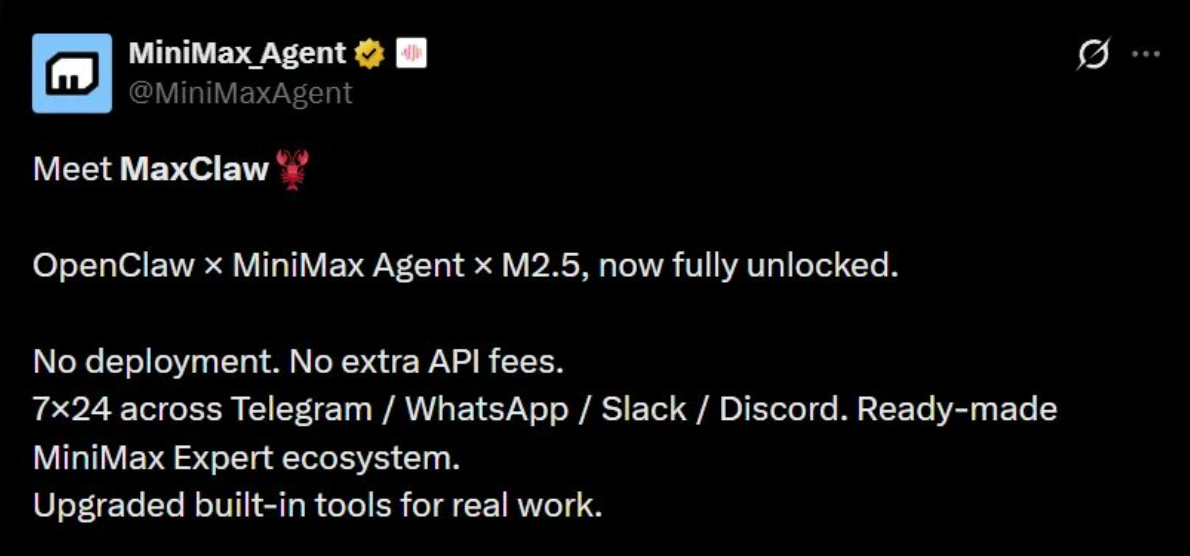
MiniMax is making a calculated move to convert open-source enthusiasm into commercial traction, launching a cloud-hosted AI agent service that strips away the technical and financial barriers that have kept the widely popular OpenClaw framework out of reach for mainstream users.
The Shanghai-based AI startup introduced MaxClaw on February 26, a fully managed cloud service built on the OpenClaw — known in Chinese AI circles as "lobster" — agent framework, and integrated directly into the MiniMax Agent web platform. The product targets a critical gap in the market: the large pool of users attracted by OpenClaw's capabilities but deterred by its deployment complexity and unpredictable API costs.
The launch carries broader strategic weight. By anchoring MaxClaw to a flat subscription model and its own M2.5 flagship model with 10 billion parameters, MiniMax is not merely offering a convenience feature — it is attempting to redefine the commercial terms on which AI agents reach consumers, while simultaneously deepening its own model training data pipeline through real-world, high-frequency interactions.
The Problem MaxClaw Is Designed to Solve
OpenClaw's appeal has never been in doubt. Its demonstration videos spread rapidly across China's developer community, showcasing autonomous, multi-platform agent behavior that captured the imagination of both technical and non-technical audiences. Yet the path from watching a demo to running a personal agent has proven far more treacherous than its marketing implied.
For most users, the official one-click deployment script is only the beginning of the ordeal. Environment configuration errors, manual API interface setup, and ongoing token management have effectively confined OpenClaw to a niche of technically proficient enthusiasts — what the industry might call "geek-only" territory. The framework itself is free, but the large language models powering it are not. Users must supply their own API keys from providers such as Anthropic or OpenAI, and a single active agent deployed in a group chat can generate exponential token consumption overnight. Anecdotal accounts of API balances being wiped out by runaway agents have become common cautionary tales in Chinese AI communities.
This combination of technical friction and financial unpredictability has produced a specific behavioral outcome: users self-censor their AI usage, limiting exploration to avoid unexpected bills. The result is a suppression of the very engagement that would otherwise drive product stickiness and commercial value.
MiniMax's Three-Pronged Commercial Logic
MaxClaw's design directly addresses each of these friction points, but the product's significance extends well beyond user experience optimization. MiniMax's strategy reflects a deliberate attempt to capture three distinct forms of value simultaneously.
First, ecosystem capture without development cost. OpenClaw has accumulated a substantial library of community-developed plugins and cross-platform integrations. By building MaxClaw on top of OpenClaw compatibility, MiniMax gains instant access to this ecosystem without having to develop individual platform integrations itself. The move effectively converts community-generated intellectual work into distribution infrastructure for MiniMax's own model.
Second, a proof-of-concept for AI subscription monetization. Historically, user willingness to pay for large language models has been constrained by the limited utility of single-session web chat interfaces. By delivering MaxClaw as a persistent "digital workforce" — one that operates across social platforms and automated workflows around the clock, even when the user's device is offline — MiniMax is testing a materially stronger value proposition for recurring subscription revenue. Converting variable, anxiety-inducing API billing into a predictable flat fee is a structural change in how AI costs are perceived by end users, not merely a pricing adjustment.
Third, a real-world data flywheel. Agent deployments in live, multi-platform environments generate interaction data that is qualitatively different from, and arguably more valuable than, data derived from conventional web chat sessions. High-frequency, task-oriented agent interactions expose model weaknesses and edge cases that controlled environments cannot replicate. For MiniMax, every MaxClaw session is simultaneously a commercial transaction and a model training signal — a compounding advantage that single-interface competitors cannot easily replicate.
Positioning in a Crowded Market
MiniMax's timing reflects an awareness that the window for establishing agent infrastructure leadership is narrow. The Chinese AI landscape is experiencing intensifying commoditization at the base model level, with capability gaps between leading providers narrowing rapidly. In this environment, the competitive differentiator is shifting from raw model performance to ecosystem depth and deployment accessibility.
MiniMax had already signaled this direction earlier by introducing one-click local deployment in its desktop client — a move that earned goodwill among power users frustrated by configuration complexity. MaxClaw represents the logical extension of that strategy to the cloud, eliminating the remaining hardware and infrastructure requirements entirely.
The zero-deployment positioning — click to activate, no code, no server, no API key management — is designed to lower the adoption threshold to a point where AI agent usage becomes comparable in friction to installing a mobile application. If successful, it would mark a meaningful inflection point in the transition of AI agents from developer tools to mass-market consumer products.
Whether MiniMax can sustain this positioning will depend on the economics of its subscription model at scale, the performance consistency of M2.5 under heavy agent workloads, and its ability to maintain OpenClaw compatibility as that framework continues to evolve. For now, the company has identified a genuine market gap and moved with notable speed to occupy it.