
Morgan Stanley: The “Cambrian Explosion” of Drones Is Here, And China Holds The Keys
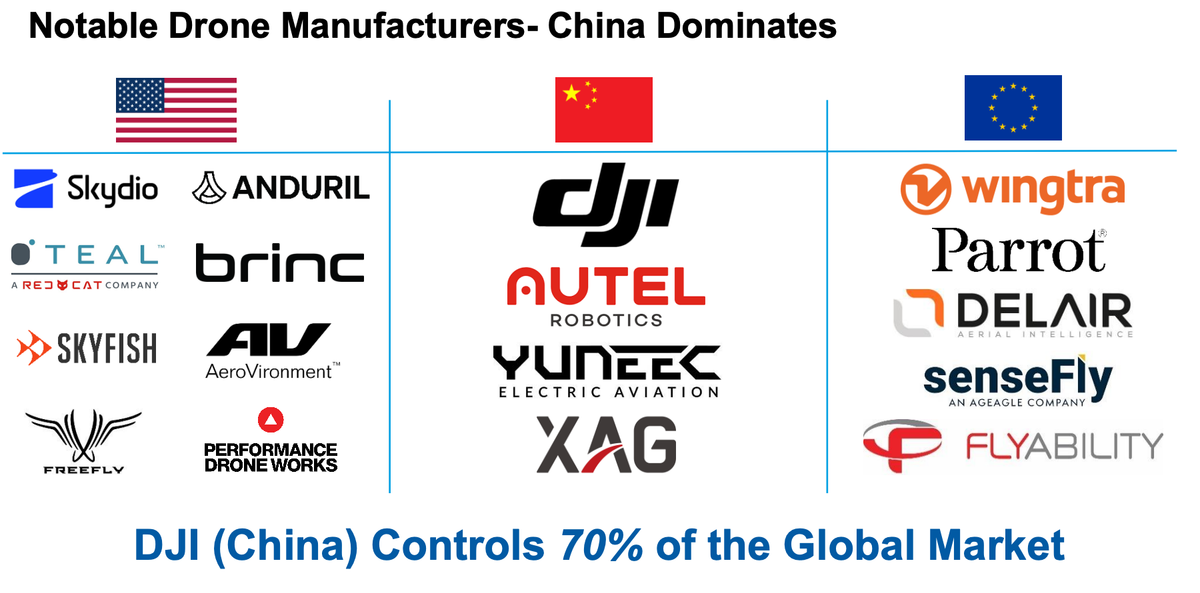
In a sprawling new report titled "The Robot Almanac Vol. 4: Drones & Air Mobility," released this month, Morgan Stanley’s Global Embodied AI Team led by Adam Jonas outlines a pivotal shift in the hardware landscape. Dated December 2025, the research posits that we are witnessing a "Cambrian Explosion" of robotic form factors, driven primarily by the convergence of artificial intelligence and plummeting hardware costs.
For investors and defense analysts alike, the report is a wake-up call. It details not just the technological inevitability of autonomous flight, but the widening geopolitical chasm in manufacturing capabilities. As the report bluntly illustrates, while the West focuses on regulation, the East—specifically China—has cornered the supply chain for the most disruptive technology since the smartphone.
Here is the breakdown of the trends shaping the drone economy in 2025.
The Lethality of "Good Enough" Tech
Morgan Stanley highlights a divergence in drone evolution: the shift from expensive, bespoke military hardware to "attritable," mass-produced commercial units adapted for conflict. The analysts define this as the "AI Unlock."
Historically, autonomy was hard-coded and rigid. Today, AI enables a $500 drone to navigate complex environments without GPS, relying on visual odometry and onboard processing that rivals legacy aerospace systems costing millions. The report notes:
"Navigating open 3-dimensional space is arguably easier than city streets... Drones today have achieved 'conditional autonomy', progressing to full autonomy."
The financial implications of this asymmetry are staggering. The research breaks down the Bill of Materials (BOM) for a standard lethal FPV (First Person View) drone. The total cost sits between $350 and $1,000. Compare this to the targets they destroy—multi-million dollar tanks and air defense systems—and the deflationary pressure on warfare becomes undeniable.
A closer look at the components reveals that a high-end flight stack costs roughly $150, while the frame is often 3D printed for pennies. This is the democratization of air superiority.
The Supply Chain Chokehold
While the technology is global, the manufacturing is heavily localized. Morgan Stanley dedicates a significant portion of the Almanac to the dominance of SZ DJI.
Despite varying sanctions and tariff discussions throughout the early 2020s, DJI controlled 70% of the global drone market in 2023, and that hegemony remains largely unchallenged in 2025. The report underscores that China’s dominance extends beyond just the end-product; it consumes the entire component stack.
"Any country that cannot manufacture its own drones is doomed to be the vassal state of any country that can." — Elon Musk, Q1 2025 Earnings Call.
The breakdown of suppliers for critical components—Brushless DC Motors, Flight Controllers, and Lithium Polymer batteries—reads like a phone book of Shenzhen. Companies like CATL and its subsidiaries dominate the energy density game, effectively controlling the flight time and payload capacity of global fleets. The report notes that even US-based manufacturers often rely on Chinese sub-components, creating a "security theater" where domestic drones are still tethered to Asian supply chains.
Battlefield Lessons: Operation Spider’s Web
The report draws heavily on recent geopolitical conflicts, referencing "Operation Spider’s Web" in Ukraine as a turning point. Battlefield data cited by Ukrainian leadership indicates that by 2025, 70% of casualties were inflicted by drones.
This reality has forced a scramble within the US Department of Defense. The Pentagon’s "Replicator" initiative and the Army's goal to acquire "millions of drones" signify a desperate pivot to catch up to the volume of fire generated by cheap, mass-manufactured adversaries.
The Almanac presents a stark cost comparison:
- AeroVironment Switchblade 300: ~$100,000
- Custom FPV Drone: ~300−300−1,000
The economic efficiency of the latter is rendering traditional procurement models obsolete.
The Commercial Horizon: 2 Billion Drones
Beyond the battlefield, Morgan Stanley forecasts a parabolic rise in commercial adoption. Their internal models project a global fleet of 2 billion drones by 2050.
This growth is driven by three sectors:
- Agriculture: DJI agricultural drones effectively service one-third of China's farmland, reducing chemical usage by 30%.
- Delivery: Companies like Zipline have completed over 1.5 million deliveries. In China, drone parcel delivery hit 2.7 million units in 2024 alone.
- Infrastructure: Inspection of critical grids and bridges is moving entirely to autonomous systems provided by companies like Skydio.
The Next Frontier: eVTOLs and Air Taxis
Finally, the report touches on the logical conclusion of battery and motor improvements: Urban Air Mobility (UAM). The team argues that if AI can navigate a crowded 2D city street, 3D airspace is "a walk in the park."
Leading players like Joby Aviation and Archer Aviation are poised to capitalize on the fact that global airspace is surprisingly empty compared to terrestrial roads. The revenue potential is significant, with Morgan Stanley estimating that a single eVTOL aircraft could generate the annual revenue of 10 to 15 rideshare vehicles.
Conclusion
The Morgan Stanley Robot Almanac Vol. 4 portrays a world rapidly transitioning from manned to unmanned systems. However, the underlying message is cautionary. The technology "unlock" is universal, but the industrial base required to scale it is currently monopolized by a single superpower. As 2026 approaches, the race isn't just about better AI; it's about who can build the hardware to house it—without relying on DJI to ship the parts.