
Neolix Raises $400M, Leads China’s Autonomous Delivery Race
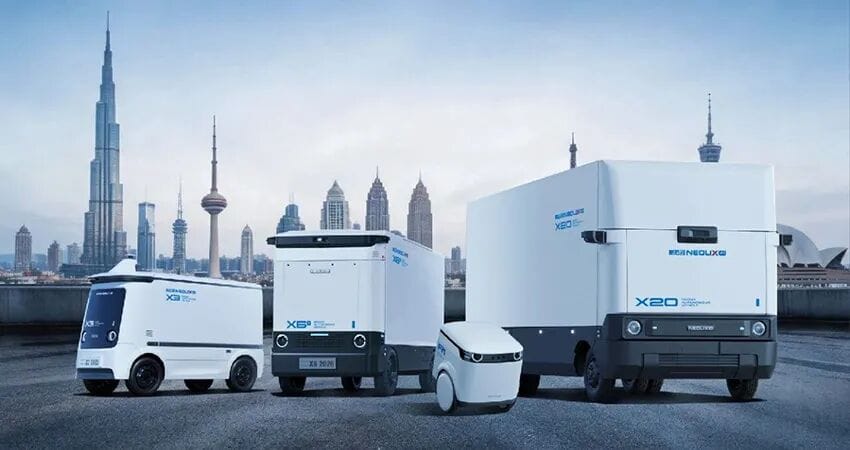
Backed by Alibaba, a sovereign AI fund, and Tencent's prior stake, the Beijing-based L4 robotics firm has now raised over RMB 10 billion ($1.39 billion) and deployed more than 30,000 vehicles across nearly 20 countries — signaling that capital consolidation in unmanned delivery has entered a decisive phase.
The fundraising arms race in China's autonomous vehicle sector reached a new milestone on Monday when Neolix, the Beijing-headquartered L4-level unmanned delivery vehicle maker, announced the close of a nearly $400 million (RMB 2.68 billion) Series E round — the single largest autonomous driving fundraise in China so far in 2026, according to the company's own accounting.
The round was co-led by Boyu Capital and an undisclosed national-level fund — which sources familiar with the matter told Chinese media is the National Artificial Intelligence Industry Investment Fund — joined by Alibaba's AEF NextGen Hong Kong Fund, Monolith Capital, GGV Capital, Temasek-backed Vertex Growth, Hua Ying Capital, GAC Capital, JD Capital, and Charoen Pokphand Robotics. A cluster of existing shareholders including SoftBank Asia, Yizhuang State Investment, CDH VGC and Lightspeed China Partners followed on.
Alibaba's Entry Completes a Duopoly Bet on Neolix
The strategic significance of this round extends beyond its dollar size. Tencent quietly joined Neolix's cap table in February 2026, when its subsidiary Guangxi Tencent Venture Investment appeared in national corporate registry filings. Alibaba's participation in this Series E now means China's two dominant internet platforms have both placed formal bets on the same unmanned logistics platform — a convergence that rarely occurs this early in a hardware-intensive deep-tech company.
That investor symmetry carries a market signal: both Alibaba and Tencent operate last-mile logistics ecosystems at scale, and their dual presence on Neolix's register suggests the company is being evaluated less as a pure robotics play and more as a potential operating-system layer for urban freight networks — one that neither internet giant wants a rival to control exclusively.
Two Rounds, $1 Billion in Twelve Months Reshapes Sector Funding Map
Neolix's fundraising velocity is itself a data point worth isolating. In October 2025, the company closed a Series D exceeding $600 million (RMB 4.02 billion), led by UAE-based Stone Venture — a round that set what was then the private-market financing record for Chinese autonomous driving. Approximately one year later, the Series E adds another $400 million, bringing the two-round combined take to roughly $1 billion (approximately RMB 6.7 billion) within a 12-month window.
Total cumulative funding now exceeds RMB 10 billion ($1.39 billion), positioning Neolix at the head of the unmanned delivery segment by capital raised. For context, the company's Series C+ round in February 2025 — at RMB 1 billion ($138.9 million) — seems almost modest by comparison, illustrating how rapidly investor appetite for scale-proven autonomous logistics platforms has intensified over 18 months.
Fleet Scale Surges Threefold, Outpacing Prior Disclosures
The operational numbers Neolix disclosed alongside the fundraising announcement are equally striking. The company's deployed fleet now exceeds 30,000 vehicles operating across more than 300 cities in nearly 20 countries, with cumulative autonomous mileage surpassing 260 million kilometers.
That represents a near-threefold leap from the company's own October 2025 disclosures, when cumulative deliveries had just crossed 10,000 units and total L4 autonomous mileage stood at 50 million kilometers. The pace of fleet expansion — from 10,000 to 30,000 units in under a year — suggests Neolix has reached an inflection point where production capacity, rather than technology readiness or regulatory approval, is becoming the binding constraint on growth.
The vehicle lineup spans the X3 and X6 models, with the X6 — developed jointly with GAC Lingcheng and carrying a 6-cubic-meter cargo bay — formally rolling off the production line in August 2026. Roadmap expansions to 12-cubic-meter and 20-cubic-meter variants are already planned under that partnership, signaling a deliberate push into sub-trunk logistics corridors that currently require human-driven light commercial vehicles.
Global Expansion Stress-Tests the China-to-Overseas Replication Model
Neolix's international footprint is no longer a proof-of-concept exercise. Active commercial operations are running in South Korea; deployment programs are live in the UAE with Saudi Arabia and Qatar under expansion; and in September 2026 the company announced plans to establish a European headquarters in Luxembourg, anchored by a demonstration at Germany's IAA Transportation show and pilot programs in Belgium.
The strategic logic is straightforward but operationally demanding. Each new geography requires Neolix to rebuild its localization stack from scratch — adapting perception models to unfamiliar road geometries, navigating vehicle homologation frameworks that differ sharply across the EU, GCC, and Northeast Asia, and establishing after-sales service infrastructure without the density advantages the company enjoys in China.
Series E proceeds are earmarked explicitly for two buckets: global operations network buildout and end-to-end autonomous driving large model R&D. The latter aligns with a broader industry shift away from HD-map dependency — Neolix has already begun commercial delivery of its map-free L4 solution domestically, reducing per-city deployment costs and compressing the timeline needed to activate new markets.
Sovereign and Industrial Capital Anchor a New Financing Architecture
The composition of this round matters as much as its size. The reported participation of the National AI Industry Investment Fund places a state-level imprimatur on Neolix's trajectory, effectively signaling regulatory comfort with the company's technology and business model at the highest institutional level. That validation typically accelerates municipal-level procurement decisions and can smooth the path for expanded operating licenses in cities where local governments hold discretionary authority over autonomous vehicle deployments.
Meanwhile, the presence of GAC Capital and Charoen Pokphand Robotics among the new investors introduces supply-chain optionality. GAC's manufacturing relationship — already materialized in the X6 co-development — could be deepened at scale, while CP Group's logistics and retail footprint across Southeast Asia offers a natural distribution channel for Neolix's international expansion.
Operational Efficiency Emerges as the Next Competitive Battleground
Capital concentration in unmanned delivery is narrowing. Large rounds are flowing almost exclusively to companies that can demonstrate vehicle delivery at scale and have begun building recurring-revenue operations models — a threshold Neolix has clearly crossed.
The company's strategic pivot from unit sales toward fleet-as-a-service — offering dispatching, fleet management, and transport capacity as bundled services — mirrors the playbook that enabled ride-hailing platforms to build durable moats once hardware commoditized. Whether Neolix can replicate that transition in a hardware category with significantly higher per-unit costs and more complex maintenance requirements will be the defining question for its next financing cycle.
Founded in 2018 by CEO Yu Enyuan, Neolix has spent eight years building toward a scale threshold that its latest funding round now appears to validate. The harder work — converting fleet size into unit economics that justify valuations at this capital intensity — begins now.
Related Coverage:
Neolix CEO: China's Autonomous Vehicles Lead the World, 10,000 Unit Milestone Just the Beginning
Neolix Secures Over $500 Million in Pre-IPO Funding with Tencent Participation