
NetShort and DramaWave Lock Up AI Short Drama Duopoly as Overseas Market Hits Maturity Inflection
Two platforms now command 60% of the global AI short drama top 100, signaling a winner-takes-most dynamic that is reshaping how Chinese content studios allocate production budgets overseas.
DataEye, a Shenzhen-based entertainment data analytics firm, on July 14, 2026 released its H1 2026 rankings for both overseas short dramas and AI-generated short dramas — the most comprehensive benchmark yet for a sector that has evolved from a cottage industry into a structured, platform-driven content economy. The dual leaderboard reveals a market bifurcating rapidly: conventional short dramas remain a broad competitive field, while the AI drama sub-segment is consolidating around two dominant players at a pace that mirrors early-stage app-store monopolization.
The immediate market signal is unambiguous. In the AI drama category, NetShort and DramaWave collectively occupy 60 of the top 100 slots — 31 and 29 respectively — leaving the remaining 40 seats split among VibeShort (10), MoboReels (10), ShortMax (8), and a long tail of smaller platforms. That concentration ratio, at 60%, is high enough to suggest that content creators and advertisers face meaningful platform dependency risk if they have not already diversified distribution.
Duopoly Tightens Its Grip on AI Drama Ad Inventory
The H1 2026 AI drama top 100 generated a combined 1.5208 million ad creative sets — a metric that functions as a proxy for monetization intensity, since short drama platforms in overseas markets are predominantly performance-marketing driven. Six titles exceeded 50,000 creative sets each, while 12 sat in the 20,000–50,000 range, and 24 in the 10,000–20,000 band. The remaining 58 titles each produced fewer than 10,000 sets, underscoring the extreme skew toward the top of the distribution.
NetShort's fantasy-revenge title One Move God Mode led the entire AI drama chart with 80,115 creative sets — the only title to breach the 80,000 threshold in the first half. DramaWave's romance entry Pucked By My Hockey Rival followed at 78,955 sets, with NetShort's werewolf-genre title The Wolfless Carpenter Rules the World third at 69,198 sets. The fact that all three top titles cleared 69,000 sets — and that all 15 top slots were held exclusively by NetShort and DramaWave — reinforces the duopoly thesis with statistical force.
Werewolf Genre Emerges as AI Drama's Breakout Content Vertical
Beyond platform concentration, the genre data carries its own strategic signal. Romance remains the dominant tag in AI dramas at 68%, followed by "underdog comeback" at 24%. But the structural surprise is werewolf content, which appears across 16 ranked titles spanning NetShort, DramaWave, and the fast-rising newcomer VibeShort — making it the single most widely distributed niche sub-genre in the AI drama top 100.
The werewolf cluster is analytically significant for two reasons. First, it suggests that AI-assisted production has dramatically lowered the cost of producing fantasy-visual-effects-heavy content, unlocking a genre that was previously prohibitively expensive for short-form formats. Second, the cross-platform distribution of werewolf titles — rather than their concentration on a single platform — indicates that the genre is demand-driven rather than platform-engineered, giving it more durable commercial legs.
VibeShort, described by DataEye as a new app launched in H1 2026, has already secured 10 top-100 slots and is the only platform outside the NetShort-DramaWave duopoly to place a title in the top 20. Its rapid ascent, partly anchored in werewolf and fantasy content, positions it as the most credible third-party challenger in the AI drama space heading into H2 2026.
Conventional Short Drama Market Shows Platform Breadth but Audience Concentration
The parallel H1 2026 overseas short drama top 100 — tracking conventional (non-AI) productions — tells a different structural story. Total "heat value" across the top 100 reached 1.793 billion index points. Only two titles exceeded 50 million heat points, 11 sat in the 30–50 million range, 56 in the 10–30 million band, and 31 fell below 10 million — a distribution that is notably less concentrated at the top than the AI drama chart.
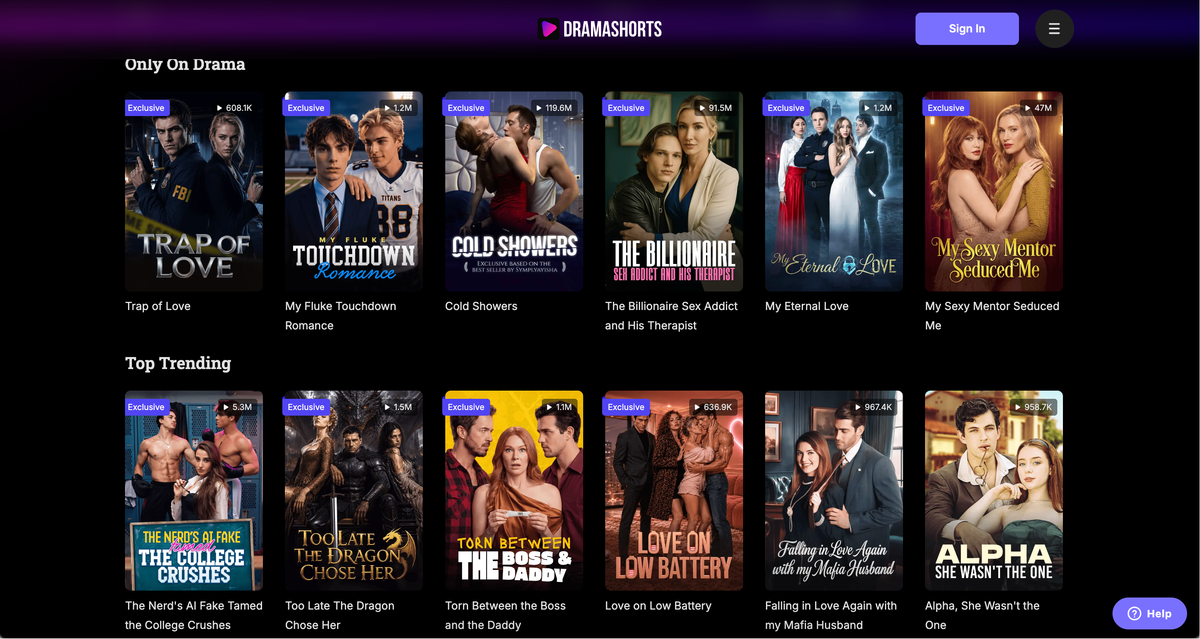
DramaShorts platform's The Billionaire Sex Addict and His Therapist topped the conventional chart at 97.996 million heat points, the only title approaching the 100 million threshold in the first half. My Drama platform's Mr Denver ranked second at 73.855 million, with I'm Her Most Dangerous Obsession third at 48.231 million. All three top titles carry romance tags, and two — the chart-topper and the third-place title — push into ethically contentious territory: the former involves a billionaire with sex addiction and a married therapist; the latter features a dual male-lead romance. DataEye's data suggests overseas audiences, particularly in North America and Southeast Asia, demonstrate measurably higher tolerance for controversial emotional narratives than domestic Chinese platforms permit.
Mr Denver also validates a multi-language IP strategy: the English-language version ranked second overall, while a Spanish-language adaptation, sr. DENVER, reached position 52 with 12.863 million heat points. The 5.7x heat-value differential between the two versions quantifies the current gap between English and Spanish-language short drama monetization — but also confirms that localized versioning generates incremental returns rather than cannibalizing the primary title.
Kuku TV's India Bet Pays Off; NetShort Leads New-Title Pipeline
In platform terms, Kuku TV leads the conventional short drama top 100 with 30 slots, followed by NetShort at 21, DramaBox at 12, My Drama at 10, DramaShorts at 8, and ReelShort at 7. Kuku TV's dominance is geographically anchored: the platform has pursued deep India market localization, with a content slate skewed toward billionaire, revenge, and underdog themes that resonate with South Asian audience preferences. Its titles occupied positions 4 through 9 on the overall chart — a remarkable six-slot sweep of the mid-tier rankings.
Among the 36 new titles that entered the conventional top 100 in H1 2026, Kuku TV contributed 12 and DramaBox 9, while NetShort added 6. NetShort's lower new-title count relative to its 21-slot total presence indicates a stronger reliance on catalog titles maintaining heat — a sign of IP longevity that carries favorable implications for content amortization economics.
Genly-produced, NetShort-distributed title The Husband Swap Game ranked 11th with 33.287 million heat points, while the translated Chinese historical drama Ruling Over All I See, produced by Haikou Tingsuo and Bao Yi Bao Culture and distributed by DramaBox, reached position 31 at 19.676 million heat points — one of the stronger performances for a Chinese-IP adaptation in the period.
Investment Implications: Platform Lock-In Risk Rises as AI Drama Scales
The combined picture from both rankings points to a sector at an inflection point. In conventional short drama, the market remains competitive enough that mid-tier platforms like DramaBox and My Drama can sustain double-digit top-100 representation. In AI drama, the window for new entrants to challenge NetShort and DramaWave at scale is narrowing — VibeShort's rapid rise notwithstanding.
For content studios and investors, the data implies three near-term considerations. First, AI drama production economics are improving fast enough that genre diversification — particularly into fantasy and werewolf content — now offers a viable alternative to the saturated romance-CEO formula. Second, the "one IP, multi-language" model demonstrated by Mr Denver is under-exploited: only a handful of titles in both rankings pursued systematic language versioning. Third, the 60% platform concentration in AI drama creates structural leverage for NetShort and DramaWave in content acquisition negotiations — a dynamic that will likely compress margins for independent studios that lack alternative distribution.
DataEye's daily spend tracking for the broader overseas short drama market, cited separately in its July 7 report, puts the sector's daily advertising expenditure at approximately RMB 30 million (US$4.17 million), with an estimated active title pool of 30,000–40,000 productions — a volume that DataEye characterizes as unfavorable for small and mid-size operators competing on cost alone.
Related Coverage:
China’s AI Drama Boom Spurs Trade in Digital Likeness, Raising Legal Risks