
Nio ES9 Showcases SkyOS Edge in EV Software Race
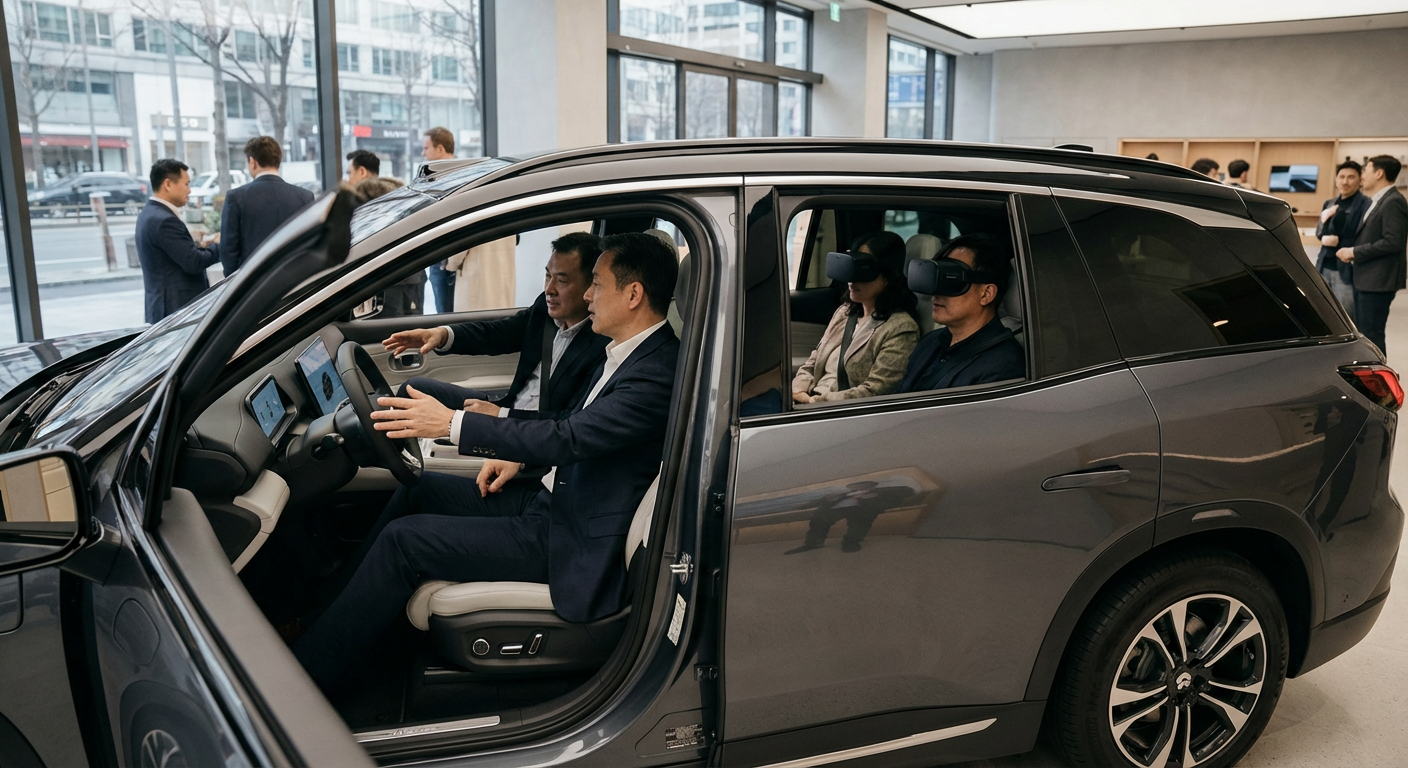
Nio is leveraging its proprietary Sky·OS architecture to transform the ES9 SUV into a highly integrated hardware-software ecosystem, signaling a broader industry shift toward centralized vehicle computing in 2026.
Building on the foundation laid by the ET9 delivered last year, the ES9 introduces a refined "5D immersive cabin" that has rapidly become a primary driver of showroom foot traffic. While the consumer-facing feature focuses on multi-sensory entertainment, early market feedback indicates that investors and industry analysts are closely watching the underlying low-latency operating system that makes such synchronization possible.
The system integrates visual, auditory, tactile, olfactory, and dynamic sensory outputs, utilizing what the automaker claims is the industry's first dual-Dolby (Vision and Atmos) cabin. However, the true technical moat lies in the architecture's ability to seamlessly bridge independent vehicle domains.
SkyOS Integration Drives Ultra-Low Latency
To execute complex cabin scenarios, the ES9 synchronizes 116 atomic capabilities across six core vehicle domains: intelligent driving, smart cockpit, chassis, body, powertrain, and cloud computing. Governed by the Sky·OS platform, these functions operate at a precise 50Hz frequency.
During a standard two-minute display program, the vehicle processes thousands of cross-device collaborative commands. According to company data, the architecture maintains a maximum processing latency of under 0.09 seconds. This proprietary communication protocol prevents the fragmentation of hardware execution, ensuring that ambient lighting, acoustic adjustments, and physical suspension drops occur simultaneously without perceptual delay.
Hardware Convergence Redefines Cockpit Standards
The physical execution relies on a suite of top-tier hardware specifications. The ES9 utilizes a 15.6-inch 3K center display and dual 16-inch 3.3K rear screens, featuring Tandem AMOLED technology and 100% DCI-P3 color gamut.
Acoustically, the vehicle introduces a 9.2.4.8 layout featuring 47 speakers and a 3,020W rated output, anchored by diamond-crafted tweeters. Dynamically, the ES9 is equipped with an electro-hydraulic active suspension system capable of a 1,000Hz torque response rate and a 40Hz actuator frequency, allowing for immediate chassis adjustments—such as a sudden 220mm drop—to mimic on-screen physical environments.
Low Latency Accelerates Active Safety Systems
Beyond entertainment, Nio's unified digital architecture translates directly into enhanced active safety margins, a critical metric for 2026 automotive evaluations.
The vehicle's augmented reality head-up display (AR-HUD) processes environmental perception and posture compensation rendering with an end-to-end delay of less than 0.02 seconds, effectively eliminating digital distortion. Furthermore, the Sky·OS communication protocol reduces the total link latency of the Autonomous Emergency Braking (AEB) system by 50% compared to traditional architectures. At highway speeds of 120km/h, shaving 0.03 seconds off the perception-to-execution timeline translates to initiating braking one meter earlier.
In extreme mechanical failure scenarios, such as a high-speed tire blowout, the centralized OS commands over ten chassis actuators—including steer-by-wire and rear-wheel steering—to stabilize the vehicle within 0.3 seconds, ensuring trajectory retention and mitigating critical risks.
Related Coverage: