
NIO Secures $1 Billion Funding, But Profitability Requires Additional Bestseller
Chinese electric vehicle manufacturer NIO Inc. has completed a $1 billion equity financing, marking its second public fundraising this year as the company accelerates efforts to achieve quarterly profitability by year-end. The funding comes as NIO reports improving cost controls and growing sales momentum from new vehicle launches.
The latest share placement priced American depositary receipts at $5.57 per share, while the Class A ordinary shares were priced at HK$43.36 each.This marks NIO’s second public fundraising this year. Compared with its March placement priced at HK$29.46 per share, which raised HK$3.5 billion (around RMB 3.27 billion), the latest deal reflects significant increases in both issue price and proceeds. The two offerings have lifted NIO’s total secondary market fundraising this year to over RMB 10 billion.
NIO's stock performance reflected mixed investor sentiment, with U.S. shares falling nearly 9% following the announcement while Hong Kong shares recovered from early losses to trade marginally higher. The funding will support core technology development, future vehicle platforms, charging infrastructure expansion, and balance sheet strengthening.
Chief Executive William Li has committed to achieving non-GAAP profitability in the fourth quarter, setting a critical milestone for the loss-making company that has never reported annual profits since its 2018 listing.
Financial Performance Shows Improvement Amid Cost Controls
NIO's second-quarter results demonstrated progress in expense management despite continued losses. The company reported Q2 deliveries of 72,056 vehicles, up 30.57% year-over-year, generating revenue of 19.01 billion yuan. Net losses narrowed to 4.995 billion yuan, down 1.51 billion yuan quarter-over-quarter, primarily due to reduced operational expenses.
Total operating expenses declined 955 million yuan from the first quarter through workforce reductions and operational efficiencies. Under non-GAAP accounting, quarterly R&D expenses dropped to 2.489 billion yuan while sales, general and administrative costs fell to 3.682 billion yuan, approaching management's target range of 2-2.5 billion yuan for quarterly R&D spending.
For the first half of 2025, NIO delivered 114,200 vehicles, up 30.57% year-over-year, with revenue reaching 31.04 billion yuan. However, net losses totaled 11.745 billion yuan, including 6.75 billion yuan in Q1. The company has accumulated losses exceeding 100 billion yuan since establishment, with 2024 net losses reaching a record 22.66 billion yuan.
New Vehicle Success Drives Sales Recovery
NIO's financial turnaround hinges largely on two new models showing strong market reception. The Ledao L90, launched July 31, achieved monthly sales of 10,575 units in August, becoming NIO's fastest model to reach five-digit monthly sales. The success helped boost NIO's total August deliveries to 31,300 vehicles.
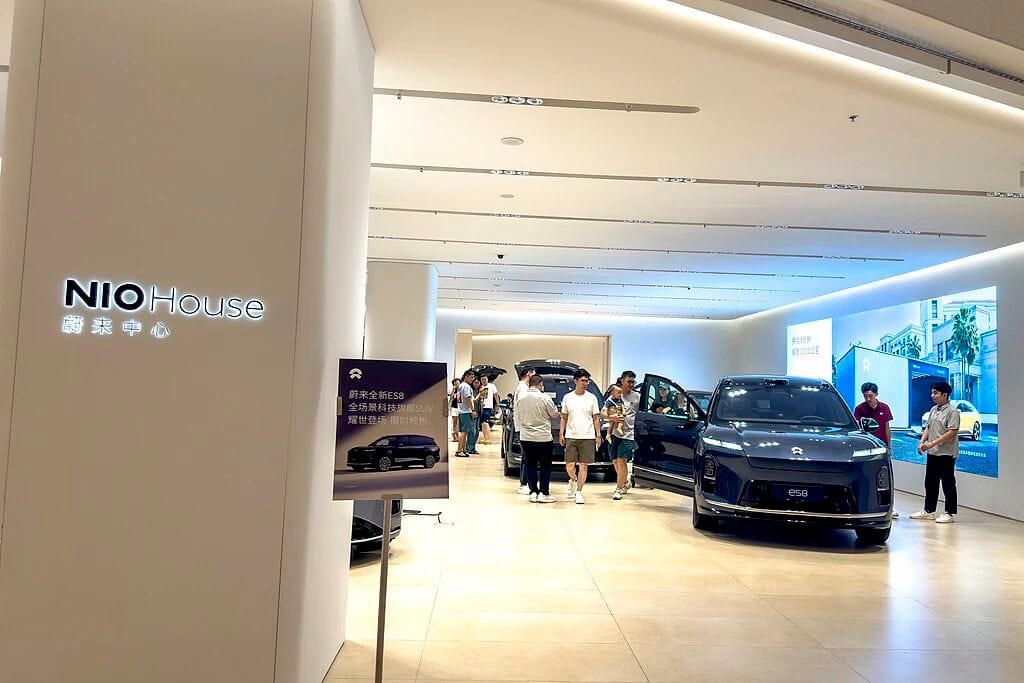
The refreshed ES8, which began pre-sales August 21, has reportedly generated even stronger order momentum than the L90 according to CEO Li. These two vehicles are expected to contribute approximately 25,000 monthly units combined, with management targeting stable monthly sales above 15,000 units for the L90 and breakthrough monthly sales for the ES8 in Q4.
Market confidence in these launches drove NIO's stock price from 3.43 to 6.58 between July 1 and September 2, nearly doubling investor returns. However, analysts suggest the company requires at least one additional bestselling model to achieve sustainable profitability beyond the targeted Q4 milestone.
Research Investment Strategy Under Scrutiny
NIO's profitability challenges stem partly from extensive R&D investments totaling over 60 billion yuan since 2014, with quarterly spending consistently around 3 billion yuan since 2022. The company has pursued comprehensive in-house development spanning vehicle platforms, battery swapping technology, autonomous driving systems, and proprietary chips.
This "comprehensive self-research" approach has created significant competitive advantages but also substantial cost pressures. While early R&D focused on user-facing technologies like battery swapping and vehicle platforms, recent investments have shifted toward foundational technologies including operating systems and semiconductor development that require longer commercialization timelines.
The strategy has created what analysts term a "perception gap" where substantial R&D investments don't immediately translate to consumer-recognizable value propositions. However, the company's new NT3.0 platform, supporting both the nearly million-yuan ET9 and sub-200,000 yuan Ledao L60, demonstrates NIO's ability to leverage these investments across diverse price segments.
Battery Swapping Network Poses Financial Challenge
NIO's nationwide battery swapping infrastructure, while providing distinctive competitive advantages, represents a significant ongoing financial burden. The network requires substantial capital expenditure and operational costs for site selection, construction, power capacity upgrades, maintenance and staffing across thousands of locations.
The company has pursued partnerships with automakers including Changan, Geely, GAC and FAW to share network costs, though progress remains limited due to competitive concerns among manufacturers. Industry speculation about potential divestiture of NIO's energy business intensified following organizational changes and reported acquisition interest from battery supplier CATL.
Key personnel shifts included energy business founder Shen Fei's transfer to Ledao brand leadership in April, with CFO Qu Yu assuming energy business oversight. Market observers interpret this transition from "business founder" to "financial manager" as preparation for potential capital restructuring, spinoff or sale of the charging infrastructure assets.
Profitability Requires Additional Bestseller
Analysis of NIO's cost structure suggests the company needs approximately 35 billion yuan in quarterly revenue to achieve profitability, assuming sales and administrative expenses stabilize around that level. This translates to roughly 140,000 quarterly deliveries or 47,000 monthly units, based on average revenue per vehicle of 250,000 yuan.
Current new platform vehicles including the L90, refreshed ES8, Ledao L60 and upcoming Firefly brand models are projected to contribute 32,000-35,000 monthly units in Q4. This leaves a gap of 12,000-15,000 units that NIO hopes to fill through promotional campaigns for older NT2.0 platform vehicles, though this approach carries risks for brand positioning and pricing integrity.
Long-term profitability likely requires launching additional mainstream models in the 250,000-350,000 yuan price range based on the latest NT3.0 platform. Success of the L90 and ES8 has provided breathing room, but sustainable profitability depends on expanding the new platform portfolio to capture broader market segments while maintaining premium brand positioning.