
NIO, Xiaomi and Chery Race to Lock In China’s DRAM Supply
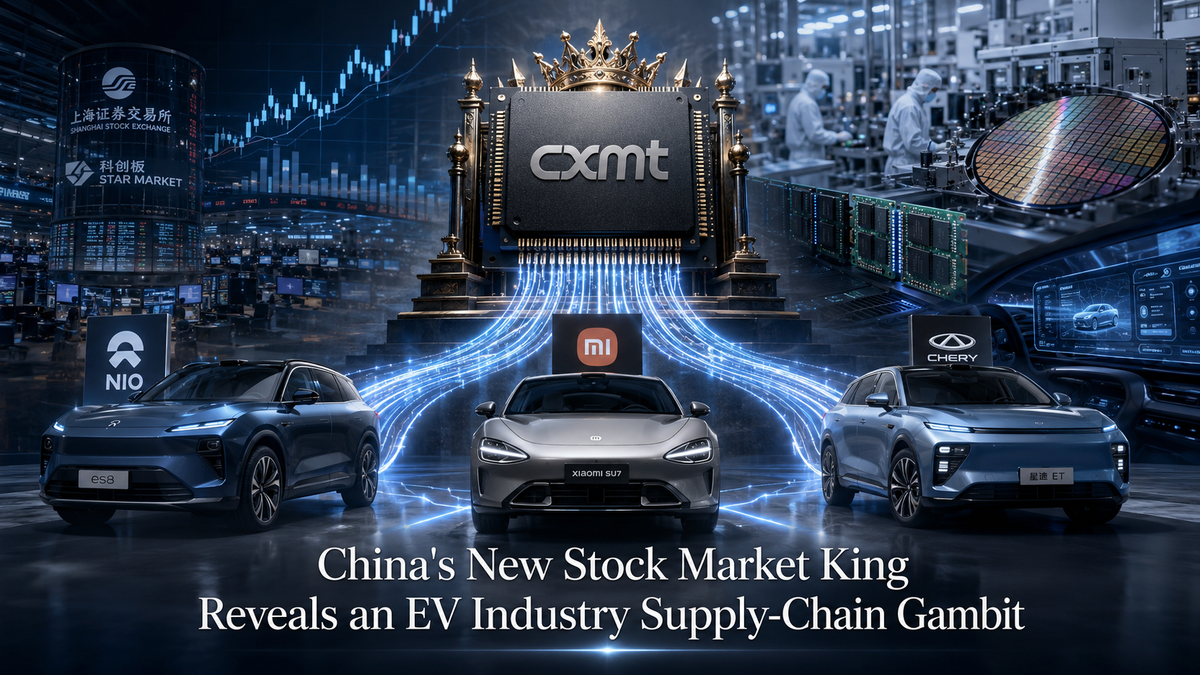
NIO, Xiaomi, and Chery each spent RMB 158 million (US$21.9 million) not to own a piece of China's hottest IPO — but to secure a guaranteed seat at the DRAM supply table before the next memory crunch hits.
Changxin Memory Technologies (CXMT) made a seismic debut on Shanghai's STAR Market on July 27, 2026, opening at RMB 49.5 per share — a 471.59% premium over its RMB 8.66 issue price — and vaulting to a market capitalization of RMB 3.31 trillion (US$459.7 billion). That single-day valuation eclipses two Kweichow Moutai units combined and surpasses Industrial and Commercial Bank of China (ICBC), making CXMT the new largest company by market cap on China's A-share market. The listing, coming less than a decade after CXMT's founding and just two quarters after the company turned its first annual profit in Q4 2025, was by any measure a textbook capital-market debut.
Yet the more strategically consequential story sits not in CXMT's own order book, but in the roster of its strategic placement investors. Among a cohort that includes TCL, Transsion Holdings, Kuaishou, Alibaba Cloud, ZTE, Montage Technology, and Advanced Micro-Fabrication Equipment, three automotive manufacturers stand out: NIO, Xiaomi, and Chery — each allocated approximately 18.24 million shares at identical RMB 158 million stakes, subject to an 18-month lock-up.
Geography Explains Why NIO and Chery Got to the Table First
CXMT's selection criteria for strategic investors were explicit in its prospectus: participants must "enhance industrial chain synergy and secure critical resource supply." Money alone was insufficient; relevance was mandatory.
The first filter was geographic. Both the NIO entity that participated — NIO Power Technology (Hefei) — and the Chery entity — Chery Intelligent Automobile Technology (Hefei) — are domiciled in Hefei, Anhui Province, the same city where CXMT's wafer fabrication facilities are located. NIO co-founder and CEO William Li has publicly noted that CXMT's factory is within walking distance of NIO's Hefei production base, both situated in the northern zone of the Hefei Economic Development Zone. A drive between the two facilities takes roughly ten minutes.
That proximity is operationally significant. Automotive-grade chip qualification cycles are notoriously long and expensive, requiring validation across extreme temperature ranges, vibration tolerances, and functional safety standards. Physical co-location compresses iteration time — a defect identified at 9 a.m. can have an engineer on-site by 10 a.m. Li has confirmed publicly that CXMT's LPDDR5X memory chips have already completed vehicle-integration validation on NIO models, framing the partnership as a direct response to cost pressure and supply-chain stability.
Anhui's Industrial Blueprint Turns Supply-Chain Logic Into Provincial Policy
The second layer of explanation is structural. Anhui Province has explicitly built its economic development strategy around what officials call "Chip-Screen-Device-Vehicle" — an integrated industrial cluster spanning semiconductors, display panels, advanced manufacturing equipment, and new-energy vehicles. NIO, Chery, and JAC Group anchor the vehicle side; CXMT and Longxun Semiconductor anchor the chip side.
The province is actively reinforcing this cluster. Just before CXMT's IPO, multiple Anhui and Hefei state-owned investment platforms led a nearly RMB 500 million (US$69.4 million) Series B round in Listenai, an edge-AI inference chip company. The three automakers' participation in CXMT's strategic placement is therefore less a spontaneous corporate decision than a response to a coordinated provincial industrial policy — one designed to stitch two trillion-RMB industries onto a single supply-chain network.
Xiaomi's Dual Exposure Gives It Outsized Leverage in the DRAM Queue
Xiaomi's position differs structurally from NIO's and Chery's. The company has been a core CXMT customer since the smartphone era, with multiple flagship handset lines already running CXMT's LPDDR memory series. Its participation in the strategic placement represents an upgrade from procurement relationship to equity binding.
The timing is notable. Xiaomi's automobile division is scaling vehicle deliveries, and the company is scheduled to unveil its SkyNomad extended-range SUV series on July 30, 2026 — a product that will deepen its dependency on automotive-grade DRAM for intelligent cockpit and autonomous-driving functions. Unlike pure-play EV startups, Xiaomi sources DRAM for both smartphones and vehicles, giving it a combined procurement volume that likely places it higher in CXMT's customer priority ranking than any single-category buyer.
All three automakers received identical allocations at identical prices. That parity is itself a signal: in the current phase of China's compute-sovereignty drive, the strategic value of the relationship — not the size of the check — determines access.
A Paper Gain Masks Structural Risks That Investors Should Not Ignore
On a mark-to-market basis, the trade looks exceptional. At CXMT's first-day closing price of approximately RMB 48 per share, each of the three automakers is sitting on a paper gain exceeding RMB 700 million (US$97.2 million) on a RMB 158 million outlay — before the 18-month lock-up expires.
The harder question is whether the strategic rationale holds under stress. DRAM is a textbook cyclical industry. During the most recent downcycle, CXMT's financial performance was unremarkable; the company only turned profitable in Q4 2025. A RMB 3.31 trillion valuation embeds aggressive growth assumptions that leave limited margin for error if memory pricing softens.
More pointedly: when CXMT's capacity is genuinely constrained, will it prioritize a customer shipping hundreds of thousands of vehicles annually, or one shipping hundreds of millions of handsets? The "priority supply" that strategic placement is meant to confer is not contractually guaranteed in the public disclosures, and CXMT's automotive-grade product line still requires extended real-world validation before it can scale to mass-production volumes.
Computing Power Defines the Next Competitive Divide
The broader context reframes what these RMB 158 million investments represent. China's leading EV brands have made substantial progress in self-designed compute chips: NIO has its "Shenji" SoC, Xpeng has the Turing chip, and Li Auto has the Mach M100. But compute chips and memory chips are not substitutable. Every self-designed AI accelerator still requires external DRAM, and the global DRAM market remains a near-oligopoly: Samsung, SK Hynix, and Micron collectively hold more than 95% of global supply.
CXMT is the only domestic Chinese supplier operating at meaningful scale. In a scenario where geopolitical friction or demand spikes trigger another DRAM shortage — as occurred in 2021 and again in late 2024 — proximity to the sole domestic alternative is not a luxury; it is a contingency plan.
NIO's Li has described memory price inflation as "the single biggest cost pressure" facing his company in 2026. Chery and Xiaomi face structurally similar exposure. As the definition of a competitive vehicle shifts from mechanical performance to computational capability, control over the memory supply stack is becoming as strategically important as battery chemistry or powertrain efficiency.
The three automakers have placed their bets. The race to lock in China's compute supply chain has only just started.
Related Coverage:
NIO's GeniTech: How a Captive Auto Chip Unit Is Becoming an AI Silicon Platform
Xiaomi Launches SkyNomad Sub-Brand, Targeting Premium Family SUVs at Up to RMB 450,000
Chery Pivots to Global Markets as Export Margins Eclipse Domestic Returns