
NIO's GeniTech: How a Captive Auto Chip Unit Is Becoming an AI Silicon Platform
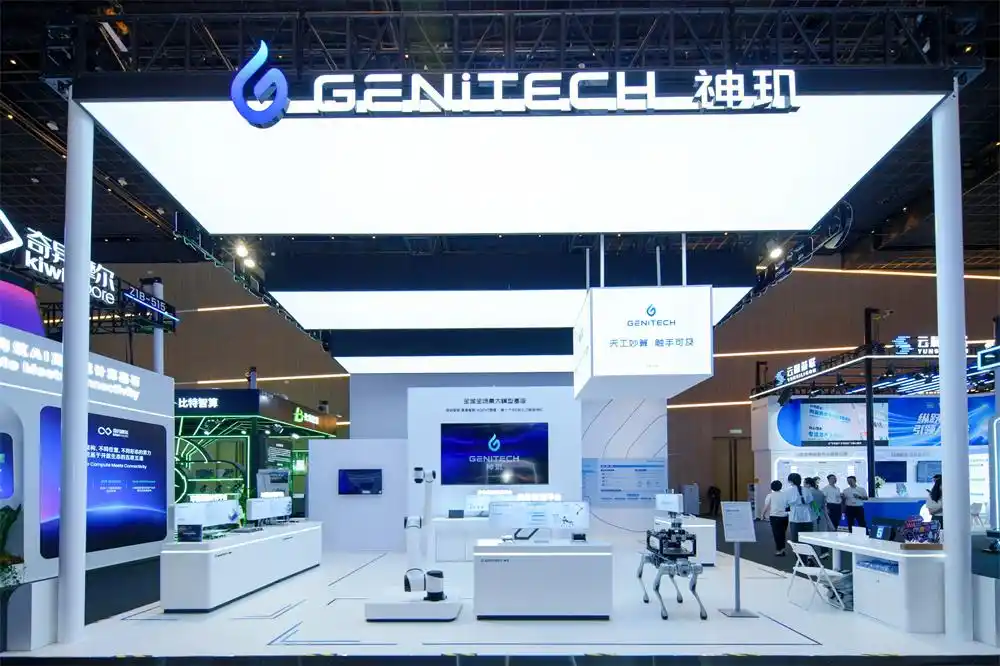
NIO’s chip arm is moving beyond cars — and toward an AI silicon platform
This article is based on Morgan Stanley Research’s July 21, 2026 report, “Evolving from captive silicon to an AI chip platform.”
What Is GeniTech (Shenji), and Where Did It Come From?
GeniTech — known in Chinese as Shenji — is NIO's semiconductor arm, originally created to develop proprietary chips for NIO's own vehicles. This kind of arrangement is called captive silicon: a chip designed exclusively for internal use, with no commercial ambition beyond the parent company's product line.
For years, GeniTech operated precisely in that role. Its flagship processor, the NX9031X, was built to power NIO's intelligent assisted-driving systems and has been embedded in every NIO and Onvo model produced. Cumulative shipments have surpassed 300,000 units.
In June 2025, NIO spun GeniTech out as a separate legal entity. By February 2026, an external funding round valued it at approximately Rmb 8.3 billion post-money. The unit has raised close to Rmb 3 billion since the spin-out. NIO retains roughly a 63% controlling stake.
The strategic logic of the spin-out is straightforward: separating the chip business allows it to raise independent capital, attract external customers, and be valued on its own merits — rather than being buried inside an automaker's balance sheet.
Why Does This Matter Beyond the Auto Industry?
At WAIC 2026 (the World Artificial Intelligence Conference in Shanghai), GeniTech made its first standalone public appearance and reframed its identity. Management described it not as an automotive chip supplier, but as an all-domain, all-scenario AI silicon platform operating across three distinct verticals:
- Intelligent assisted driving — the original use case
- Embodied intelligence — chips for humanoid robots and physical AI systems
- Agent inference — compute infrastructure for AI agents and large model deployment
This repositioning matters because it dramatically expands the addressable market. A captive auto chip supplier's revenue ceiling is essentially the volume of vehicles its parent company sells. An AI silicon platform serving robotics manufacturers, autonomous logistics operators, and inference data centers faces a fundamentally different — and much larger — growth curve.
Management described GeniTech as the only Chinese chipmaker currently spanning all three domains. That claim is difficult to independently verify, but the product lineup lends it some credibility.
How Does the Product Architecture Work?
GeniTech's current lineup is built around the NX9031 family, all manufactured on a 5nm automotive-grade process node:
- NX9031X — The high-end variant anchoring assisted driving in NIO and Onvo vehicles. Already in mass production with over 300,000 cumulative units shipped.
- NX9031U — A midrange variant delivering up to 800 TOPS (tera-operations per second) of equivalent compute under air cooling. This chip powers the new Ruidong embodied-intelligence development platform, which targets robot perception and planning, intelligent computing, and advanced manufacturing applications.
- NX9031C / NX6031 — A sensing chip that, alongside the broader NX9031 family, supports a distributed agent platform for AI inference workloads.
To put the compute density in context: a single NX9031 is rated at the equivalent compute of four Nvidia Orin processors. Orin is Nvidia's automotive-grade system-on-chip, widely used across the Chinese EV and robotics industry. If the performance comparison holds under real-world conditions, it represents a meaningful efficiency advantage — particularly relevant for cost-sensitive Chinese manufacturers looking to reduce dependence on imported silicon.
What Is the Business Model, and How Does GeniTech Make Money?
GeniTech's monetization strategy has three layers:
1. Captive supply to NIO group vehicles Every NIO and Onvo model ships with GeniTech silicon. As NIO's vehicle volumes grow — particularly the ES8, where Morgan Stanley projects sales rising from roughly 47,000 units in 2025 to over 140,000 in 2026 — internal chip volumes scale proportionally. This spreads fixed R&D costs across a larger production base, improving unit economics over time.
2. External licensing In late 2025, GeniTech began licensing the NX9031 technology to a third-party automotive chip company. This adds a royalty revenue stream that is largely incremental — the underlying R&D has already been paid for. Licensing is structurally attractive because it converts sunk development costs into recurring income without requiring additional capital expenditure.
3. External chip sales to non-automotive customers The Ruidong platform and the agent inference products are designed explicitly for customers outside NIO's vehicle ecosystem — robotics companies, autonomous logistics operators, and AI infrastructure providers. This is the highest-optionality segment, and also the least proven. Revenue here depends on GeniTech winning design-ins at third-party companies, a process that typically takes 18–36 months from platform launch to meaningful shipment volumes.
What Problem Does In-House Silicon Solve for NIO?
To understand why NIO invested heavily in chip development in the first place, it helps to understand the cost structure of a premium Chinese EV.
High-end assisted driving and intelligent cockpit systems require substantial compute. Until recently, most Chinese automakers sourced that compute from Nvidia — primarily the Orin and, more recently, Thor platforms. These chips are expensive, subject to US export controls, and create a dependency on a foreign supplier whose pricing and availability NIO cannot control.
By developing in-house silicon, NIO achieves three things simultaneously:
- Cost reduction: Displacing imported compute with domestically produced chips lowers bill-of-materials costs per vehicle.
- Supply chain security: Reducing Nvidia dependency removes a geopolitical vulnerability.
- Margin defense: As volumes scale, each chip produced amortizes the fixed R&D investment across a larger base, structurally improving gross margins.
This is the same logic that drove Apple to develop its own M-series chips, or Tesla to build its Full Self-Driving computer internally. Vertical integration in silicon is a long-term margin strategy, not just a technology statement.
What Are the Key Risks and Constraints?
Several structural challenges could limit GeniTech's trajectory:
Execution risk in new verticals Automotive chip development and robotics chip development share some engineering overlap, but the customer relationships, certification requirements, and sales cycles are different. Winning business in embodied AI and agent inference requires GeniTech to compete against established players — including Nvidia, which remains dominant in AI training and inference globally.
Volume dependency GeniTech's cost economics improve as volumes rise. If NIO's vehicle sales disappoint — a real risk given intense price competition in China's EV market — the captive volume base shrinks, and the R&D amortization logic weakens.
External customer concentration The licensing deal with a single third-party auto chip company is a start, but it also illustrates how early-stage GeniTech's external revenue base is. Diversifying beyond one licensee and one parent company will take time.
China's semiconductor ecosystem constraints While GeniTech's 5nm production relies on TSMC or equivalent foundry capacity, China's domestic semiconductor supply chain — particularly for advanced packaging and EDA tools — remains constrained. Scaling a chip business within these limitations is structurally harder than doing so in an unrestricted environment.
What Does This Mean for How NIO Is Valued?
Traditionally, NIO has been valued as an EV company — assessed on vehicle delivery volumes, gross margins per car, and cash burn rate. By those metrics, NIO has been a challenging investment: the company has run persistent losses, and competition in China's premium EV segment is fierce.
GeniTech's emergence as a standalone, externally funded entity introduces a different valuation lens. If the chip business develops external customers and recurring royalty revenue, it begins to resemble a semiconductor IP company or a platform business — categories that typically command higher valuation multiples than vehicle manufacturers.
Morgan Stanley's base case price target for NIO's Hong Kong-listed shares (9866.HK) is HK$58, implying roughly 48% upside from mid-July 2026 levels of HK$39.26. The bull case reaches HK$109, predicated on successful expansion into new segments and accelerating ADAS adoption. The bear case is HK$21, reflecting weaker-than-expected demand and slower monetization.
The key variable that bridges the base and bull cases is not vehicle sales alone — it is whether GeniTech can demonstrate that its silicon is winning design-ins outside NIO's own product ecosystem.
What Happens Next? The Milestones to Watch
Several developments over the next 12–24 months will clarify whether GeniTech's repositioning is substantive or primarily a narrative exercise:
- Ruidong platform adoption: Which robotics or industrial AI companies integrate the NX9031U? Design-in announcements from credible third parties would validate the embodied intelligence pivot.
- Additional licensing deals: A second or third NX9031 technology licensee would confirm that the royalty model is replicable, not a one-off arrangement.
- GeniTech's next funding round: Valuation and investor composition in a future round will serve as an independent market assessment of the platform's progress.
- NIO vehicle volume: Particularly ES8 ramp and Onvo L80 launch. Higher internal volumes remain the foundation that makes everything else in the cost model work.
- NIO group profitability: Morgan Stanley projects NIO turning profitable at the net income level in 2027. GeniTech's contribution to margin improvement — through cost displacement and royalty income — will be a measurable component of that trajectory.
The Structural Takeaway
GeniTech's WAIC 2026 debut illustrates a pattern that is becoming increasingly common among China's leading technology companies: the conversion of defensive, cost-driven R&D investment into an offensive, revenue-generating platform business.
NIO spent years building chip capability primarily to reduce its Nvidia bill and ensure supply chain resilience. That investment is now being repositioned as a commercial asset — one that can attract external capital, serve external customers, and eventually be valued independently of the automotive business that funded it.
Whether GeniTech succeeds in that transition depends on execution in markets — robotics, autonomous logistics, AI inference — where NIO has no established track record. But the structural logic of the pivot is sound: the hardest part of building an AI chip platform is the years of engineering investment required to produce silicon that actually works. NIO has already paid that cost. The question now is whether it can collect a return on it.
Related Coverage: