
Nio’s Moment of Truth
Once on the brink of collapse, Nio has engineered a remarkable turnaround. But as it pivots from a premium-only brand to a multi-tiered challenger, it faces its most critical test yet: turning its audacious, high-cost vision into sustainable profit.
In the biting Shanghai winter of late 2019, the atmosphere inside Nio’s headquarters felt as cold as the air outside. The company, once the darling of China’s electric vehicle boom, was hemorrhaging cash. Its New York-listed stock had collapsed to below $2 a share. A series of battery fires had forced a costly recall of nearly 5,000 of its flagship ES8 SUVs. Layoffs were gutting its global teams, from its Silicon Valley R&D hub to its mainland China operations.
William Li, Nio’s charismatic founder and CEO, found himself saddled with an unenviable media title: “the most miserable man of 2019.” The visionary who had corralled tech titans like Tencent’s Pony Ma and Xiaomi’s Lei Jun to back his dream of a Chinese luxury EV brand was now steering a ship perilously close to sinking. With a planned Shanghai factory canceled and funding drying up, Nio’s cash reserves were dwindling to a matter of weeks. The company, whose name means “Blue Sky Coming,” was staring into an abyss.
Five years later, the scene is dramatically different. In August 2025, Nio reported a record 31,300 monthly deliveries. Its stock, after another round of financing, surged over 90% in 60 days. A sprawling network of over 2,700 battery-swap stations now covers China, having completed over 50 million swaps. And the company that once sold a single, expensive SUV now commands a multi-brand armada aimed at conquering every price segment, from the premium Nio line to the mainstream family-focused Onvo and the upcoming mass-market Firefly.
For investors who have ridden this gut-wrenching rollercoaster, Nio’s story is a case study in resilience, ambition, and high-stakes reinvention. The company didn't just survive its near-death experience; it used the crisis to forge a new identity. But now comes the great reckoning: Can Nio's expensive, tech-laden ecosystem, built on a mountain of capital, finally deliver the profitability it has long promised?
A Phoenix From Hefei
The turning point came not from a private equity firm in Hong Kong or a tech giant in Shenzhen, but from the municipal government of Hefei, a city in Anhui province determined to become China’s EV capital. In April 2020, with Nio on the financial brink, the Hefei government orchestrated a $1 billion (RMB 7 billion) strategic investment. In exchange, Nio would locate its China headquarters there.
It was a lifeline that changed everything.
“The Hefei deal was more than just cash; it was a state-level vote of confidence,” says a Shanghai-based auto analyst who follows the company. “It signaled that Beijing saw strategic value in Nio’s premium positioning and its technology stack, especially as a counterweight to Tesla.”
With its balance sheet stabilized, Nio went on the offensive. The capital injection didn't just fund operations; it accelerated the buildout of Nio’s most audacious—and controversial—bet: its Power Swap network. While other automakers focused on faster charging, Nio championed the idea that drivers could swap a depleted battery for a fully charged one in under three minutes.
This strategy came with a colossal price tag. Each station is a complex piece of engineering, and the network’s annual operating expense runs to RMB 4.2 billion ($580 million). For years, Wall Street analysts lambasted it as a capital sinkhole. But Nio doubled down, launching its “Battery-as-a-Service” (BaaS) subscription model in August 2020. This unbundled the battery—the single most expensive component of an EV—from the car’s purchase price, lowering the entry barrier for customers. The gambit worked: over 80% of Nio buyers now opt for BaaS.
The Playbook Evolves: From Niche to Everywhere
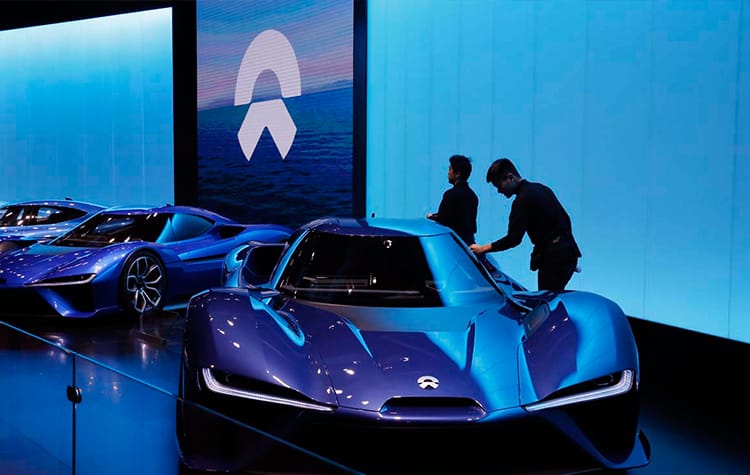
For its first decade, Nio was defined by its premium identity. It launched with the EP9, a record-breaking electric supercar. Its first mass-market vehicle, the ES8, boasted a revolutionary all-aluminum body—a feat of engineering that won accolades in Europe. Its swanky "NIO Houses" served as exclusive clubhouses for owners, fostering a fiercely loyal community where user referrals once accounted for up to 69% of new orders.
But the brutal reality of China’s EV price war, a "qualifying round" as Li calls it, forced a strategic pivot. A premium-only play was no longer enough.
In May 2024, Nio unveiled “Onvo”, a new brand aimed squarely at the mainstream family market, with its L60 SUV priced to compete directly with Tesla’s best-selling Model Y. The launch was an immediate success. By the second quarter of 2025, Onvo accounted for 23.7% of Nio’s total sales, and its new L90 model surpassed 10,000 deliveries in its first full month. A third brand, codenamed “Firefly” , is slated to target the even larger, lower-priced segment.
This march downmarket is a calculated risk. It has already pushed Nio's average selling price down to RMB 224,000 ($31,000) in Q2 2025, a steep 18% drop year-over-year. Gross margin per vehicle fell by 30% in the same period.
“The challenge is to scale for volume without eroding the premium halo of the core Nio brand,” the analyst notes. “Can you be both Porsche and Volkswagen at the same time? Nio is trying to manage this with tiered services, like reserving certain swap stations for Nio owners, but it’s a delicate balancing act.”
William Li, however, sees it as a necessary evolution. In a recent earnings call, he stated that comprehensive cost-cutting measures, including a new "Core Business Unit" structure integrating Nio and Onvo functions, were already showing results. “Our non-GAAP operating loss improved by over 30% sequentially,” he told investors, signaling a clear path toward efficiency.
A Tech Moat and an Open Kingdom
Underpinning Nio’s ambition is a relentless focus on in-house technology. Unlike many rivals who rely on suppliers, Nio has pursued a "full-stack" self-development strategy across the six core components of a smart EV.
This includes its Aquila sensing system, with its distinctive "watchtower" LiDAR layout providing a 500-meter detection range, and its Adam supercomputing platform, which boasts over 1,000 TOPS of processing power from four NVIDIA Orin X chips. This August, it unveiled Shenji NX9031, the world’s first 5nm automotive-grade chip for intelligent driving. With over 9,300 patent applications, Nio is building a formidable technology moat.
Perhaps its most strategic long-term play is opening its once-proprietary battery-swap kingdom. Nio has formed a “Power Swap Alliance” with seven other automakers, including state-owned giants like Changan and private competitors like Geely. The forthcoming fifth-generation swap stations are designed to be multi-brand compatible.
The vision is clear: turn the battery network from Nio’s biggest cost center into an industry-wide utility and a future revenue driver, much like Amazon did with AWS. If successful, Nio would not just be selling cars; it would be selling access to the most convenient refueling infrastructure in the EV world.
The Final Mile to Profitability
Despite the renewed momentum, the shadow of the balance sheet looms large. In the first half of 2025, Nio posted a net loss of RMB 12 billion ($1.65 billion), a 15.9% increase year-over-year. The road to profitability depends entirely on massive scale.
Li has set an audacious target: achieve quarterly profitability by the end of 2025. To get there, analysts estimate Nio needs to hit a monthly delivery rate of around 50,000 to 55,000 vehicles. It’s a steep climb from the recent record of 31,300. The company is betting the ramp-up of the Onvo L90 and the newly launched Nio ES8, which secured 30,000 pre-orders, will provide the necessary firepower.
The global stage offers another frontier. Nio has established a presence in several European markets and recently opened its first "NIO Hub" on Dubai's prestigious Sheikh Zayed Road, bringing its entire service ecosystem to the Middle East. With a plan to be in 25 countries by the end of 2025, international sales are a key part of the long-term growth story.
For now, all eyes are on the company’s ability to execute. The man once dubbed the most miserable in China is now orchestrating one of the most complex corporate maneuvers in the auto industry. He's wrestling with brand dilution, relentless competition, and the immense cost of his own visionary infrastructure. He survived the storm of 2019 by securing a billion-dollar lifeline and doubling down on his convictions.
The question for William Li and his legion of investors is no longer whether Nio can survive a storm, but whether its high-cost, high-tech gamble will finally bring the blue sky it has long promised.