
PNDbotics: How a 15-Year Quest to Master Robot Joints Led to a World Championship
A Chinese humanoid robot startup that spent over a decade building core technology from the ground up has emerged as an unlikely champion in the global race to commercialize embodied AI, backed by nearly 100 million yuan ($14 million) in strategic investment from Ningbo's local government.
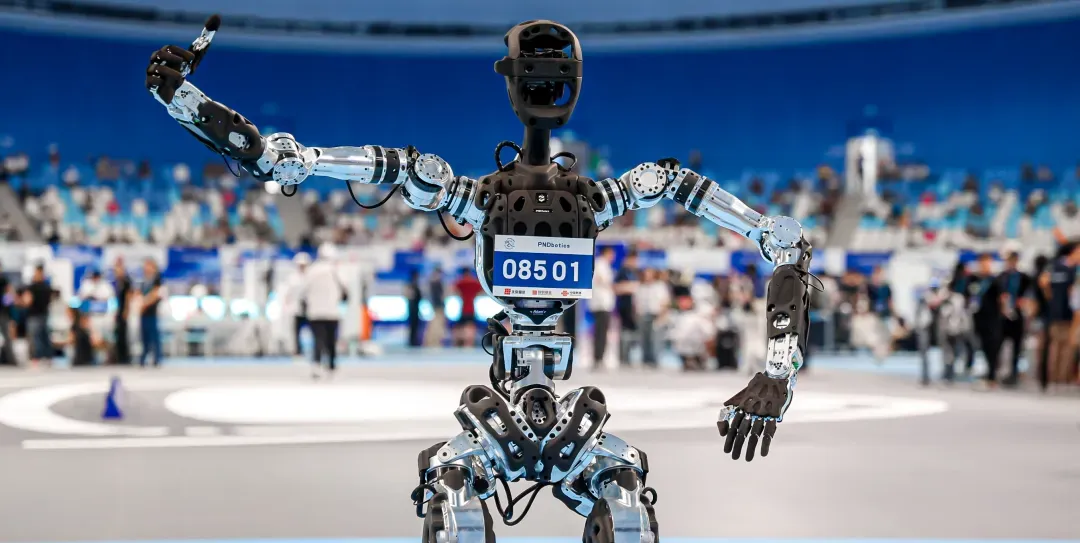
PNDbotics' Adam humanoid robot scored 31.050 points to win the martial arts division at the 2025 World Humanoid Robot Games, executing tai chi movements with precision that showcased China's advances in motion control technology. The victory marks a milestone for the Ningbo-based company, which has sold its robots to leading institutions including ETH Zurich, Germany's DLR aerospace agency, and U.S. embodied AI unicorn Skild AI.
The success reflects a strategic bet by Ningbo High-Tech Zone, which led the investment round to establish the city as a manufacturing hub for humanoid robotics. "We are supporting the company in building a more modern factory," said a representative from Ningbo High-Tech Zone. "This is not just about expanding production lines, but creating a benchmark for intelligent manufacturing that integrates R&D, precision manufacturing, and ecosystem adaptation."
The deal underscores how second-tier Chinese cities are positioning themselves in the humanoid robot supply chain, leveraging existing manufacturing capabilities to capture value in an industry where global shipments are projected to reach commercial scale within three years.
A Decade Before the Boom
PNDbotics' trajectory began long before humanoid robots became a Silicon Valley obsession. Co-founders Yan Xunge and Cui Haotian started developing robotic actuator technology in 2011, when Tesla's Optimus was still a decade away and Boston Dynamics' Atlas had yet to debut.
The team founded INNFOS in 2015, becoming among the first globally to invent and define Smart Composite Actuators (SCA)—highly integrated units combining motors, reducers, drivers, and encoders into compact packages. By the time they launched PNDbotics in September 2023, they had accumulated 15 years of experience in precision encoders, high-accuracy reducers, and servo motors.
"Hardware must come first," said Cui. "Before you have a physical platform, it's difficult to develop true intelligence." That philosophy led PNDbotics to pursue full-stack development rather than assembling off-the-shelf components—a slower path that delayed commercialization but created deeper technical moats.
The timing proved prescient. PNDbotics launched just as OpenAI's GPT-4 sparked renewed interest in embodied AI, and as Tesla's progress with Optimus convinced investors that humanoid robots represented a market potentially larger than automotive.
Technical Architecture Built for Durability
Adam stands 1.67 meters tall, weighs 62 kilograms, and features 43 degrees of freedom with peak joint torque reaching 340 N·m. Its distinctive feature is a biomimetic three-degree-of-freedom hip design—the first of its kind globally in a full-size humanoid robot.
The hip joint connects the torso to the lower limbs, directly affecting balance and movement efficiency. PNDbotics' design incorporates quasi-direct drive compliant force-control joints, enabling complex movements including deep squats, lateral shifts, and rotations with human-like fluidity.
"You can feel our humanoid robot is more human-like, from its high degrees of freedom to its highly biomimetic structure, including the extremely compact three-degree-of-freedom waist design," said Cui. "This is exceptionally difficult to achieve."
The company's PSA series integrated actuators cover torque ranges from 60 N·m to 340 N·m, with highly integrated designs combining motors, reducers, encoders, servo drivers, and communication units. "The metrics that matter for collaborative robots are completely opposite to humanoid robots," Cui explained. "Humanoid robots prioritize impact resistance."
Adam's motion control system fuses Whole Body Control (WBC) with Model Predictive Control (MPC), enhanced by deep reinforcement learning. WBC coordinates all joints for optimal overall movement strategy, while MPC predicts future states to enable preemptive adjustments. Reinforcement learning allows continuous optimization through trial and error.
"Movement intelligence can only be achieved through physical testing," Cui emphasized. "Large language models cannot access the physical layer—they need reinforcement learning to adjust through trial and error."
The robot's proprietary PND-Network real-time communication protocol ensures high-speed, reliable synchronization across dozens of joints while supporting expansion with lidar, vision cameras, and other multimodal sensors.
International Validation
PNDbotics' technical credibility extends beyond domestic competitions. Adam series robots have been sold to customers across the United States, Europe, Japan, and South Korea, including U.S. frontier technology companies RoboForce and Applied Intuition, ETH Zurich, Germany's DLR, and Hong Kong logistics firm NEXX.
Skild AI, a leading U.S. embodied intelligence unicorn founded by Carnegie Mellon University professors and staffed by veterans from OpenAI, Google Brain, and Meta FAIR, selected Adam as its standard platform for foundation model training. The endorsement validates that Adam meets international benchmarks for hardware performance, software interfaces, and scalability.
Swiss robotics software company Flexion Robotics deployed Adam-U for data collection and model iteration. Adam-U is PNDbotics' platform specifically designed to address the industry-wide shortage of high-quality training data for embodied AI systems.
"We dare to sell overseas because we have sufficient confidence in our after-sales support, technology, and quality control," said Yan. "Early PNDbotics customers were almost entirely overseas, and products had virtually no returns. This stems from Adam's highly modular design." Such reliability is rare in humanoid robotics, where system complexity makes any component failure potentially catastrophic.
Ningbo's Industrial Bet
Ningbo High-Tech Zone's investment in PNDbotics represents more than capital allocation—it signals the city's strategic positioning in China's humanoid robot supply chain.
Ningbo, a major port city in the Yangtze River Delta, has built its economy on manufacturing prowess, hosting China's densest mold industry clusters, world-class automotive component production bases, and complete supply chains spanning precision machining to electronics manufacturing. The city now faces pressure to transition from manufacturing scale to intelligent manufacturing leadership.
In 2025, Ningbo accelerated its humanoid robot ecosystem development: establishing an AI bureau in January, releasing a three-year humanoid robot innovation action plan in June, and landing policies in July offering up to 100 million yuan for national-level innovation centers and 40 million yuan for industrialization projects.
By year-end, Ningbo's high-tech enterprises exceeded 10,000, with high-tech industrial output reaching 337.89 billion yuan ($47 billion), up 6.3% year-over-year. The city's "complete-component collaboration" model shows particular promise: among nearly 300 suppliers collaborating with Zhejiang Humanoid Robot Innovation Center, 88 are Ningbo-based, achieving nearly 40% local component sourcing.
Zhongda Leader Intelligent Transmission supplies planetary, harmonic, and RV reducers for power conversion. Ningbo Huaxiang applies precision machining experience from automotive clients to robot joint modules. Hansheng Transmission, Sunny Optical, Zhenyu Technology, and Keli Sensing provide servo motors, vision sensors, precision molds, and force sensors.
In September, Punsmart Future, jointly established by Jun-Pu AI Research Institute and Shanghai Zhiyuan Robotics, announced plans for an initial batch of 200 embodied intelligence robots, with capacity expanding to 2,000 units in 2026.
PNDbotics' planned production base in Ningbo High-Tech Zone, which began construction in May 2025, marks the company's transition from pilot production to scaled manufacturing. "Humanoid robots have never been mass-produced, so how can we claim the supply chain is mature?" Cui said, highlighting industry pain points. Ningbo's manufacturing ecosystem provides the optimal environment for building that supply chain from scratch.
The Long Game
China's humanoid robot industry in 2025 was characterized by intense competition—demo battles, parameter races, and marketing campaigns creating an atmosphere of collective anxiety about falling behind or missing opportunities.
PNDbotics' approach stands apart. "Current competition isn't real competition, it's chaotic brawling," the team said. "True competition isn't about whose parameters are higher, whose funding is larger, or whose exposure is greater—it's about who can truly solidify product technology and smoothly transition to large-scale production and application."
For 2026, Yan's priority is straightforward: achieving higher-quality delivery. The 15-year journey from founding team formation in 2011 through INNFOS' establishment in 2013 to today's PNDbotics demonstrates a commitment to building from first principles—starting with motors and drivers rather than taking shortcuts through component integration.
"We have a somewhat grander ideal," said the founders, perhaps the best summary of the team's ethos. In an industry prone to hype cycles and short-term thinking, PNDbotics represents a counternarrative: that enduring competitive advantage in humanoid robotics will accrue to companies that master core technologies, build reliable products, and cultivate deep manufacturing capabilities.
The company's global customer base, near-zero return rates, and championship performance validate that patient capital and technical depth can coexist with commercial success. As Ningbo positions itself as a "Ningbo Intelligent Manufacturing" hub for global humanoid robotics, PNDbotics serves as proof that China's robotics ambitions extend beyond assembly and integration to fundamental innovation in the technologies that make machines move like humans.