
Pony.ai CEO Reflects on Decade-Long Journey as Robotaxi Industry Enters Commercial Acceleration Phase
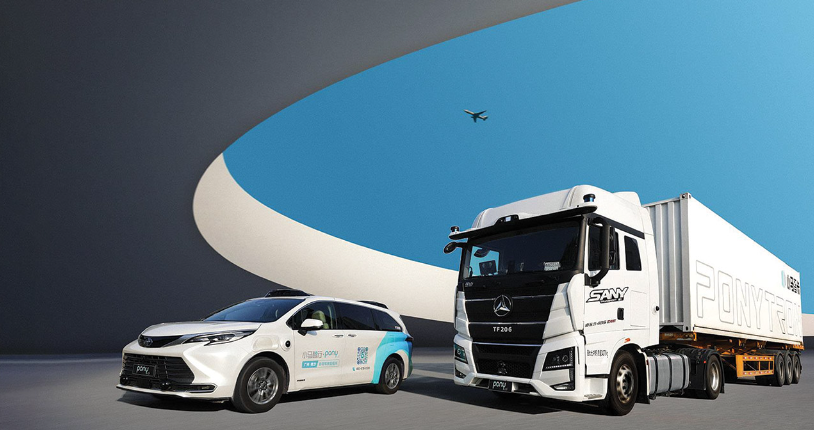
Chinese autonomous driving company Pony.ai Inc. has reached a pivotal milestone in its decade-long journey toward commercializing robotaxis.
On November 6, the company completed its Hong Kong Stock Exchange listing, achieving dual primary listings in both the U.S. and Hong Kong—in less one year after its Nasdaq IPO in November 2024.
This comes as the robotaxi sector prepares for what industry watchers describe as a critical expansion phase, with HSBC forecasting that China's robotaxi fleet could grow tenfold between the second half of 2025 and 2026.
In an exclusive interview with ChinaBiz Insider on the day of its Hong Kong listing, Pony.ai's founder and CEO Peng Jun, along with co-founder and CFO Wang Haojun, discussed the company's evolution from a Silicon Valley startup to a dual-listed autonomous driving company, their strategy for scaling operations, and their vision for the next decade.
The conversation revealed insights into how the company navigated a decade of technological challenges, maintained investor confidence during funding winters, and positioned itself as what they describe as an "AI driver" in the emerging mobility ecosystem.
The 10-Year Journey
The Hong Kong listing is Pony.ai's second public offering. In November 2024, the company debuted on Nasdaq, completing its first capital market appearance. Less than one year later, it returned to Hong Kong to complete its "U.S. and Hong Kong" dual listing.
Looking back 10 years to an era when autonomous driving remained largely unfamiliar to the general public, how did Pony.ai win investor confidence? What challenges did the company face after germinating in Silicon Valley and returning to China?
CEO Peng Jun and CFO Wang Haojun recalled the details of that period.
ChinaBiz Insider: Compared to last year's U.S. listing, how do you feel differently about this Hong Kong listing?
Peng Jun: Last year was our first listing, which brought more of a sense of novelty. This year, because Hong Kong is closer to the Chinese mainland, it feels more like accomplishing something back home—though both occasions brought the same excitement.
Of course, the journey has been incredibly challenging, with many ups and downs and uncertainties, but the results have been positive.
ChinaBiz Insider: Do you still remember how you wrote your business plan when trying to raise fund from Sequoia China 10 years ago?
Peng Jun: We didn't have a business plan back then. We didn't even know what a business plan was. It was more about chatting with investors, and they thought we were reliable, so they invested in us. Angel investment is primarily about investing in people.
However, by 2017, when 5Y Capital came in, we did prepare a business plan.
I've always been relatively conservative and not aggressive. I wouldn't say we'd achieve something in three to five years. We had a full understanding of the difficulty of autonomous driving.
ChinaBiz Insider: Did you ever think that this venture might not be profitable even after 10 years, yet you'd continue investing?
Peng Jun: Because autonomous driving was only a concept back then, and there were no corresponding laws and regulations, people had absolutely no idea of this.
Many people said there would be unmanned vehicles everywhere by 2020, and we all knew that was impossible. In fact, I think the current pace of legal and regulatory advancement is faster than I initially envisioned.
ChinaBiz Insider: So you didn't know what the commercialization endgame would look like?
Peng Jun: I knew what the commercialization endgame was, but I didn't know the path. I could definitely see the mountain top. The goal was actually very clear—autonomous driving has social, commercial, and safety value, and it brings convenience to people's travel. I knew all that.
That's why I've always told my team that we persist because we know this goal is valuable. We just don't know the path—I really don't know how long it will take to achieve or what the specific direction is.
ChinaBiz Insider: Do you remember early investors' experiences regarding test-riding robotaxis?
Wang Haojun: Something very interesting actually happened. In June or July 2017, when our cars had just started running, 5Y Capital's team happened to come to Silicon Valley for a team-building activity, and they organized a visit to test-ride our Robotaxi.
At that time, we only had one fixed route and very few cars available for demonstration, but they brought over a dozen people, so the entire test-ride process had to be divided into several rounds, with some people waiting by the roadside and others sitting in the car.
During this process, one young man was very brave—just as the car was approaching the stop, he suddenly ran in front of the vehicle, and our car braked in time.
That young man actually just wanted to verify whether the car was fully autonomous.
After this incident, when I returned to the office, I felt we should immediately show investors the data from our car's operation to demonstrate our actual performance, so we quickly transmitted the data to them on the spot.
Because of this, 5Y Capital led that funding round.
Later, people from 5Y Capital told us they had never seen a company that could immediately provide investors with actual road condition data. This showed we could iterate on technology very quickly, and our workflow was highly efficient.
ChinaBiz Insider: Were you ever tempted to pursue other directions, such as robotics?
Peng Jun: Temptations have always existed, but the ultimate thinking is that this has enormous economic and social value, so it's definitely worth doing.
I think my greatest contribution to Pony.ai has been finding the direction forward on this long-term journey. This is also a modest contribution to the industry.
Especially setting a goal each year that is challenging yet achievable—this kind of foresight is not easy. Looking back now, I don't know how we somehow felt that this direction was the right one to pursue. Fortunately, the results have been good.
ChinaBiz Insider: During this process, have you and fellow founder Lou Tiancheng ever had disagreements?
Peng Jun: Never. We all have an engineering mindset.
ChinaBiz Insider: Did you ever waver between the L2 and L4 technology paths? For example, whether to do L2 first and then L4?
Peng Jun: No. We recognized very early that L2 and L4 are two different things. Of course, we might pursue one for commercialization purposes.
ChinaBiz Insider: When the company moved from Silicon Valley to China, was there any cultural adaptation challenge?
Wang Haojun: There actually was. We were established in the U.S. first, but soon after, we also had an office in China.
The first problem we encountered when landing in Guangzhou was rainy weather. California doesn't have that much rain, but Guangzhou rains frequently.
So in 2017 and 2018, when we landed in Guangzhou to test our Robotaxi, we spent great effort updating our AI models to improve our ability to handle rainy conditions.
Moreover, we used the same code and models to test in Beijing and other places. This also enhanced our AI capabilities to cover different scenarios.
Expecting Profitability in 2028 or 2029
Pony.ai is now entering a new phase of 1-to-100, with scaled operations becoming the new challenge ahead.
According to conversations with Pony.ai's management team, the company currently focuses deeply on first-tier cities including Beijing, Shanghai, Guangzhou, and Shenzhen. It expects to deploy 50,000 Robotaxis thereafter, making the company profitable in 2028 or 2029.
ChinaBiz Insider: How many Robotaxis does the company think the fleet needs to reach before it can be called "large-scale operations"?
Wang Haojun: First, from an absolute quantity perspective, several hundreds to 1,000 is the minimum. Second, in terms of density, from end-users’ perspective, if people can frequently see cars running in their living areas, this actually gives everyone confidence and expectation that when they want to hail the car, it will be available.
ChinaBiz Insider: How did the company obtain L4 licenses in first-tier cities?
Wang Haojun: It takes a comprehensive evaluation process.
First, we need to accumulate considerable mileage locally for the vehicle's safety to be verified.
Second, we need to go through a process of providing free services to local residents, attracting the public to use Robotaxis. In the process, the government can see the actual operational results and hear passenger feedback during this process.
If all these requirements can be met, local authorities will grant commercial operation licenses to companies.
Overall, local government’s attitude toward Robotaxis all starts with small-scale pilot programs.
ChinaBiz Insider: Why do you choose to start with first-tier cities?
Wang Haojun: From the overall mobility market perspective, first-tier cities are definitely the largest market, with the most potential and highest returns.
So we hope to accumulate actual mileage in first-tier cities to demonstrate our safety, and through the demonstration effect in first-tier cities to show public acceptance of us. This is also our 0-to-1 accumulation process over these years.
For every company wanting to develop Robotaxis, they must go through this 0-to-1 process, which is also legally mandated.
After passing this stage, if the subsequent 1-to-100 can gradually develop positively, then overall it should be an acceleration phase.
ChinaBiz Insider: Will the company expand to second and third-tier cities in the future?
Wang Haojun: Yes. We are currently building up our operation models in first-tier cities. If we can do well, then future expansion to second and third-tier cities will proceed more smoothly.
ChinaBiz Insider: The public is very concerned about safety. Can you explain what advantages you have compared to regular taxis?
Wang Haojun: The regulatory requirements for L4 are actually very strict, completely different from L2.
For an L4 company to obtain a license in a city, the first step is to conduct on-road testing with safety officers in closed venues to obtain data on actual vehicle operating speed, emergency braking, and other aspects. Only after evaluation through actual data and accumulating to a certain mileage can they obtain commercial operation qualifications.
So from China's regulatory perspective, if a company is allowed commercial demonstration operations, safety-wise it is basically at the same level as regular taxi drivers. Pony.ai also achieved demonstration operations in a region after meeting safety requirements.
The insurance premiums charged on our robotaxis also indicate to strong performance in terms of safety . Our premiums are actually a few thousand yuan (approximately US$400-600), lower than automobiles operated by human drivers.
ChinaBiz Insider: What is your fleet expansion plan for the next 2-3 years?
Wang Haojun: This is mainly considered from four aspects:
First is vehicle production capacity;
Second, after large-scale operations, whether we can technically control accident rates and user experience. Because after more vehicles, users will have higher requirements for experience, such as which stops can pick up passengers and whether they can hail a car within a shorter distance;
Third is regulation—how many licenses will be opened next;
Fourth is operational efficiency. For example, if a passenger suddenly feels unwell and requests to get off quickly or seek help, this will be a new challenge for Robotaxis, testing our response speed.
So we must manage each aspect well before we can push forward commercialization.
This is a challenge for any company. If a company can manage this well, this becomes its moat—complexity itself becomes a moat.
So if you ask me about our future fleet size, we still hope to have a trend of multiple-fold growth each year.
ChinaBiz Insider: When can the company achieve profitability?
Peng Jun: According to our current projections, having 50,000 robotaxis on the road should make the company profitable, probably around 2028 or 2029.
ChinaBiz Insider: But Pony.ai currently only operates in 4 cities. To have 50,000 robotaxis, how many more cities do you expect to expand into?
Peng Jun: Not like that. We believe a first-tier city needs at least 200,000-300,000 vehicles.
We will combine breadth and depth. Mobility needs density. A scattered approach has no commercial value, and user experience is poor.
So now everyone talking about how many markets they have is actually quite laughable—it's meaningless.
We will continue to focus relatively on Beijing, Shanghai, Guangzhou, and Shenzhen until 2028 and 2029, though second-tier and international cities are also possible.
Positioning: AI Driver?
The year 2026 is viewed as a critical year for large-scale commercialization of Robotaxis. Because of this, more players including OEMs and platforms are joining the battle, and Pony.ai faces intensifying competition.
Whether to be a pure technology provider or a platform in the future relates to market valuation of Pony.ai.
On this core question, Pony.ai management's answer is: AI driver.
ChinaBiz Insider: Why does everyone say 2026 will become the starting point for large-scale commercialization of the Robotaxi industry?
Wang Haojun: If single-vehicle gross margins can turn positive next year, it marks that as we deploy more vehicles going forward, we and our partners will become more confident. Everyone will realize this can be profitable.
You can also see that at this time point, more companies are saying they're willing to get into the Robotaxis business because they also see this opportunity.
Going forward, it's about seeing public and various parties' acceptance of the daily use of Robotaxi.
Overall, everyone hopes Robotaxis can bring forward a completely new riding experience. It's not replacing today's ride-hailing drivers but providing a completely new AI experience, including privacy, stability, etc.
In fact, we've also found that Robotaxis catalyze new use scenarios. For example, some passengers specifically choose Robotaxis at noon to rest and sleep in the car.
ChinaBiz Insider: Why do you insist on developing L4 technology?
Wang Haojun: First, from AI's evolution and future potential, we believe technology can definitely achieve L4;
Second, from the entire commercial implementation model perspective, L4 provides complete driving capability, so the business model becomes simple.
Because L2 is still intelligent driving assistance. So-called intelligent driving assistance helps human drivers achieve liberation in some functions.
But this degree of liberation varies from person to person. Some think it's 10%, some think it's 50%, so different people's preferences for intelligent driving assistance are different, causing controversy about the value of technology implementation.
But L4 is different. We completely liberate drivers from driving. We can use local driver costs as a pricing benchmark.
These years' experience has further verified our thinking: if the technology path is L2 and L4, you'll eventually discover these are actually two directions.
For example, people used to think Tesla's Robotaxi FSD (Full Self-Driving) was upgraded from the Model series, but from this week's media reports, we can see Musk himself admitted that Tesla's FSD actually has 2 versions—one is the Model series FSD, one is Robotaxi FSD.
So this further verifies that if you want to do both Robotaxis and L2 simultaneously, you'll gradually evolve toward two technical directions due to different safety requirements. (Note: Tesla's Model series vehicles are equipped with supervised FSD, while Robotaxis have complete FSD)
ChinaBiz Insider: So you think Xpeng Motors' Robotaxi effort will also follow two paths? (Note: Xpeng recently announced it will officially launch three Robotaxi models in 2026)
Wang Haojun: I think at least Musk has already stated today that L4 and L2 ultimately develop toward two technical directions, and the two will increasingly separate.
Of course, we very much welcome Xpeng and more companies to do Robotaxis. I believe first, everyone recognizes this and its commercialization potential.
Second, as more companies join, it means the entire supply chain will mature over time, which is also good for us.
Third, we highly recognize Xpeng Motors' capabilities in intelligent driving, but they may also realize later that these are actually two different technology sets requiring R&D.
Of course, each company will eventually have its own technology path.
ChinaBiz Insider: If L4 level autonomous driving are widely adopted in the future, won't there eventually be no distinction between passenger cars and commercial vehicles?
Wang Haojun: No, I believe it will definitely be a hybrid model for a long time in the future.
Just like looking at the private car market today, many people don't drive every day, but they definitely want to own their own car. So the transportation market is too large, with different needs. Some people enjoy driving as fun, some view it as a boring process.
I believe in the future many people will gradually realize that using AI to help them drive so they can do their own things will become a mobility choice. But at the same time, some people will want to drive themselves. This will always be a hybrid model.
ChinaBiz Insider: How do you position Pony.ai in the future? Is it purely a technology provider or a platform? Will you become the next "Didi"?
Wang Haojun: The industry mainly has the following types of participants: customer acquisition, including platforms like Didi. After acquiring customers, drivers need to transport passengers from point A to point B—this is the driver's work. There are also OEMs, vehicle maintenance providers, etc.
From the entire business model perspective, drivers actually account for 50% of the entire value chain, so our revenue is actually the value of the driver's work.
Therefore, we're not trying to replace platforms like Didi. For example, we've already integrated with AutoNavi. You can see AutoNavi uses mixed dispatching, and we're actually drivers integrated into AutoNavi. If our orders come from the AutoNavi platform, we pay them corresponding service fees.
We're equivalent to AI drivers, using local driver costs as the anchor for our pricing.
So for investors evaluating Pony.ai, the future Robotaxi commercialization logic is actually very simple—fleet size corresponds to revenue.
We're actually creating a model in first-tier cities now, demonstrating to industry participants what scaled operations of a Robotaxi company should look like.
This is why positive single-vehicle gross margins are so important. Because only after you create a successful model and tell your partners that doing this can achieve positive gross margins will everyone be willing to do it.
Peng Jun: Whether Pony.ai is an operator, service provider, or technology provider in the future doesn't really matter. Mobility is just four things: customer acquisition, driver driving, vehicles, and vehicle maintenance.
Pony.ai's core is AI drivers. I can do anything related to driving. So what I do doesn't really matter, as long as I have the most drivers in the world. I don't need to be the largest platform or largest automaker.
ChinaBiz Insider: Can I define "drivers" here as technology solution providers?
Peng Jun: Not necessarily. To make drivers perform well, I might also acquire customers myself. This is all designed around drivers.
I should put it this way: my goal is simple—getting more drivers out there. Any approach can be explored.
ChinaBiz Insider: Following this logic, Pony.ai has many competitors?
Peng Jun: No, they're all my partners.
Just like AutoNavi and Didi now have many cars available for hailing, we're just one option.
Targeting Globalization
Besides the domestic market, Pony.ai is also deploying Robotaxis overseas. The main approach is partnering with platforms like Uber to integrate into local ecosystems.
From Pony.ai's overseas market practice, the Middle East region currently has a more positive attitude toward autonomous driving, with commercialization potential.
ChinaBiz Insider: Why pursue globalization?
Wang Haojun: From our inception, we firmly believed in Autonomous Mobility Everywhere. So we're convinced that as a highly capable L4 technology company, our technology can empower various types of vehicles.
This means we should be a global company, not a single-market company. And through our development over these years, we've found we have the ability to control costs.
Therefore, we believe if many countries are willing to open up in the future, it can definitely bring us significant profit margins.
But this industry is still very closely related to laws and regulations. Currently, we can see China and the U.S. are most advanced, following a process from small-scale pilots to now several hundred vehicles in scale.
So we believe if overseas markets want to open Robotaxis, companies definitely need to accumulate local road conditions and other data locally to be trusted by local authorities.
So we're also deploying early in overseas markets, accumulating mileage to demonstrate we're safe, preparing for future commercialization.
To be honest, we can't judge which countries will definitely be fast and which will be slow. We're currently doing some broad deployment work. But fortunately, with our current capabilities, we can do small-scale implementation work overseas and run actual mileage locally with relatively small investment.
In this process, we've also met good local operating companies to help us do this. In the future, we'll be exporters of AI driver technology.
ChinaBiz Insider: We notice companies like Pony.ai are deploying in the Middle East market. Why is everyone so interested in this region?
Wang Haojun: This is still related to the local regulatory environment.
From a global perspective, besides China and the U.S., the region currently most ambitious about promoting L4 Robotaxis is the Middle East. They're very clear about wanting to develop high technology, giving everyone clear expectations.
Because if you're going to invest today, you still hope that by a certain time point, commercial licenses can be issued to generate returns.
The Middle East's development of L4 Robotaxis has top-down momentum with a clear timeline, so everyone participates actively. Moreover, the Middle East isn't only promoting local companies, so they have more motivation to introduce companies to fully develop this market, which is also better for them.
ChinaBiz Insider: Is your partner Uber essentially helping you acquire orders in overseas markets?
Wang Haojun: Yes, because Uber has already integrated into many countries, so users can hail rides on the Uber platform, equivalent to having an additional AI driver choice.
ChinaBiz Insider: Won't you worry about platforms like Uber driving down your prices in the future?
Wang Haojun: This is an evolving process. Many companies' vehicles are now on ride-hailing platforms. Compared to this, Robotaxis globally are still very few, so we're not worried.
The Next Decade
ChinaBiz Insider: Have you thought about what the fleet size of Pony.ai will be by 2035?
Peng Jun: I never think about this question. I think what makes autonomous driving great is that the ceiling is high enough. I just need to keep getting closer. As for the short term, like our market share, etc., that's not important.
ChinaBiz Insider: What do you think Pony.ai most needs to strengthen now?
Peng Jun: Now it's really about scaling up.
The most important thing in the previous phase was fundraising. Now that fundraising is complete, it's about developing business. For example, now I need to discuss with my team improving operational capabilities, customer acquisition capabilities, and user experience.
In developing the business, supply chain is very important because vehicles have thousands of components. I can't manufacture without any single component. These things can't be accomplished just by talking.
ChinaBiz Insider: For the next 10 years, can you set a goal?
Peng Jun: Our goal is to make autonomous driving an important mobility choice for many people.