
Pop Mart Moves to Build Appliances In-House, Betting IP Alone Can No Longer Sustain Growth
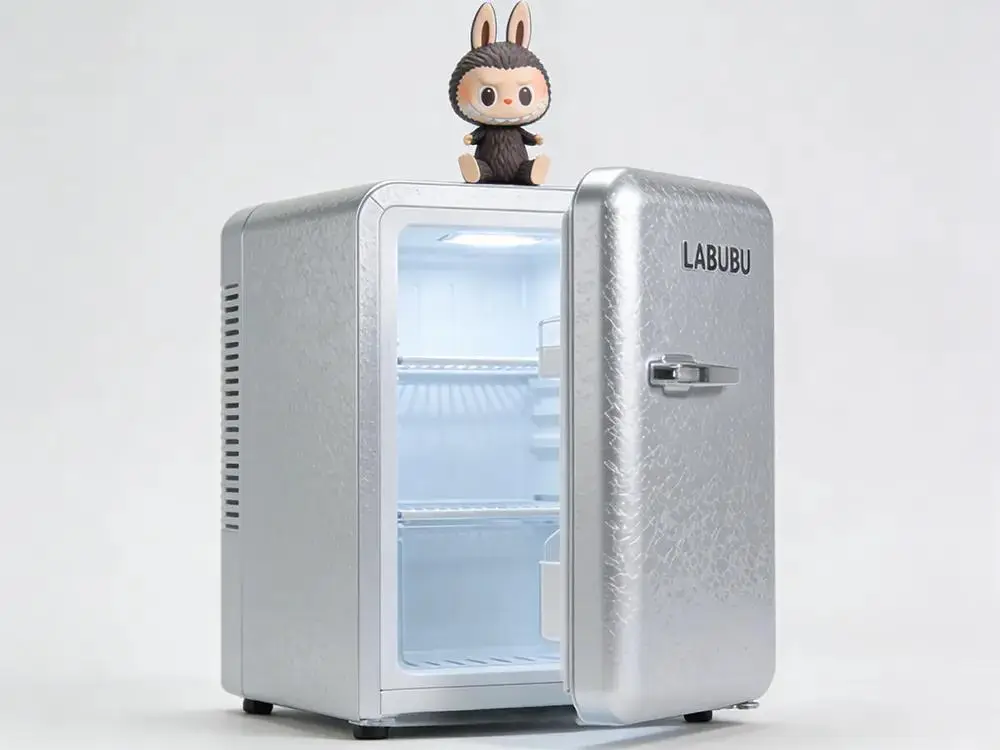
Pop Mart, the Beijing-based designer toy company that turned LABUBU into a global phenomenon, is quietly assembling an in-house small-appliance team — a structural shift that reveals how dependent the blind-box model has become on finding a second growth engine.
Job postings surfaced across multiple Chinese recruitment platforms in early July 2026 show Pop Mart hiring for small-appliance R&D engineers, procurement supervisors, and quality assurance specialists. Critically, at least one listing is flagged internally as an "A+ major investment project" — corporate shorthand in China's tech-consumer sector for a fully resourced, board-level priority initiative. The company has not issued an official statement confirming a formal market entry, but the breadth of the hiring matrix — spanning design, supply chain, and quality control — leaves little ambiguity about intent.
The move comes roughly ten weeks after Pop Mart's first foray into hardware generated spectacular optics but modest economics. On April 30, 2026, the company launched THE MONSTERS Living Series LABUBU refrigerators — two colorway variants, each limited to 999 units, priced at RMB 5,999 (US$833) per unit. Pre-orders across platforms exceeded 28,000 registrations on JD.com alone; both variants sold out in 37 seconds. On secondary marketplace Xianyu, resale prices briefly spiked to RMB 19,999 — a 233% premium — before collapsing to RMB 6,000–8,988 within 24 hours. Total official revenue from the launch: approximately RMB 12 million (US$1.67 million), a figure Pop Mart COO Si De publicly characterized on the Q1 earnings call as "an extremely, extremely small share of revenue."
Blind-Box Ceiling Forces Pop Mart to Diversify Its Revenue Architecture
The appliance push is not opportunistic — it is structurally inevitable. Pop Mart's core blind-box mechanic, which drove explosive growth through IP characters including MOLLY, DIMOO, and Labubu, operates on a scarcity-and-novelty loop: hidden variants, limited editions, and secondary market premiums sustain consumer urgency. The model works until it doesn't. IP fatigue is a documented risk in the category; Sanrio, the Japanese IP conglomerate behind Hello Kitty, saw domestic Japanese revenue decline from JPY 102.5 billion to JPY 73.8 billion between 1992 and 2010 — a compound annual contraction of 2.03% over 16 years — before pivoting aggressively to an asset-light licensing model that now generates roughly 70% of its operating profit.
Pop Mart's strategic calculus mirrors the Disney playbook more than Sanrio's: rather than licensing IP outward and collecting royalties, it is attempting to own the manufacturing and retail layer across multiple consumer touchpoints — apparel, cosmetics, fragrance, furniture, hotel experiences, and now appliances. The logic is reinforced by a behavioral insight: a blind-box figure sits in a display case; a coffee maker or humidifier bearing LABUBU's likeness sits on a kitchen counter, generating daily brand impressions that no amount of collectible SKUs can replicate.
On Chinese lifestyle platform Xiaohongshu, search terms such as "aesthetic appliances," "healing-style home electronics," and "desk setup essentials" consistently trend among the 18–30 demographic — precisely the cohort that built Pop Mart's RMB 13.04 billion (US$1.81 billion) revenue base in fiscal year 2024. The convergence of emotional purchasing behavior and functional product categories is the gap Pop Mart is moving to occupy.
LABUBU Refrigerator Controversy Exposes the Functional-Emotional Tension Pop Mart Must Resolve
The April launch also generated a cautionary data point that Pop Mart's product teams cannot ignore. Consumer feedback on the LABUBU refrigerator was sharply polarized. The unit's specifications — 121-liter total capacity (106L refrigeration, 15L freezer), Grade-1 energy efficiency, 0.38 kWh daily consumption, 33 dB(A) noise output — were manufactured by Xinbao Shares under an OEM arrangement and described by critics as unremarkable for the price point. The warranty terms compounded the controversy: Pop Mart offered only a seven-day no-questions-return window with no stated commitment on compressor or full-unit warranty coverage — standard protections that Chinese consumers expect on appliances costing RMB 1,000 (US$139) or more, let alone RMB 5,999.
The resale price collapse from RMB 19,999 to RMB 6,000 within a single trading session is analytically significant. It demonstrates that speculative demand for IP-branded hardware evaporates faster than for collectible figures, because appliances carry an implicit functional benchmark that blind boxes do not. A blind box priced at RMB 99 can sustain a 10x secondary market premium purely on scarcity; a refrigerator at 3x its functional equivalent cannot, because buyers eventually price in utility.
Si De's framing on the earnings call — explicitly rejecting the label of "entering the traditional appliance industry" in favor of "combining small appliances with lifestyle and IP pop-toy culture" — signals that Pop Mart understands this distinction. The company is not attempting to compete with Midea or Haier on compressor efficiency or energy ratings. It is building a parallel category where the product's aesthetic and IP identity justify a premium that functional specs alone would not support.
Competitive Landscape Reveals Three Distinct IP-to-Appliance Models
Pop Mart's in-house manufacturing push differentiates it from both peers and predecessors in the IP-lifestyle space.
Sanrio built its empire through self-owned manufacturing before retreating to pure licensing — a lesson in the capital intensity of vertical integration that Pop Mart appears willing to revisit, at least at the small-appliance scale.
Miniso, which held approximately 180 licensed international IPs and 16 proprietary IPs as of 2025, operates as a distribution and co-branding platform rather than an IP originator. Its licensed products — spanning Disney, Sanrio, Pokémon, and Chiikawa — lack exclusivity by design; the same IP appears across competing retail formats including KKV and Mumuso. Miniso has never entered appliance manufacturing; its IP activations remain at the co-branding surface layer.
BE@RBRICK, the Medicom Toy franchise, has collaborated with more than 150 global brands since 2001 — including Porsche, Snow Peak, Leica, and All Nippon Airways — but its product extensions, including Snow Peak camping gear and Ballon ceramic diffusers, function primarily as collectibles with incidental utility. BE@RBRICK remains a prestige signifier; Pop Mart is explicitly targeting daily functional use.
The distinction matters for revenue modeling. Licensing generates high-margin, low-capital returns but caps brand depth. OEM co-branding generates short-cycle buzz but no proprietary manufacturing capability. In-house production carries execution risk and upfront capital expenditure — the "A+ investment" designation in Pop Mart's job listings is consistent with a multi-hundred-million-renminbi budget allocation — but it creates a defensible product layer that licensing cannot replicate.
Investment Implication: Watch for Margin Compression Before Category Validation
For investors tracking Pop Mart's Hong Kong-listed shares (9992.HK), the appliance initiative presents a near-term margin headwind before any revenue contribution materializes. Building an R&D and supply chain function from scratch in a category where incumbents like Midea and Haier operate at scale efficiencies will compress operating margins during the ramp phase. Si De's own characterization of current appliance revenue as negligible sets a low base — but also signals that the company is not yet under pressure to justify the investment on a quarterly timeline.
The more consequential question is whether Pop Mart can solve the warranty and after-sales infrastructure gap that the LABUBU refrigerator launch exposed. Emotional purchasing drives trial; functional reliability drives repeat and brand loyalty. If the in-house product line launches with credible warranty terms and quality control — areas the new "appliance quality specialist" hires are presumably tasked with addressing — the category could evolve from a brand-extension experiment into a genuine revenue diversification lever.
The LABUBU refrigerator's 37-second sellout proved that IP demand exists. The 24-hour price collapse proved that appliance consumers are more rational than blind-box collectors. Pop Mart's next product will need to satisfy both audiences simultaneously.
Related Coverage:
Pop Mart Teases Labubu Mini Fridge as It Pushes Into Home Appliances