
Unitree vs. UBTECH: China’s Humanoid Robot Race Splits in Two
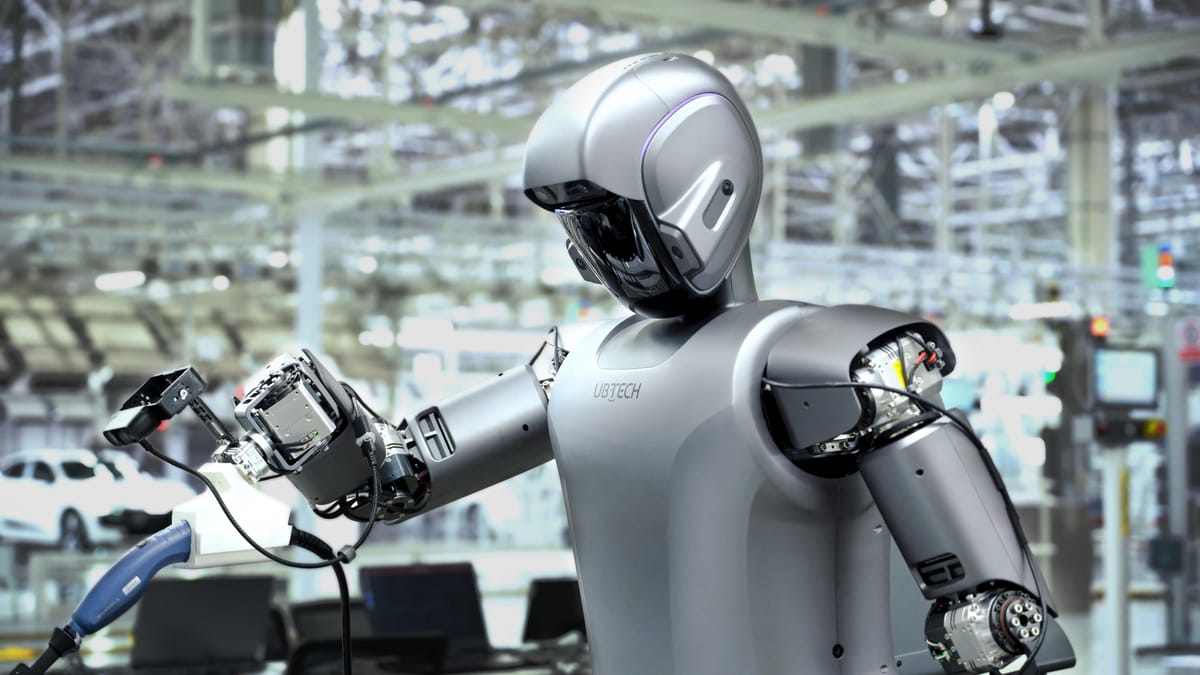
Unitree's IPO windfall and UBTECH's near-photorealistic companion robot define the sharpest strategic fork yet in China's embodied AI industry—one chasing industrial dominance through cost compression, the other targeting a high-net-worth loneliness economy at RMB 990,000 (US$137,500) per unit.
The convergence of two landmark events in early July 2026 has crystallized what analysts had long suspected: China's humanoid robot sector is not racing toward a single finish line. Within days of each other, Unitree Robotics completed a record-speed STAR Market IPO registration raising over RMB 4.2 billion (US$583 million), while UBTECH Robotics unveiled its "U-World U1" ultra-biomimetic consumer series in Shenzhen—a product that drew more than 13,000 pre-orders at prices approaching RMB 1 million (US$138,889) within days. The two events represent not merely competing companies, but competing theories of how embodied AI creates durable economic value.
Market observers noted that neither announcement was accidental in timing. Both companies are racing to establish category ownership before the sector's inevitable consolidation, and both are leveraging China's vertically integrated supply chain as the core competitive weapon—just aimed at radically different targets.
Unitree Executes a Ford-Model Playbook to Crush Global Rivals on Cost
Unitree's commercial logic is built on a supply chain advantage accumulated over years in the quadruped robot market, where the company became a dominant global shipper of four-legged machines before pivoting to bipedal humanoids in 2024–2025. That foundation—spanning proprietary brushless motors, high-torque reducers, miniaturized hydraulic systems, and sensor arrays—allowed Unitree to enter the humanoid segment without rebuilding its bill of materials from scratch.
The result: a G1 humanoid robot with over 30 degrees of freedom, autonomous navigation, and complex grasping capability, priced at approximately US$13,500 (around RMB 99,000). For context, Boston Dynamics' Atlas platform carries estimated development and manufacturing costs of several million dollars per unit, while Tesla's Optimus—despite Elon Musk's stated target of sub-US$20,000 pricing—continues to face delays in mass consumer deployment due to North American supply chain gaps.
Unitree's January 2026 Spring Festival Gala appearance, where a fleet of G1 robots performed synchronized martial arts routines in front of a national television audience of hundreds of millions, functioned as the most cost-effective product demonstration in the company's history. Industry peers watching the performance were reportedly focused less on the choreography and more on what the uniformity of movement implied about manufacturing consistency and unit economics.
The RMB 4.2 billion (US$583 million) raised through the STAR Market listing is being deployed on two fronts: expanding a Yangtze River Delta "super factory" toward industrial-scale annual output of tens of thousands of units, and deepening development of the company's WVLA 2.0 (World-Video-Language-Action) embodied large model, designed to improve generalization in unstructured physical environments. A closed-loop pilot at Tokyo Haneda Airport, where Unitree robots operate 24-hour baggage-handling shifts between conveyor belts and storage racks, represents the company's clearest proof-of-concept for industrial and logistics deployment.
Unitree's full-year 2026 shipment target stands at 20,000 units—a figure that, if achieved, would represent a meaningful step toward the kind of production scale that historically triggers further cost deflation in Chinese hardware categories, from smartphones to solar panels to electric vehicles.
UBTECH Targets the Loneliness Economy With a Near-Million-Yuan Companion Robot
Where Unitree has deliberately avoided anthropomorphic aesthetics, UBTECH has made the opposite bet its entire product thesis. The U-World U1 series, unveiled June 30, 2026, is engineered to overcome the "uncanny valley" effect—the psychological discomfort humans experience when encountering near-human but imperfect replicas—that has constrained humanoid robot adoption for decades.
The engineering specifics are notable. The flagship configuration features a silicone biomimetic skin with visible pore texture and subcutaneous vascular detail replicable under light. Finger surfaces carry individualized fingerprint patterns, and a thermal simulation system delivers a handshake temperature slightly above ambient. Eighty-eight high-precision servo-driven joints produce movement described by observers as approximating human fluidity. Male models stand 183 cm; female models, 168 cm—proportions calibrated to human golden-ratio standards.
The technical differentiation extends beyond materials. U1's multimodal emotional AI model compresses voice-to-lip-sync and facial micro-expression latency to under 20 milliseconds—effectively eliminating the perceptible lag that has historically marked human-robot interaction as mechanical. The perception system identifies 20 categories of micro-expression within one second and detects emotional valence shifts of as little as 10% in vocal tone. The behavioral output is contextual rather than command-driven: a user returning home visibly fatigued triggers a sequence—a glass of warm water, ambient lighting adjustment, a personalized verbal acknowledgment—rather than a query prompt.
The top-configured unit carries a retail price of RMB 990,000 (US$137,500). Critics framed this as an extreme luxury tax. The pre-order data rendered that framing largely moot: 13,000 units reserved within days, with market speculation attributing the buyer base to first-tier city high-net-worth individuals, affluent elderly households, and premium hospitality venues.
The commercial logic UBTECH is exploiting sits at the intersection of two accelerating structural trends in 2026 China: a rapidly aging population and what sociologists are increasingly labeling an "extreme loneliness economy"—a demand for non-judgmental, unconditionally available emotional engagement that neither pets nor human relationships can reliably deliver. For a segment of high-net-worth consumers, the RMB 990,000 price point is not evaluated against a Porsche or a property investment; it is evaluated against the cost and psychological risk of alternatives that carry human unpredictability.
Two Models, One Supply Chain: China's Industrial Base Anchors Both Strategies
The deeper market implication of the Unitree-UBTECH divergence is that China's manufacturing ecosystem has proven capable of simultaneously supporting both extremes of the humanoid robot value spectrum. Unitree's cost architecture is rooted in the Pearl River and Yangtze River Delta hardware supply chains; UBTECH's biomimetic skin technology and emotional AI stack draw on China's materials science research base and large model application layer.
Neither strategy is directly replicable by Western competitors in the near term. Boston Dynamics remains focused on industrial inspection and research applications rather than mass-market deployment. Tesla's Optimus timeline for consumer-scale production remains publicly unspecified. European and Japanese robotics incumbents have not demonstrated comparable cost structures or consumer-facing product roadmaps.
The two experiments now underway in China's humanoid sector will likely produce data—on unit economics, consumer adoption curves, enterprise procurement cycles, and regulatory responses—that shapes global industry strategy for the remainder of the decade. Whether the market ultimately rewards the industrial commoditizer, the emotional luxury provider, or some hybrid that has not yet emerged, the competitive reference point will be set in China.
Related Coverage:
UBTECH’s Scarcity Premium Evaporates as Citi Slashes Target 34% Ahead of Unitree IPO