
Sugon All-Flash Storage Tops IO500, Highlighting China’s Shift to Industry Standard-Setter
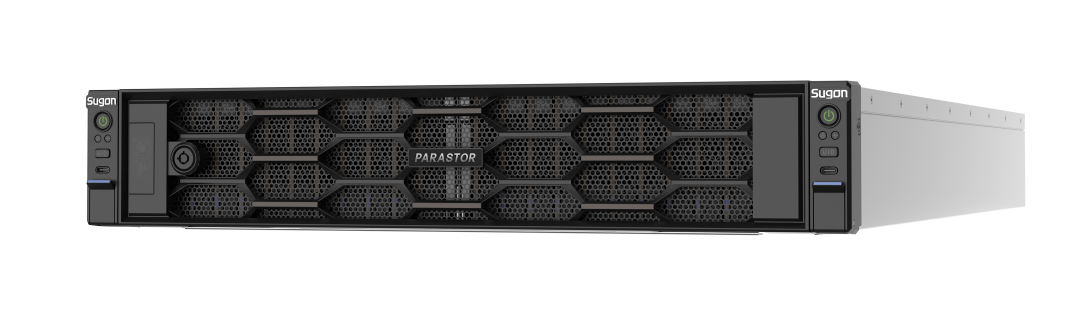
Sugon has claimed the top positions on both the full-node and 10-node IO500 production-tier rankings at ISC 2026, becoming the first Chinese vendor to achieve the double crown on the benchmark widely regarded as the most rigorous real-world performance standard in high-performance storage—displacing incumbents including Intel and DDN that have dominated the list for years.
The results, announced June 24 at ISC 2026, carry weight beyond competitive optics. The IO500 production-tier list bars systems that have not operated under sustained, real-world workloads; qualification requires continuous deployment typically measured in years, not months. Sugon's ParaStor F9000 all-flash storage system had already been running in clusters exceeding tens of thousands of GPU cards for over a year before the benchmark was submitted, supporting more than 100 production AI and high-performance computing applications. That sequencing—production first, benchmark second—represents a structural departure from how Chinese vendors have historically pursued international recognition.
The timing is not incidental. As large-model training enters the petabyte-throughput era, storage has displaced compute silicon as the binding constraint on GPU utilization. Idle GPUs, interrupted training runs, and checkpoint recovery measured in hours increasingly trace back to storage bottlenecks, not chip shortages. Whoever controls storage throughput increasingly controls the effective output of an AI cluster.
Market Share Data Validates What Rankings Confirm
Benchmark victories are verifiable; commercial traction is the harder test. According to IDC data cited by Sugon, the company's AI storage products have held the No. 1 position in China's market for two consecutive years through 2025, with ParaStor F9000 now the default storage selection for large-model training deployments among enterprise clients.
The commercial durability reflects measurable economics. Sugon claims ParaStor F9000's five-tier acceleration architecture—spanning local memory, SSD acceleration, XDS direct-path technology, network acceleration, and high-speed storage nodes—raises cluster training efficiency by 50% and cuts deployment time for hundred-billion-parameter models by 50%. On the inference side, an embedded KV Cache offload engine reduces GPU memory consumption by more than 60%, lifts single-card concurrent inference throughput by 2x to 10x, and lowers overall inference latency by 80%.
In an environment where high-end GPUs remain constrained and expensive, the ability to extract materially more inference capacity from existing hardware directly improves capital return on AI infrastructure—a calculation that procurement teams at Chinese hyperscalers and model developers are running with increasing urgency.
Three Deployments Demonstrate Where Benchmarks Meet Payroll
Sugon has disclosed three production deployments that illustrate the commercial translation of its IO500 performance.
Embodied intelligence: For Zhiyuan Robot, Sugon deployed a ParaStor distributed all-flash solution delivering aggregate read bandwidth exceeding 500 GB/s. Embodied AI model training demands simultaneous ingestion of lidar point clouds, depth imagery, six-axis force data, and joint-angle sequences—workload profiles that punish storage systems with inconsistent latency. Low-latency data access is not an engineering preference in this context; it determines whether a robot's physical response keeps pace with its inference cycle.
Autonomous driving: Sugon has supplied more than 100 petabytes of storage capacity to leading Chinese new-energy vehicle manufacturers, enabling real-time ingestion of terabyte-scale daily road-collection data per test vehicle. An intelligent data-tiering strategy reduced total cost of ownership by 40% while the end-to-end data pipeline—collection, labeling, training, simulation—compressed model development cycles by more than 40%. On a competitive timeline where a one-month acceleration in model iteration can determine whether a feature ships before or after a rival, that compression has direct revenue implications.
AI for Science: ParaStor F9000, integrated with Lonxun Quantum MatPL software on a scaleX ten-thousand-card supercluster, completed a molecular dynamics simulation at 41.47 billion atoms—a world record at that scale. The workload required simultaneous handling of massive small-file I/O, high-concurrency reads and writes, and sub-millisecond access latency, stress-testing precisely the capabilities the IO500 production benchmark is designed to measure.
Four Years of Benchmark Progression Reframe China's Storage Narrative
The IO500 double crown is the latest data point in a trajectory that began in 2022, when an earlier ParaStor system first topped the IO500 10-node list, improving the world record by 146%. Subsequent milestones included the FlashNexus centralized all-flash platform achieving leading scores on the SPC-1 international performance test. The progression from single-category breakthrough to production-tier sweep across both node categories over four years is not a coincidence of engineering—it reflects sustained, directed investment in a technology stack that China's policymakers have explicitly identified as critical AI infrastructure.
The strategic significance extends beyond any single company. IO500 and TOP500 collectively define the global benchmark hierarchy for supercomputing capability. Long-term dominance of the IO500 production tier by Western vendors—DDN and Intel most prominently—has meant that the de facto performance standards for AI and scientific computing infrastructure were set outside China. Sugon's double crown introduces a Chinese reference point into that standard-setting process for the first time.
Structural Shift: From "Cost-Effective Alternative" to Preferred Specification
The vocabulary shift matters. Chinese storage vendors have spent the better part of a decade marketed under the implicit label of cost-effective substitutes for Dell EMC, NetApp, Pure Storage, and DDN. That framing positioned domestic products as acceptable when budgets were tight, not when performance was paramount.
ParaStor F9000's deployment as the primary storage backbone in ten-thousand-card and hundred-thousand-card AI clusters—where storage failure or throughput degradation directly translates into GPU idle time measured in millions of dollars—reflects a different procurement calculus. Enterprise clients are not selecting it to save money on a secondary tier; they are selecting it for the most performance-sensitive position in their infrastructure stack.
The broader implication for the global AI infrastructure supply chain is that Chinese vendors are no longer competing solely on price in the storage layer. As large-model training scales toward trillion-parameter architectures, scientific computing extends to hundred-billion-atom simulations, and embodied AI moves from laboratory to factory floor, storage throughput will increasingly determine the ceiling of what any AI cluster can produce. Sugon's ISC 2026 results suggest that ceiling is now being set, in part, in China.
Related Coverage:
Morgan Stanley Raises China AI Chip TAM to $91B by 2030, Bets Big on Domestic GPU Champions