
T3 Chuxing Files HK IPO as Robotaxi Pivot Tests Profit Margins
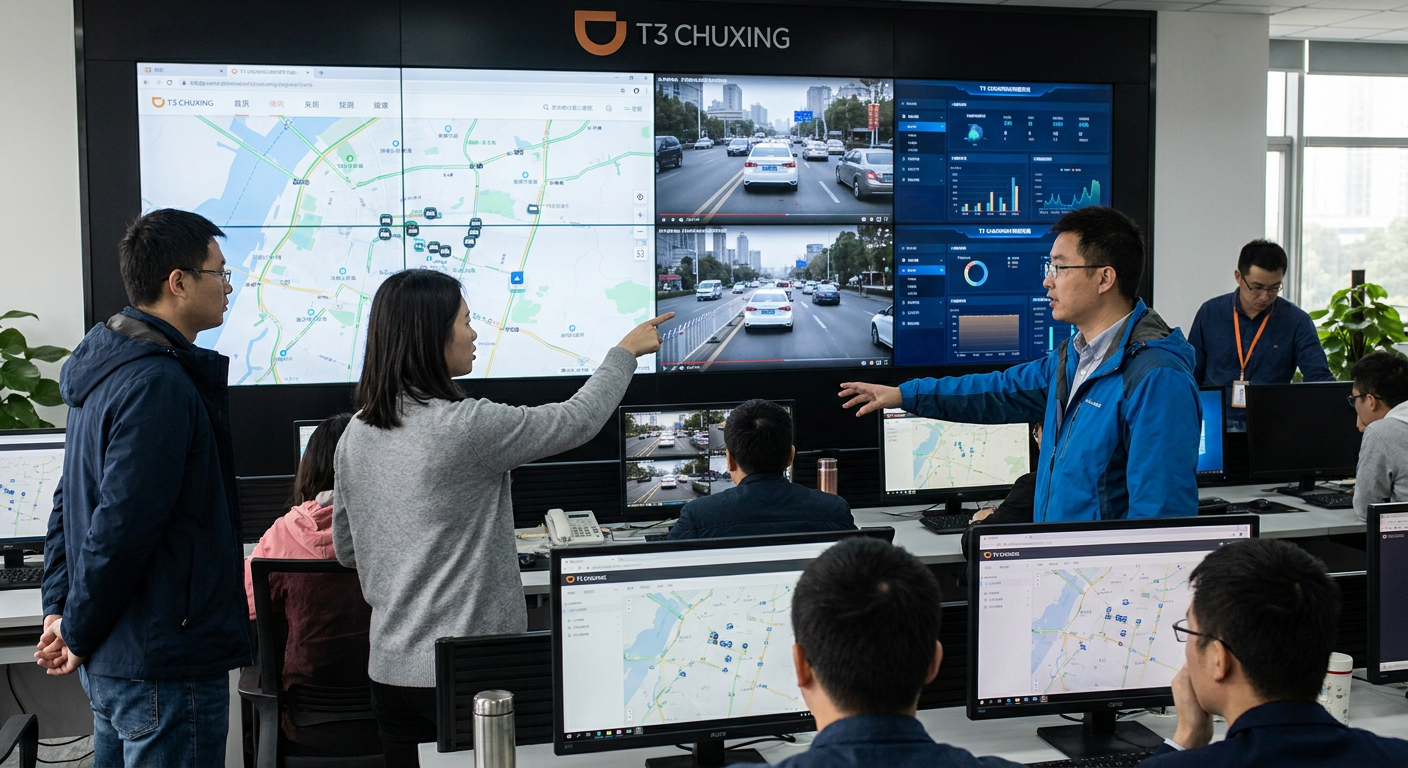
Nanjing Lingxing Technology, operating as China's third-largest ride-hailing platform T3 Chuxing, has filed for an initial public offering in Hong Kong to bankroll its structural transition from a traditional mobility provider to an autonomous fleet operator.
The filing arrives at a critical juncture for the state-backed mobility firm, which reported a razor-thin net profit of RMB 7.44 million (US$1.08 million) in 2025, marking its first profitable year following a net loss of RMB 690 million in 2024. This turnaround highlights the initial success of its AI-driven dispatch optimization, though early market feedback suggests investors remain cautious about the platform's long-term unit economics.
Backed by an alliance of state-owned automakers—FAW Group, Dongfeng Motor, and Changan Automobile—alongside tech giants Tencent and Alibaba, T3 Chuxing reported total revenue of RMB 17.109 billion (US$2.48 billion) for 2025. Despite an 8.8% three-year compound annual growth rate, the company faces mounting scrutiny over its structural reliance on third-party traffic channels as the mobility sector enters a hyper-competitive 2026.
Surging Channel Costs Expose Structural Vulnerabilities
While T3 Chuxing successfully expanded its gross margin from 0.4% in 2023 to 13% in 2025, the underlying revenue architecture reveals significant dependency risks. A staggering 85.9% of the company's 797 million orders in 2025 were generated through aggregator platforms, primarily Amap and Tencent Mobility.
This reliance has created a steep toll on operational efficiency. In 2025, T3 Chuxing paid RMB 1.388 billion in channel service fees to these aggregators, accounting for 90.7% of its total sales and distribution expenses and consuming 8.1% of its gross revenue. The prospectus explicitly flags this dynamic as a material risk, noting that any commission hikes or partnership disruptions from these aggregators could severely compress margins. For every RMB 100 earned by the platform, approximately RMB 86 originates from third-party networks, highlighting a structural bottleneck that the IPO capital must address.
Adopting the 'Golden Triangle' Robotaxi Strategy
To break free from the low-margin aggregator trap, CEO Cui Dayong is repositioning T3 Chuxing as an "operator of the autonomous driving era." The company has sidestepped the capital-intensive self-development route taken by Didi and Baidu's Apollo Go, opting instead for an asset-lighter "Golden Triangle" model that integrates its operational network with external AI developers and state-backed OEM manufacturing.
The platform has already deployed its proprietary "Lingxing Qianmo" vertical mobility AI model, which utilizes a hybrid dispatch system to coordinate both human-driven and L4 autonomous vehicles. This system has reportedly reduced driver deadhead rates by 17.5%. By the end of 2025, T3 Chuxing had integrated over 300 Robotaxis into its network across Nanjing and Suzhou, accumulating more than 41,000 kilometers in driverless road tests—ranking second in the domestic market.
As the Chinese smart mobility market marches toward a projected RMB 898.5 billion valuation by 2030, T3 Chuxing's IPO serves as a litmus test for the industry. Investors are now tasked with evaluating whether the company's robust automotive supply chain backing and early Robotaxi operational metrics can outpace the margin erosion caused by aggregator dependency.