
The Chinese AI Ecosystem Explained: Structure, Key Players, and Long-Term Trends
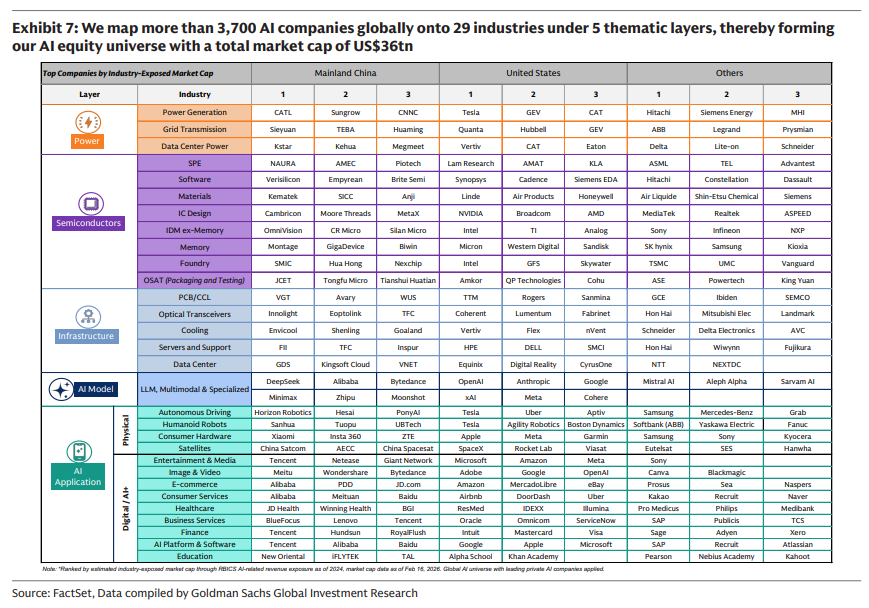
What is the Chinese AI Value Chain? The Chinese Artificial Intelligence (AI) value chain is a highly integrated, multi-layered ecosystem comprising over 3,000 publicly listed companies with an aggregate market capitalization of approximately US$10 trillion. Rather than a single monolithic sector, it is a complex supply chain that spans physical energy generation, hardware infrastructure, foundational models, and end-user applications.
Based on a comprehensive March 2026 framework developed by Goldman Sachs, the global AI universe can be understood through a revenue-based classification system rather than traditional sector taxonomy. In this framework, China accounts for roughly 10% of the global AI-related market capitalization and 16% of global AI revenues, making it a critical, albeit distinct, pillar of the global technological infrastructure.
Why Does It Matter Now? The global AI narrative underwent a structural shift following the "DeepSeek moment" in early 2025. This period marked a rapid acceleration in AI adoption and a sharp decline in average token costs, transitioning AI from a conceptual investment theme to a measurable driver of corporate revenue.
For global markets, the Chinese AI sector matters now because it has begun to demonstrate high return idiosyncrasy—meaning its performance is increasingly decoupled from US tech equities. As the global AI bottleneck shifts from computational power buildouts to energy constraints and physical infrastructure limits, China’s structural advantages in manufacturing and power generation have positioned its ecosystem as a distinct, un-correlated asset class for global capital.
How is the Ecosystem Structured? (The 5 Key Layers and Major Players) The underlying logic of the AI industry operates across five thematic layers. While the US currently dominates in Semiconductors and Foundation Models, China has established highly competitive, densely populated supply chains in Power, Infrastructure, and Physical AI.
Here is how the ecosystem functions, along with its representative companies:
- 1. Power (Generation, Grid, and Data Center Power)
- How it works: AI data centers require unprecedented amounts of electricity and advanced grid transmission to function. This layer provides the physical energy foundation.
- Key Players: CATL and Sungrow (Power Generation); Sieyuan and TEBA (Grid Transmission); Kstar and Kehua (Data Center Power).
- 2. Semiconductors (Equipment, Design, Foundry, and Packaging)
- How it works: The silicon brains of AI. While the US and North Asia lead in advanced IC design (e.g., GPUs), China maintains a robust presence in mature node foundries, semiconductor manufacturing equipment (SPE), and Outsourced Semiconductor Assembly and Test (OSAT).
- Key Players: Cambricon (IC Design); SMIC and Hua Hong (Foundry); NAURA and AMEC (SPE); JCET and Tongfu Micro (OSAT).
- 3. Infrastructure (Hardware and Thermal Management)
- How it works: The physical hardware required to build and cool data centers, including servers, optical transceivers for data transfer, and liquid cooling systems.
- Key Players: Innolight and Eoptolink (Optical Transceivers); Envicool (Cooling); FII and Inspur (Servers); GDS and VNET (Data Centers).
- 4. AI Models (LLMs and Multimodal)
- How it works: The foundational algorithms trained on massive datasets to perform complex, economically valuable tasks.
- Key Players: DeepSeek, Alibaba, ByteDance, Minimax, and Zhipu.
- 5. Applications (Physical AI and AI+)
- How it works: The commercialization layer. This is divided into "Physical AI" (autonomous driving, humanoid robots) and "AI+" (software, e-commerce, healthcare, and consumer services integrating AI).
- Key Players (Physical AI): DJI, Horizon Robotics, UBTECH.
- Key Players (AI+): Tencent, Baidu, Meitu, New Oriental (Education), JD Health.
Where Does China Hold Structural Advantages? The global division of labor in AI is becoming distinctly regional. According to the Goldman Sachs analysis, the US dominates the Semiconductor, Model, and AI Software Application cohorts in both market cap and revenue.
Conversely, China's opportunity set is heavily concentrated in the physical and infrastructural layers. Chinese companies account for 38% of the global revenue pool in AI Power, 26% in AI Infrastructure, and 27% in Physical AI. This divergence implies that while US firms design the core algorithms and chips, Chinese firms are increasingly supplying the power equipment, thermal cooling systems, and physical robotics required to scale and deploy these technologies globally.
What Are the Constraints and Key Variables? Several constraints will dictate the long-term viability of companies within this ecosystem:
- The Monetization Gap: Globally, AI Application proxies (both Physical AI and AI+) have lagged behind infrastructure stocks. The primary constraint is investor concern over the actual monetization of AI tools and the risk of AI cannibalizing existing software business models.
- Capital Allocation Discrepancies: Despite generating 16% of global AI revenue and accounting for nearly 20% of global AI R&D and Capex, Chinese AI equities remain structurally under-owned. As of early 2026, global mutual funds allocated only 1.2% of their tech portfolios to China AI equities, creating a significant tracking error relative to China's actual economic footprint in the sector.
What Will Happen Next? The investment and operational focus within the AI industry is broadening. Over the past few years, the market was heavily concentrated on Semiconductor manufacturers. However, as compute power scales, the most pressing bottlenecks are shifting to energy supply and data center thermal management.
Moving forward, the AI value chain will likely see a consolidation phase in the Model layer, where only a few well-capitalized tech giants (like Alibaba, ByteDance, and DeepSeek) can afford the massive R&D and compute costs. Meanwhile, the Infrastructure and Power layers are expected to see sustained, long-term demand, heavily favoring China's advanced manufacturing and hardware supply chains regardless of which foundational models ultimately win the software race.