
Unitree's 3.9 Million Yuan Mech Suit: Engineering Spectacle or Viable Business?
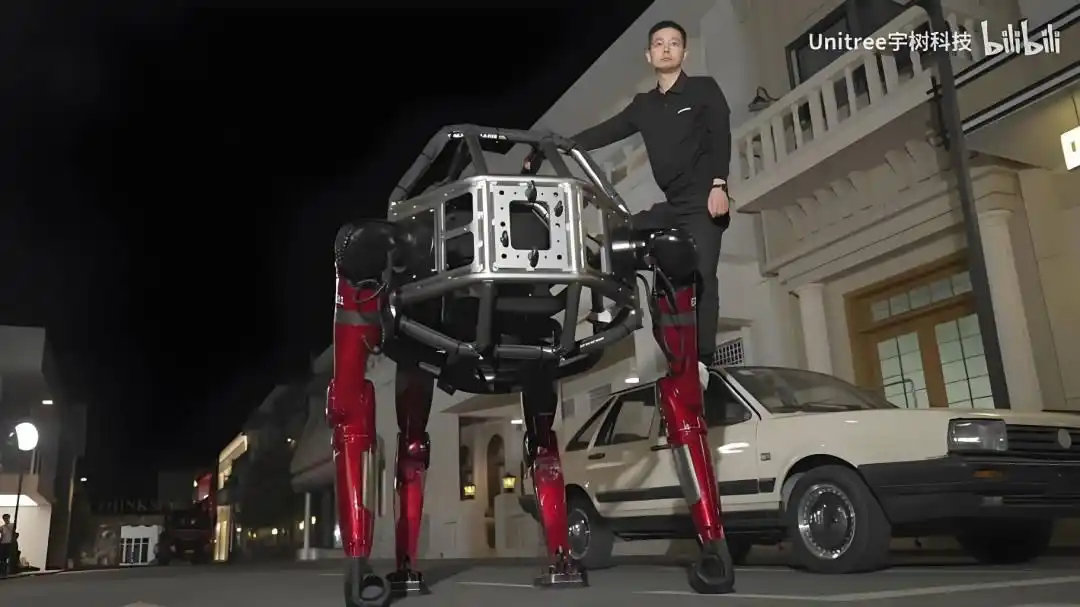
Unitree Robotics has unveiled what it calls the world's first mass-produced rideable transforming mech, the GD01, priced at RMB 3.9 million yuan (approximately US$537,000) — a product that sits at the intersection of cutting-edge robotics and high-end luxury goods, and arrives less than two months after the company filed for a STAR Market IPO.
A Price Tag With Precedent
The sticker price may invite skepticism, but context matters. Japan's Kuratas mech, built by Suidobashi Heavy Industry in 2012, stood four meters tall, weighed four tons, and sold for roughly US$1 million — a handcrafted, low-volume product. Unitree's GD01 weighs approximately 500 kilograms when occupied, is offered in a mass-production configuration, and carries a price tag roughly 60% of its Japanese predecessor. Within Unitree's own product lineup, the GD01 anchors the top end of a range that starts at RMB 26,900 for the R1 dual-arm robot, giving the company coverage from entry-level industrial tools to seven-figure showpieces.
Founder Wang Xingxing personally climbed into the cockpit during the product demonstration, showcasing the unit's dual-mode capability — upright bipedal walking and quadrupedal crawling — as well as its ability to deliver a punch strong enough to topple a brick wall without destabilizing the chassis.
Commercial Logic: Volume Is Not the Point
Industry observers contacted by Phoenix Technology suggest the most immediate buyers are unlikely to be industrial operators. Tourism destinations and technology exhibition venues represent the most probable early adopters. A theme park deploying a GD01 as a paid experience attraction — charging visitors per session — could conceivably offset a significant portion of the capital cost within a year, according to the analysis. One industry participant cited venues comparable to Universal Studios as potential customers.
Others pointed to special operations and hazardous environment applications as longer-term targets, while cautioning that the current generation of humanoid robots remains far from ready for autonomous deployment. Terrain navigation in complex environments, autonomous task execution, endurance, and fine motor capability in the hands all require further development, according to practitioners in the field.
For high-net-worth individuals, the GD01's claim to being the world's first mass-produced rideable mech carries inherent scarcity value — a dynamic not unlike that of a limited-edition timepiece.
IPO Backdrop Sharpens the Signal
The timing of the GD01 launch is difficult to separate from Unitree's capital market ambitions. The Shanghai Stock Exchange accepted the company's STAR Market IPO application on March 20, 2026, with the company seeking to raise RMB 4.202 billion yuan (approximately US$579 million). The GD01 was unveiled less than two months later.
The company's underlying financials lend credibility to the narrative. Unitree reported revenue of RMB 1.708 billion yuan in 2025, a 335% year-on-year increase, with non-GAAP net profit reaching RMB 600 million yuan, more than six times the prior year's figure. The company shipped 5,500 humanoid robots in 2025, capturing a 32.4% share of the global market, while cumulative sales of its quadruped robots exceeded 30,000 units — both figures ranking first globally, according to the company.
For investors evaluating the IPO, the GD01 functions as a proof-of-concept for Unitree's full-stack technical capability rather than a near-term revenue driver.
Technical Depth, Cognitive Gap
The GD01 consolidates multiple technology threads Unitree has developed over the past several years — from the consumer-grade Go1 robot dog in 2024, to the G1 humanoid robot that appeared on China Central Television's Spring Festival Gala in 2025, to the R1 dual-arm robot released in April 2026. The mech's core capabilities rest on the company's proprietary M107 high-torque-density joint motors, precision servo drive systems, and reinforcement learning-based motion control algorithms, with in-house development accounting for more than 90% of key components including motors, reducers, and controllers.
However, Unitree has been candid about where the technology falls short. Autonomous perception, environmental understanding, and intelligent decision-making — the dimensions that define embodied intelligence — remain areas requiring substantial improvement. The GD01, as currently demonstrated, is primarily a showcase of mechanical mobility.
Safety is an equally unresolved question. Unitree's promotional materials explicitly caution users against dangerous modifications and warn that "global humanoid robot development remains in an early exploratory stage." Regulatory certification, road-use compliance, endurance range, and after-sales infrastructure would all need to be addressed before any civilian transportation application becomes viable.
From Follower to First Mover
The broader significance of the GD01 may lie less in its commercial prospects than in what it represents for China's robotics industry. Unitree's trajectory — from manufacturing follower to global first-mover in a product category — marks a structural shift that industry participants say carries weight beyond unit sales.
The harder test remains ahead: translating engineering ambition into sustainable commercial value. That distance, as one embodied intelligence practitioner put it, is longer than the road from robot dog to mech suit.
Unitree has launched the world’s first mass-produced, drivable humanoid mecha priced at RMB 3.9 million (US$541,666), utilizing the flagship hardware platform to showcase its vertically integrated supply chain ahead of a planned approximately RMB 4.2 billion (US$583 million) initial public offering.
Unveiled in mid-May 2026, the GD01 model represents a strategic expansion from volume-driven industrial tools to high-margin experiential technology. The machine, which supports a 500-kilogram payload and switches seamlessly between bipedal and quadrupedal mobility modes, serves as a physical prospectus for the company’s mechanical engineering capabilities.
Early market feedback indicates the pricing targets commercial venues, such as theme parks and technology exhibitions, rather than immediate industrial deployment. Investors view the release as a calculated valuation anchor designed to justify the company's dominant 32.4% global market share in humanoid robotics ahead of its Shanghai STAR Market listing.
Compressing Capital Expenditure Drives Hardware Commoditization
The GD01 illustrates a rapid deflationary trend in advanced robotics manufacturing, driven by Chinese supply chain maturity. Compared to the custom-built Kuratas mecha introduced by Japan’s Suidobashi Heavy Industry in 2012—which weighed four tons and cost $1 million—Unitree’s model weighs one-eighth as much and retails at a 40% discount while achieving mass-production status.
This cost compression stems from Unitree’s component localization. The company reports a core component self-sufficiency rate exceeding 90%, manufacturing its own M107 high-torque joint motors, precision servo drives, and reinforcement learning controllers. By controlling the base hardware layer, Unitree has established a product matrix ranging from the RMB 26,900 (US$3,736) R1 dual-arm robot to the multi-million-yuan GD01, capturing both the entry-level developer market and the premium experiential segment.
The hardware monetization strategy is already yielding financial results. According to IPO prospectus data filed in March 2026, Unitree recorded 2025 revenues of RMB 1.708 billion (US$237 million), a 335% year-on-year increase, backed by global shipments of 5,500 humanoid units and over 30,000 quadruped robots.
Pivoting to Niche Cash Flows Amid Embodied AI Bottlenecks
Despite the mechanical sophistication required to stabilize a 500-kilogram bipedal chassis during high-impact strikes, the GD01 exposes the widening gap between hardware readiness and software autonomy in the robotics sector. The system relies heavily on human piloting, acknowledging current limitations in Embodied AI, specifically regarding autonomous perception, environmental understanding, and intelligent decision-making.
Consequently, the commercial viability of the GD01 hinges on specific, controlled environments. Industry analysts project the primary adoption curve will begin with closed-loop entertainment ecosystems, such as Universal Studios, where high foot traffic can amortize the capital expenditure. A secondary market exists among ultra-high-net-worth individuals treating the mecha as a Veblen good, analogous to limited-edition hypercars.
Deployment in complex, unstructured environments like disaster relief or special operations remains restricted by current battery density limitations, poor terrain adaptability, and the absence of fine-motor manipulation capabilities. Furthermore, Unitree’s explicit safety disclaimers regarding civilian modification highlight the regulatory void surrounding heavy-duty, mobile robotic platforms. Until safety certifications, road traffic regulations, and liability frameworks adapt to human-piloted mechas, the GD01 will remain confined to private commercial spaces, functioning primarily as a highly profitable technological demonstrator.
Related Coverage:
Unitree Robotics Unveils World's First Mass-Production Manned Mech Suit at RMB 3.9M