
What Is China’s G60 Satellite Program — And Why 2027 Matters
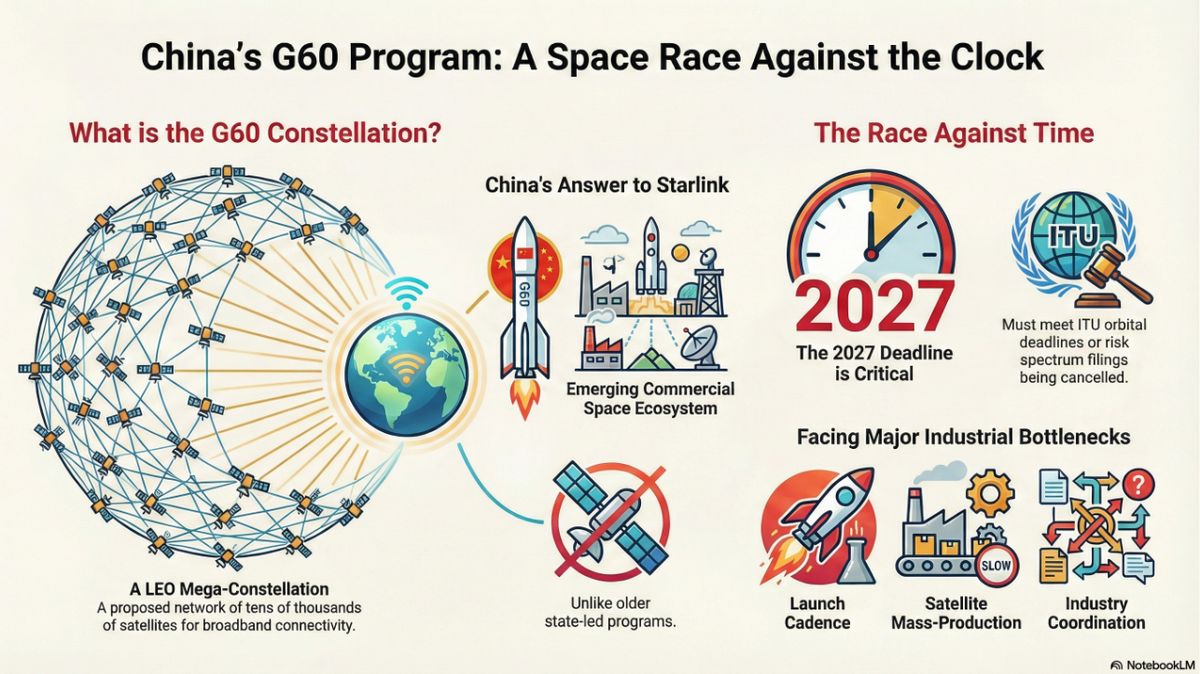
- G60 (千帆) is China’s most prominent proposed LEO satellite mega‑constellation, often compared with SpaceX’s Starlink.
- The real constraint is not ambition, but ITU spectrum and orbital deadlines (the so‑called Bring‑Into‑Use, BIU, rules).
- 2024–2027 is the decisive window: miss it, and spectrum filings risk being cancelled.
- China’s commercial space sector is undergoing rapid industrialization, but launch cadence, satellite mass‑production, and coordination remain key bottlenecks.
What Is G60?
G60, sometimes referred to as “Qianfan” (千帆, Thousand Sails), is a proposed Chinese low‑Earth‑orbit (LEO) satellite constellation filed with the International Telecommunication Union (ITU). The plan envisions tens of thousands of satellites operating primarily in the Q/V frequency bands, aimed at providing broadband connectivity and strategic space infrastructure.
Unlike earlier, state‑led satellite programs, G60 is closely associated with China’s emerging commercial space ecosystem, involving local governments, state‑owned enterprises, and private launch and satellite manufacturers.
At a high level, G60 represents:
- China’s attempt to secure future orbital and spectrum resources
- A response to the global dominance of Starlink and other Western constellations
- A stress test for China’s ability to industrialize space at scale
How Do ITU and “Bring‑Into‑Use” (BIU) Rules Work?
The ITU governs the allocation of radio spectrum and orbital slots. Filing a constellation is not enough — countries must use what they file.
Under ITU rules:
- After a constellation is filed, operators typically have 7 years to bring satellites into use (BIU).
- Additional extensions may apply, but only if real satellites are launched and operating.
- If deadlines are missed, filings can be reduced or cancelled, freeing spectrum for others.
In practice, this means that paper plans or slow deployment strategies do not count. Launch cadence matters more than announcements.
For China’s G60 filings, this places enormous pressure on the mid‑2020s, making 2024–2027 the critical execution window.
Why 2024–2027 Is China’s Commercial Space “Normandy Moment”
The phrase “Normandy moment” captures the idea of a point of no return. For China’s commercial space ambitions, several forces converge in this period:
1. Spectrum Deadlines
The ITU clock is ticking. Without sufficient satellites in orbit, spectrum rights weaken rapidly.
2. Industrial Scaling
China is transitioning from custom‑built satellites to assembly‑line production, similar to how the auto industry scaled a century ago.
3. Launch Capacity
Heavy‑lift rockets, reusable launch vehicles, and new coastal launch sites are moving from testing to early operations.
4. External Competition
By the late 2020s, Starlink and other constellations will have occupied much of the most attractive orbital real estate.
Taken together, failure to act decisively in this window would not merely delay G60 — it could structurally limit China’s space presence for decades.
Technology and Industrial Shifts Behind G60
Satellite Manufacturing
Chinese firms are rapidly adopting:
- Smaller, modular satellite designs
- Commercial off‑the‑shelf (COTS) components
- Automated testing and integration
The goal is to reduce both unit cost and production time, enabling launches in batches rather than one‑offs.
Launch Vehicles
Historically, launch availability — not satellite design — has been the binding constraint.
Recent changes include:
- Faster iteration cycles for private rockets
- Early experiments with reusability
- Expansion of sea‑based and coastal launch infrastructure
Still, achieving the cadence required for ITU compliance remains uncertain.
How Starlink Changes the Game
SpaceX’s Starlink has redefined what is technologically and operationally possible:
- Thousands of launches in a few years
- Tight integration between rockets, satellites, and software
- Aggressive occupation of orbital shells
For China, Starlink creates two pressures:
- Time pressure — orbital shells fill quickly
- Benchmark pressure — global expectations shift upward
G60 does not need to replicate Starlink exactly, but it must demonstrate credible scale and continuity.
Can China Actually Deliver G60 in Time?
The answer is uncertain, but no longer theoretical.
Strengths:
- Strong policy support
- Deep manufacturing base
- Rapid learning curves once scaling begins
Risks:
- Fragmented coordination among actors
- Launch bottlenecks
- Regulatory and export‑control headwinds
Success depends less on breakthrough technology and more on execution discipline.
What G60 Means for Investors, Operators, and Policymakers
- Investors should focus on firms tied to launch cadence, satellite production, and ground systems.
- Operators must plan for spectrum uncertainty and phased deployment.
- Policymakers face a trade‑off between coordination and market competition.
G60 is not just a space project; it is a systems‑engineering test of China’s commercial governance model.
Key Timeline (Indicative)
- 2020–2022: ITU filings and early planning
- 2023–2024: Industrial capacity build‑up
- 2025–2027: Critical BIU compliance window
- Post‑2027: Consolidation or contraction
FAQ
Q: What is G60 (千帆)?
A: A proposed Chinese LEO satellite mega‑constellation filed with the ITU.
Q: Why is 2027 so important?
A: It marks key ITU deadlines for bringing satellites into use.
Q: Is G60 China’s Starlink?
A: Strategically similar, but technologically and organizationally different.
Q: What happens if deadlines are missed?
A: Spectrum filings can be reduced or cancelled.
Q: Can China catch up to Starlink?
A: Possibly in scale over time, but execution in the mid‑2020s is decisive.
Sources
- ITU Radio Regulations
- Public filings on Chinese LEO constellations
- Industry and policy analyses on global satellite broadband