
Xiaomi Escalates Apple Rivalry With Flagship Series Targeting iPhone 17
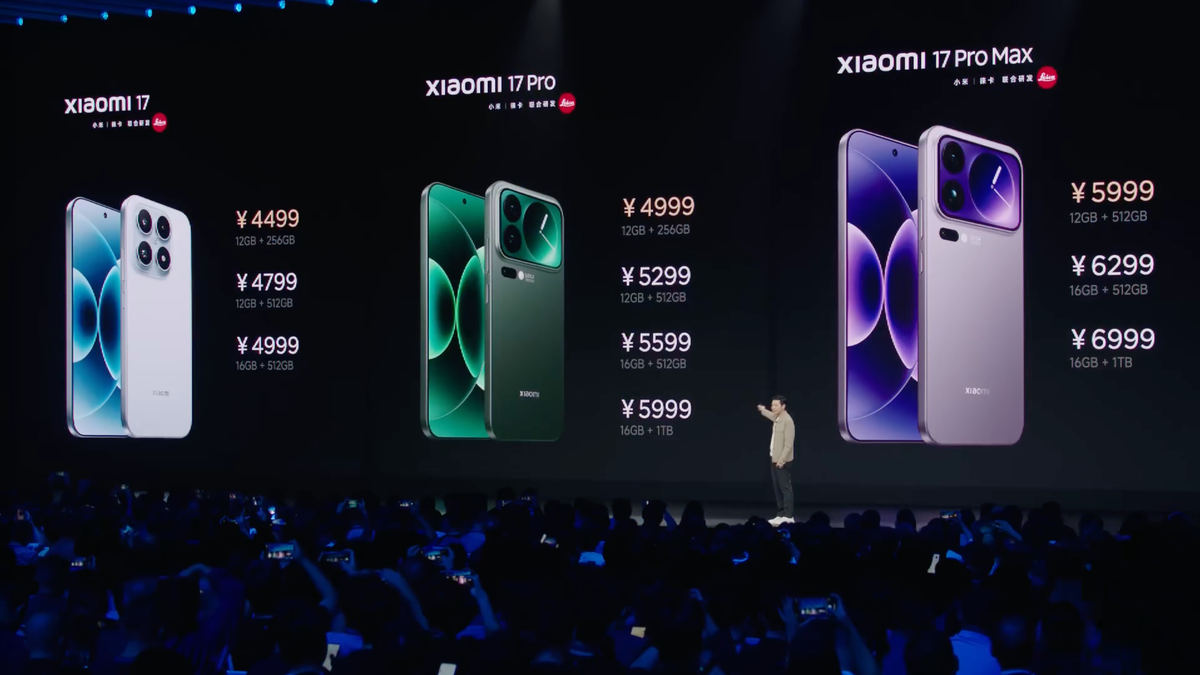
Xiaomi Corp. has launched its Xiaomi 17 smartphone series, an aggressive and direct challenge to Apple Inc.'s dominance in the premium market, synchronizing its product name and launch cycle to compete head-on with the upcoming iPhone 17.
In a clear strategic maneuver, the Chinese electronics giant skipped the "16" designation for its flagship line to create a direct generational comparison with its U.S. rival. Lei Jun, Xiaomi's chief executive, framed the launch as a "face-to-face" confrontation, with the new series mirroring Apple's lineup by offering three models: the Xiaomi 17, 17 Pro, and 17 Pro Max.
The new phones are positioned to compete on key hardware specifications, most notably battery life and charging speed. Xiaomi is touting a 7000mAh battery in its standard model—nearly double the capacity of the iPhone 17—and significantly faster charging technology, presenting these as crucial advantages for consumers in the high-end segment.
This assertive product strategy is underpinned by aggressive pricing. The Xiaomi 17 will start at RMB 4,499 yuan (about $620), while the top-tier Pro Max model is priced from RMB 5,999 yuan. These prices are designed to significantly undercut Apple, marking the latest step in Xiaomi’s five-year strategy to solidify its position in the premium smartphone category.
A Battle of Specifications
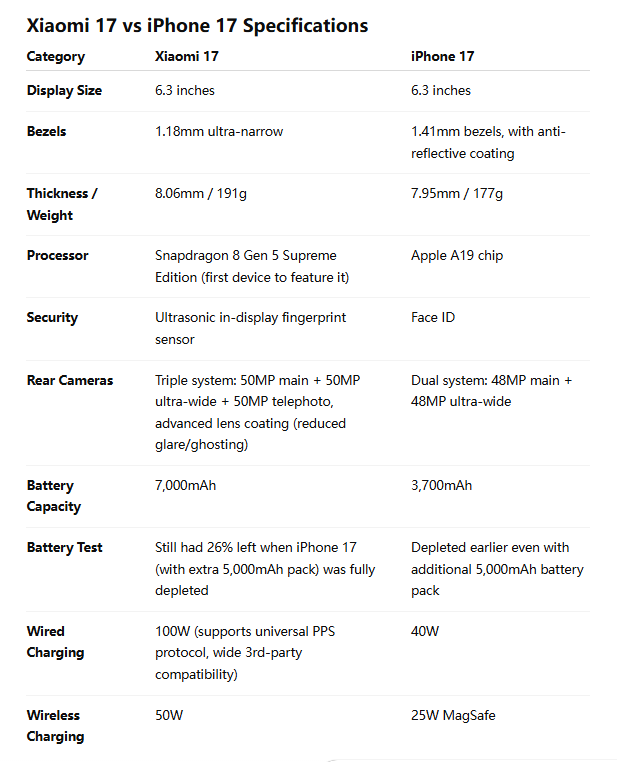
The standard Xiaomi 17 is positioned as a direct competitor to the iPhone 17, with both devices featuring 6.3-inch screens. Xiaomi claims a design edge with ultra-narrow 1.18mm screen bezels, compared to the iPhone’s 1.41mm. However, Apple’s device includes an anti-reflective screen coating, a feature absent from the Xiaomi 17 series. The Xiaomi 17 is slightly thicker and heavier at 8.06mm and 191 grams versus the iPhone 17’s 7.95mm and 177 grams.
Under the hood, the Xiaomi 17 is the first device to feature the fifth-generation Snapdragon 8 Supreme Edition processor. In contrast, the iPhone 17 is expected to run on Apple's A19 chip. During the launch event, Lei claimed the Xiaomi 17’s performance is “close to the iPhone 17 Pro.” For security, Xiaomi employs an ultrasonic in-display fingerprint sensor, while Apple continues to rely on its Face ID system.
In the camera department, the Xiaomi 17 boasts a versatile triple-lens system, comprising a 50-megapixel main sensor, a 50MP ultra-wide lens, and a 50MP telephoto lens. This contrasts with the iPhone 17's dual-camera setup featuring a 48MP main and a 48MP ultra-wide lens. Xiaomi also highlighted its advanced lens coating technology, designed to reduce glare and ghosting in photos.
The Endurance Advantage
Battery life appears to be Xiaomi’s most significant differentiating factor in its 2025 flagship lineup. The standard Xiaomi 17 is equipped with a 7,000mAh battery, a substantial increase over the iPhone 17's reported 3,700mAh capacity. During its presentation, Xiaomi showed a test video where the Xiaomi 17 still had 26% of its charge remaining after an iPhone 17, connected to an additional 5,000mAh external battery pack, had been fully depleted.
Xiaomi’s lead extends to charging technology. The Xiaomi 17 supports 100W wired charging and 50W wireless charging, far exceeding the iPhone 17’s 40W wired and 25W MagSafe capabilities. Furthermore, Xiaomi's device is compatible with the 100W universal PPS charging protocol, allowing for fast charging with a wider range of third-party adapters.
Pro Models Introduce Novelty
For its Pro models, Xiaomi introduced features not found in the standard version or its Apple counterparts. The Xiaomi 17 Pro and 17 Pro Max are distinguished by a "Mi Enjoyment Back Screen," a small secondary display on the rear of the device. This screen can be used for notifications, custom wallpapers, and as a viewfinder for taking higher-quality selfies with the main camera system.
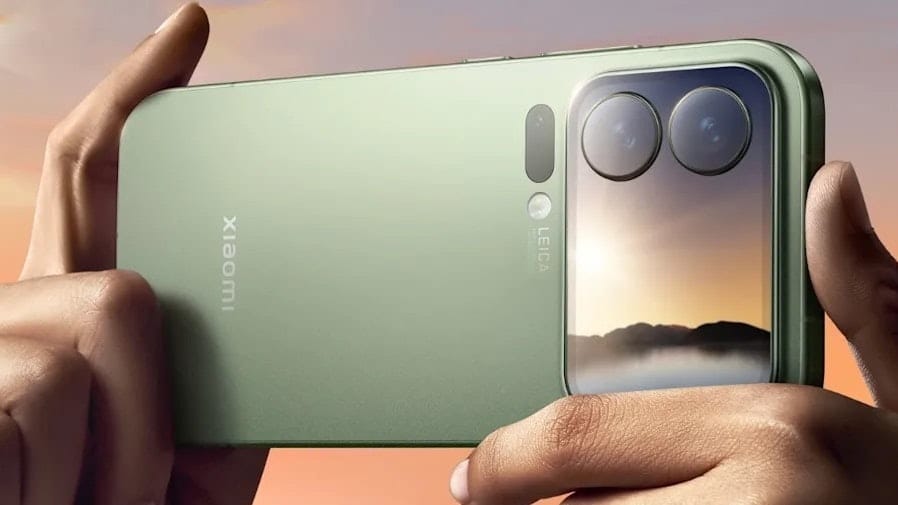
The Pro series also features an upgraded main camera sensor, the "Light Hunter 950L," which incorporates LOFIC technology to achieve a dynamic range of 16.5 EV for improved performance in high-contrast lighting. The top-of-the-line Xiaomi 17 Pro Max exclusively features a "Super Pixel" display technology, which the company says arranges RGB sub-pixels more efficiently for 2K-level clarity with lower power consumption. The Pro Max also boasts the largest battery in the series at 7,500mAh.
Strategic Pricing and Market Play
The launch of the Xiaomi 17 series represents a critical phase in the company’s long-term push into the premium market. The pricing strategy is explicitly designed to challenge Apple’s market share, offering comparable or, in some areas, superior hardware specifications at a lower cost. The series starts at RMB 4,499 yuan for the 12GB+256GB Xiaomi 17, with the Pro and Pro Max models starting at RMB 4,999 yuan and RMB 5,999 yuan, respectively.
As part of its strategy to attract users from other ecosystems, Xiaomi announced that its new operating system will feature enhanced interoperability with Apple products, including file and photo transfers between Xiaomi phones and iPhones or Macs. This move aims to lower the barrier for Apple users considering a switch. The market’s reception of the Xiaomi 17 series will be a key indicator of whether the company’s substantial investments and direct competitive strategy can successfully challenge the established order in the global smartphone market.