
Xpeng Teases GX With AI Privacy Glass and 3,000 TOPS Compute as China Pushes “Physical AI” Into Full-Size SUVs
Xpeng on April 14 released official interior images of its GX flagship SUV, positioning the model as a “new technology flagship” that bundles AI-driven cabin hardware with high local compute—an approach that underscores how Chinese automakers are racing to differentiate through integrated AI features rather than incremental styling updates.
The company said the GX will make its formal debut at a technology launch event on April 15, putting investor attention on whether Xpeng can translate headline-grabbing specifications—such as “the world’s first AI dimming privacy glass” and an L4-capable driver-assistance stack—into a scalable product narrative in a market where feature velocity has become a core competitive weapon.
The reveal highlights a widening contrast in product strategy between China and the US: Chinese EV brands increasingly market “physical AI” as an end-to-end experience across cockpit, comfort and assisted driving, while US consumers have historically been conditioned to separate premium cabin features from autonomy claims. For global investors, the question is less about a single model and more about whether China’s hardware-first AI packaging will reset expectations for what a mass-market SUV must include.
Early read-through for the supply chain is that GX’s configuration—fast-switch smart glass, a 33-speaker audio system, steer-by-wire, rear-wheel steering and multi-chip compute—signals rising content per vehicle, which can lift bill-of-materials complexity while expanding opportunities for component makers that can meet automotive-grade reliability and cost targets.
Interior Teaser Signals a China-Led Push to Productize “Physical AI”
Xpeng said the GX cabin follows a “Universe Quantum” design concept and aims to deliver a “first-class cabin” experience. The interior centers on a 17.3-inch 3K ultra-narrow-bezel display and a “floating” central island with a liftable charging panel and hidden, lift-up cupholders—features designed to communicate both technology density and day-to-day usability.
The company also highlighted an “intelligent welcome” function for the steering wheel and seats, including a 135 mm electric telescoping range. Materials and lighting are part of the pitch: door panels use a light-transmitting leather-like finish paired with ambient light strips, reflecting how Chinese OEMs increasingly treat human-machine interaction and cabin mood as sellable “AI” outcomes rather than trim-level add-ons.
AI Dimming Glass and 3,000 TOPS Compute Raise the Stakes for Differentiation
Xpeng said the GX will debut what it calls the world’s first AI dimming privacy glass, capable of changing tint in 0.16 seconds. The system supports automatic stepless dimming in backlight and tunnel scenarios, blocks 99.9% of ultraviolet light and allows one-touch switching by button or voice.
On driver assistance, Xpeng said the GX uses four Turing chips delivering 3,000 TOPS of effective local compute and is equipped with L4-level autonomous driving capability. In China’s EV market, where software features can converge quickly, the combination of extreme headline specs—sub-second glass tinting and multi-thousand TOPS compute—has become a primary way to claim leadership, even before real-world performance metrics are disclosed.
For US-China comparison, the GX messaging illustrates a China-centric playbook: sell the car as a compute platform where cabin comfort, privacy and assisted driving share a common “AI” brand story. In the US, similar feature sets are more often marketed as separate value pillars—luxury, infotainment and autonomy—rather than as one unified “physical AI” narrative.
Full-Size Dimensions and Flexible Seating Target China’s Family-SUV Battle
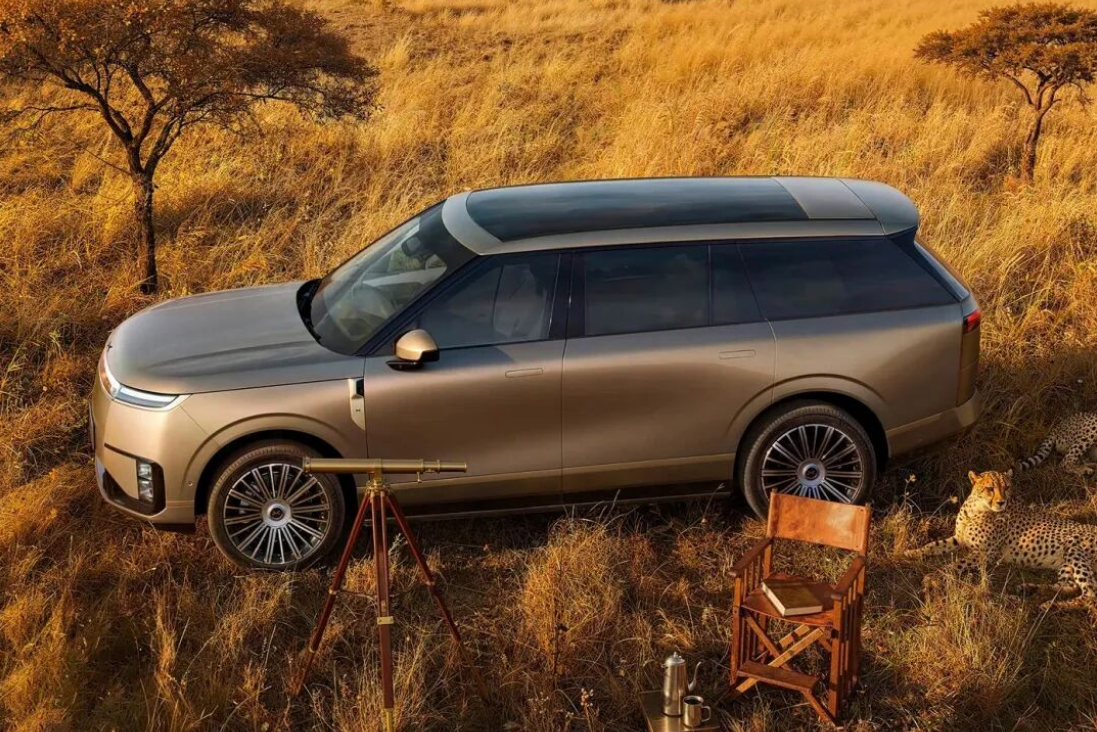
Xpeng described the GX as its first full-size flagship SUV, with dimensions of 5,265 mm length, 1,999 mm width and 1,800 mm height, and a 3,115 mm wheelbase. The vehicle adopts a family design language with a full-width light bar, a “yacht-style” profile and blacked-out A, B, C and D pillars to create a floating-roof effect. It also uses hidden door handles and 22-inch multi-spoke wheels, with staggered tire widths—265 mm front and 285 mm rear.
The interior is built around a “large six-seat” comfort pitch. Xpeng said the second row features independent zero-gravity seating, while the third row supports 0–180° electric reclining. The company also markets a “three-row electric three-fold” mechanism aimed at switching among six-, five- and four-seat configurations, framing space flexibility as a differentiator in China’s crowded family-SUV category.
Powertrain Breadth and Steer-by-Wire Reflect China’s High-Content SUV Trend
Based on previously filed information cited by the company, GX will offer both an extended-range variant and a battery-electric version. Xpeng said the BEV range options are 635 km, 665 km, 720 km and 750 km, while the extended-range variant offers 320 km of pure-electric range.
GX will also include steer-by-wire and a rear-wheel steering system, adding to its “high-content” positioning. For investors tracking US-China divergence, this matters because China’s leading OEMs increasingly treat advanced chassis electronics and cabin automation as standard ingredients of a tech-forward SUV, while US-market adoption often depends on tighter cost discipline and clearer regulatory and consumer acceptance paths—especially when autonomy claims rise toward L4 language.
Related Coverage:
Xpeng Upgrades Best-Selling MONA M03, Igniting AI Arms Race in Sub-$20,000 EV Market