
XPeng’s Europe Strategy: Global Platform, Local Software, and the B2B Challenge
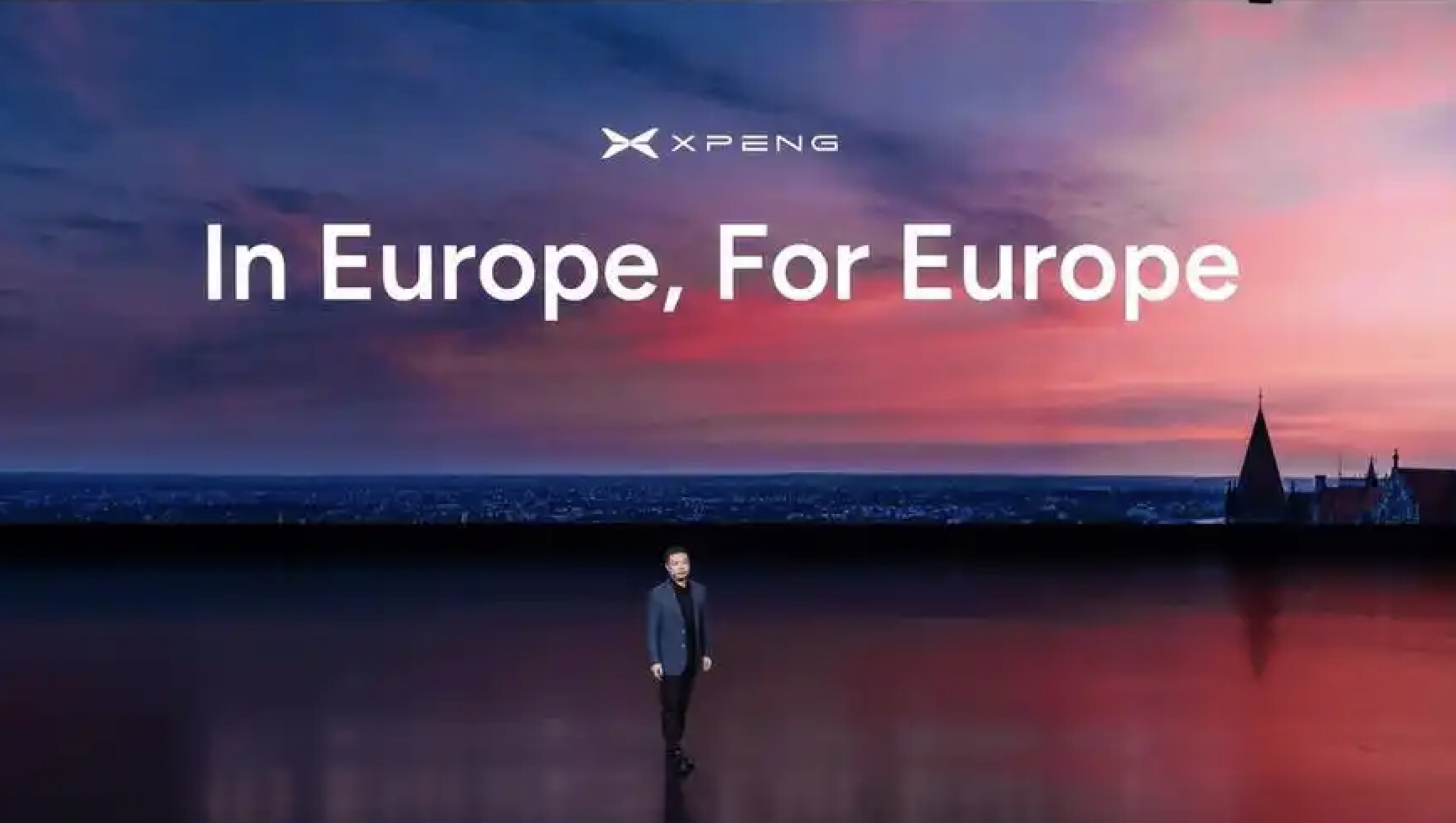
46,859 Chinese pre-orders within one hour of a Munich reveal underscore the dual-market ambition behind XPeng's most globally engineered car yet — but the harder battle lies in software, data, and winning Germany's B2B fleet buyers.
Six Years of Tuition Fees Produce a Pivot From Niche to Volume
On July 16, 2026, inside an arts center adjacent to Bayern Munich's Allianz Arena, XPeng Chairman He Xiaopeng announced the European starting price of the Mona L03: €35,600 — roughly RMB 275,000 (US$38,200). At the same moment, a parallel livestream broadcast to Chinese viewers revealed the domestic price: RMB 129,800 (US$18,000), less than half the European figure. The gap was deliberate and instructive.
European media immediately described the L03's pricing as "aggressive." Chinese consumers responded with their wallets: 46,859 firm orders were placed within the first hour of the domestic announcement.
The contrast encapsulates where XPeng now stands after six years of costly, halting, and ultimately instructive attempts to crack Europe. The company that sold just 438 vehicles in Norway in 2021 — its designated "beginner's market" — has engineered a product it explicitly calls its first true global vehicle. Whether that vehicle can convert critical acclaim into durable volume is the question that will define XPeng's next chapter.
Early Missteps Force a Strategic Rebuild Under Wang Fengying
XPeng's European journey began in September 2020 when 100 units of the G3i were shipped to Norway. The timing was structurally premature. Europe's battery-electric vehicle penetration stood at just 10% in 2021, and XPeng arrived without brand equity, a mature product lineup, or a functioning aftersales network. Norway sales that year totaled 438 units.
The company compounded the market challenge with internal turbulence. The first-generation G9 launch failure in 2022 triggered a sweeping reorganization. He Liyang, the former Huawei Western Europe enterprise head recruited to lead overseas operations and who had built a nearly 300-person international business unit, departed. The Germany team shrank to a handful of people.
The inflection point came in 2023 with the arrival of Wang Fengying as President. Under the new triumvirate of He Xiaopeng, CFO Brian Gu, and Wang, overseas strategy was relaunched with a clear product mandate: adapt the G9 and P7 for European regulatory and consumer requirements using a cross-timezone development model — German team inputs European requirements, China-based engineers modify, Germany validates. Despite the friction inherent in that workflow, direct sponsorship from He Xiaopeng accelerated execution. The G9 and P7 launched in the Nordic markets in September 2023; Germany followed in March 2024, with the G6 and X9 added subsequently.
The results were modest but directionally correct. XPeng's overseas sales rose from 23,000 units in 2024 to 45,000 units in 2025. Germany's dealer network expanded to more than 50 outlets, with 2025 German sales reaching approximately 3,600 units — a small number in a market of under three million new vehicles annually, but a validated proof of concept.
Premium Positioning Captures Margins but Misses Germany's Volume Core
XPeng's German strategy was built around a deliberate premium anchor. The G9 retails at €61,100 in Germany; the entry-level G6 starts at €43,600. These price points — 50% to double the Chinese equivalents — generate dealer margins comparable to selling Mercedes-Benz or BMW, a critical factor in persuading German dealers, whose showroom leases run 10 years, to take on an unfamiliar Chinese brand.
Volkswagen AG's US$700 million strategic investment in XPeng in 2023 materially reduced that persuasion cost. XPeng's first German dealer, who also sells Mercedes-Benz, approached the company proactively and opened the first Munich showroom. The halo of the Volkswagen relationship signaled institutional credibility that XPeng could not have generated independently at that stage.
The premium strategy, however, has a structural ceiling. In Germany's sub-three-million-unit annual market, 55% of new-car sales fall below the €50,000 threshold. More critically, two-thirds of new vehicles are sold to corporate and fleet buyers (B2B), not individuals. XPeng's existing lineup — priced and positioned to compete with BBA — addresses the remaining one-third of a market already dominated by established European and German brands. Its current German buyers skew heavily toward high-income, highly educated consumers over 50, many of them automotive engineers drawn to the technology proposition.
The L03 is XPeng's answer to that structural gap. At €35,600 to €46,600 in Europe, it targets the €40,000 segment where Škoda's Elroq and Enyaq — which together recorded more than 36,000 German registrations in the first half of 2026 — are the volume benchmarks. XPeng's positioning logic: larger body (4.65 meters), lower price, and higher standard specification than segment peers, including standard-fit HUD, active noise cancellation, and advanced driver-assistance hardware that rivals charge as options.
L03's 4.65-Meter Compromise Reveals the Mechanics of True Globalization
The L03's vehicle length — 4.65 meters, 135 millimeters shorter than the Chinese-market Mona M03 SUV on which it is based — is the most visible artifact of a genuinely bilateral product development process. XPeng's German team initially proposed a 4.3–4.4 meter body, the most common size class on European roads. The China team rejected it as commercially unviable domestically. After multiple rounds of negotiation and multiple design iterations, 4.65 meters emerged as the compromise: acceptable to Chinese buyers who prefer larger vehicles, not alienating to European buyers who prefer compact ones.
XPeng's German team frames this as a transition from globalization Phase 1 — adapting finished domestic models for export — to Phase 2, in which overseas teams participate in product definition from inception and the resulting vehicle achieves synchronized global launch. The L03's Munich world premiere, He Xiaopeng's decision to deliver the entire presentation in English, and the simultaneous domestic and European launch structure are all markers of that phase transition.
Phase 3 — a complete brand, aftersales, and used-vehicle ecosystem that generates owner loyalty — remains a future objective.
Germany R&D Center Cracks Google Integration, Clearing Path for VLA 2.0
XPeng's most commercially differentiated asset in China — its intelligent driving and smart cockpit software stack — faces three distinct barriers in Europe: consumer indifference, ecosystem incompatibility, and regulatory restriction.
On ecosystem, XPeng's earlier European models used TomTom for navigation, while European consumers predominantly rely on Google Maps. To resolve this without surrendering control of the vehicle's software architecture to a Google "full-stack" takeover, XPeng's Munich R&D center — formally opened in September 2025 — completed a Google integration demo in one month that Google's own team had estimated at six months of work. The engineering demonstration secured XPeng access to Google Maps' in-vehicle SDK and broader Google Mobile Services integration. The L03's European variant runs a secondary-developed Google Maps interface alongside XPeng's proprietary vehicle OS and voice assistant. XPeng retains the software brain; Google provides the mapping layer European consumers expect.
On autonomous driving, the regulatory window is opening. The EU's DCAS (Driver Control Assistance Systems) framework, which removes the primary legal barrier to high-level autonomous driving commercialization, takes effect in 2027. XPeng has established a European compute center to train its VLA 2.0 autonomous driving model on European road data. XPeng autonomous driving head Liu Xianming confirmed the infrastructure is in place.
The L03 is currently the only sub-€40,000 vehicle in Europe with a roadmap to mass-produce high-level autonomous driving capability. If VLA 2.0 deploys successfully in Europe — a significant conditional, given GDPR data collection constraints that make European autonomous driving data far more expensive to acquire and process than Chinese equivalents — XPeng will compete directly with Tesla's FSD on a regulatory-level playing field for the first time.
He Xiaopeng, who test-drove an in-training version of VLA 2.0 in Europe ahead of the L03 launch, told European media his most-used phrase: "Embrace change."
Impact Assessment: What the L03 Launch Means for Investors and the Competitive Landscape
For XPeng shareholders: The L03's 46,859 first-hour domestic orders validate demand at the RMB 129,800 price point and reduce near-term volume risk in China. European revenue upside is longer-dated and contingent on B2B fleet penetration and VLA 2.0 deployment, but the Munich launch establishes a credible second-market narrative.
For European OEMs: The L03 directly targets the Škoda Elroq and Enyaq's core segment with a specification advantage and a price undercut. Volkswagen AG's position as both a strategic investor in XPeng and the parent of Škoda creates a structural tension that will intensify as L03 deliveries ramp.
For the supply chain: XPeng's move toward globally unified vehicle platforms — with overseas teams embedded in product definition — signals a structural shift in how Chinese EV makers allocate engineering resources. Tier-1 suppliers serving XPeng's domestic platform will increasingly need to demonstrate compliance with European regulatory standards.
Key risk: GDPR-compliant data collection for autonomous driving training in Europe is the single largest execution risk in XPeng's European technology roadmap. Tesla encountered repeated delays localizing FSD for China; XPeng faces the inverse challenge with comparable regulatory complexity.
Related Coverage:
XPeng MONA L03 Scores 46K Orders as China’s EV Playbook Goes Europe