
Agibot Targets $14.5B Revenue by 2030, Pivots to RaaS Model
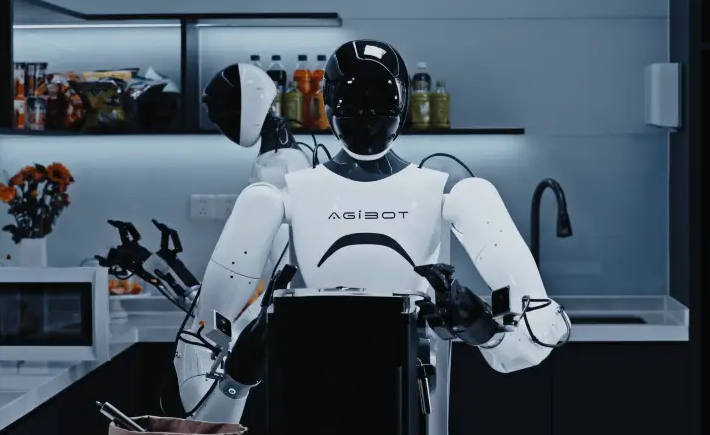
Chinese robotics startup Agibot is aggressively pivoting its business model from hardware sales to a cloud-like subscription service, setting an ambitious revenue target of RMB 100 billion (US$14.5 billion) by 2030. The strategic shift marks a critical inflection point for the broader embodied AI sector in 2026, transitioning from viral movement demonstrations to factory-floor productivity.
Speaking at the 2026 Agibot Partner Conference in Hong Kong, co-founder and CTO Peng Zhihui detailed the company's "358 Plan." Having cleared its initial RMB 1 billion (US$145 million) revenue hurdle in 2025, the Shanghai-based firm is now scaling its Robotics-as-a-Service (RaaS) unit, Qingtianzu, to target RMB 10 billion (US$1.45 billion) by 2027.
The market reaction underscores a maturing hardware landscape. Institutional investors are increasingly penalizing capital-intensive robotics manufacturers focused purely on kinematics, demanding instead recurring revenue streams and tangible integration into industrial supply chains.
Repositioning Hardware into RaaS Architecture
"We don't view Qingtianzu as a Taobao for robots; internally, the closer analogy is Amazon Web Services," stated Jiang Qingsong, Agibot’s Co-President. Instead of absorbing high upfront capital expenditures for humanoid units, manufacturing clients like Longcheer Technology and service sector brands like Haidilao are transitioning to pay-per-month deployment contracts covering scheduling, maintenance, and data management.
This operational pivot repositions the robot from a depreciating physical asset to an AI infrastructure node. Peng highlighted that deployed robots will become continuous "token consumption gateways." Unlike the discrete token consumption of text-based Large Language Models (LLMs), physical AI requires real-time perception, reasoning, and control, driving exponential, uninterrupted token utility within commercial workflows.
Driving Automation via Generative Motion Models
The commercial viability of the RaaS model relies heavily on eliminating rigid, high-cost programming. Outlining the company’s "One Body, Three Intelligences" architecture, Agibot CEO Deng Taihua unveiled the Generative Control Foundation Model (GCFM), signaling a departure from traditional motion-capture imitation.
Utilizing a cross-modal decoder—mechanically similar to Diffusion models used in image generation—GCFM allows robots to autonomously generate fluid, continuous actions via text, audio, or visual prompts. By shifting from executing predefined paths to generating real-time dynamic responses, the system drastically lowers the deployment threshold for enterprise clients.
To handle long-tail edge cases in factory environments, Agibot introduced the GE-2 World Model alongside an autonomous driving-style Distributed Online Learning System (SOP). By training units in simulated real-time environments, Agibot establishes a proprietary data closed-loop. As commercial deployment scales, edge-case data is routed back to the cloud, accelerating the global fleet’s learning curve without risking physical capital.
Establishing the Embodied AI Data Flywheel
Entering the second half of 2026, the competitive moat in the humanoid robot sector has definitively shifted away from mechanical engineering towards data scale and model iteration. Agibot's recent proof-of-concept at Longcheer’s Nanchang facility—where units executed 3,000 material handling tasks with a 100% success rate during an 8-hour live benchmark—validates its transition into the deployment growth phase.
As the industry targets generalized intelligence by 2030, hardware commoditization is highly probable. Agibot’s early transition to a data-driven, subscription-based ecosystem suggests the ultimate market leaders in China’s robotics supply chain will be software-defined platforms capable of monopolizing and monetizing real-world physical data.
Related Coverage:
AgiBot Secures Landmark Deal to Deploy Industrial Robots in Auto Sector