
ByteDance's Seedream 5.5 Targets Pro Creators With 100-Round Editing Stability
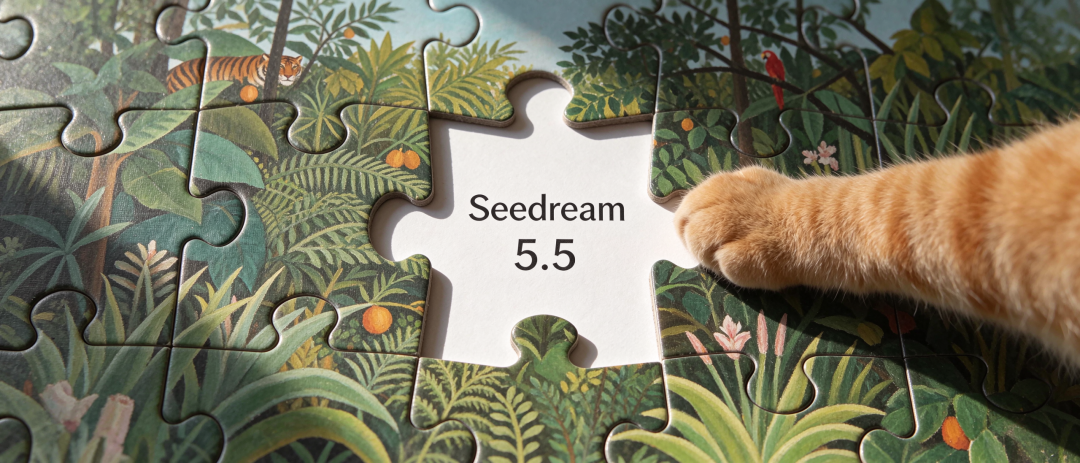
ByteDance Pushes AI Image Generation Into Production-Grade Territory as Seedream 5.5 Slashes Text Rendering Failures to 0.4%
ByteDance has launched Seedream 5.5, an upgraded image generation model that directly addresses the reliability gap preventing AI tools from replacing—rather than merely supplementing—professional visual production workflows, with benchmark data showing severe text corruption rates falling to 0.4% and usability scores in film and office-design scenarios more than doubling those of its predecessor.
The release, announced in mid-2026, marks a strategic pivot in how ByteDance positions its visual AI stack: away from consumer novelty and toward enterprise-grade dependability. The model is now rolling out across ByteDance's domestic platforms—Jimeng, Doubao, Doubao Work, and Volcano Ark—consolidating distribution within an ecosystem that already serves hundreds of millions of users across e-commerce, advertising, and entertainment verticals.
Internally, ByteDance frames the benchmark results as evidence of competitive leadership. Independent evaluation conducted via the MagicArena platform by domain-expert raters showed Seedream 5.5 achieving a text-to-image realism GSB (Good/Same/Bad) score of +55.62% relative to Seedream 5.0 Pro—a margin the company claims surpasses GPT Image 2.5 Sunburst and Nano Banana 2.1 on both text-structure fidelity and photorealism.
Solving the Accumulation Problem: Pixel-Level Stability Redefines Multi-Round Editing
The most commercially significant engineering claim in Seedream 5.5 is not raw image quality—it is edit-chain stability. The model is designed to preserve unedited pixels at a near-exact level across up to 100 consecutive editing rounds, each using the previous output as input.
This matters enormously for production economics. In a standard commercial photography or marketing-asset workflow, iterative revision cycles are unavoidable. Every time a generative model is re-prompted, legacy systems introduce color drift, texture degradation, and geometric inconsistencies that compound with each pass. Creative teams are then forced to restart or manually retouch, negating the efficiency gains AI was supposed to deliver.
ByteDance's solution involves dedicated training on non-edit-region preservation—ensuring that spatial relationships, occlusion logic, perspective, and shadow rendering update coherently with each change rather than drifting stochastically. Demonstrated use cases include 100-round character editing (adjusting jewelry, eyewear, and clothing while maintaining facial identity and lighting continuity) and room-renovation sequences where furniture repositioning correctly updates cast shadows and previously occluded surfaces.
For enterprise buyers procuring AI tools based on total workflow cost—not just per-image quality—this positions Seedream 5.5 as a tool that can anchor a full revision pipeline, not just generate a first draft.
Native RGBA Output Eliminates a Stubborn Post-Production Bottleneck
Seedream 5.5's native RGBA transparent asset generation—outputting images with embedded Alpha channels without requiring manual masking—targets a friction point that has quietly limited AI adoption in design and advertising studios.
The professional significance is structural. Post-production workflows in sectors such as fast-fashion e-commerce, gaming UI design, and digital advertising depend on compositable assets: elements that can be dropped onto variable backgrounds, layered in design software, or fed into motion graphics pipelines without additional clean-up. The current standard workflow—generate image, manually remove background, refine edge artifacts—adds labor hours and introduces inconsistency at scale.
By generating transparent assets natively, including complex structures such as layered feathers, fine hair strands, and semi-transparent materials, Seedream 5.5 compresses that post-production step to near-zero. The model also supports transparent artistic-text generation—producing calligraphic or stylized letterforms with transparent backgrounds directly from text prompts—a capability with direct applications in packaging, branding, and social-media creative.
The reusability angle is commercially acute: designers can store a single set of RGBA character assets and rapidly generate that character in new scenes, reducing redundant rendering time across campaign series.
Benchmark Outperformance Flags a Competitive Realignment in China's Foundation Model Race
ByteDance's decision to benchmark Seedream 5.5 explicitly against GPT Image 2.5 Sunburst and Nano Banana 2.1 is itself a strategic signal. It frames the competition not as a domestic Chinese model race but as a global one—and positions ByteDance as a credible challenger to OpenAI in the visual generation segment.
The quantitative case rests on three data points:
Text rendering has historically been a critical vulnerability for Chinese-language AI image models—complex stroke structures in Hanzi characters degrade far faster than Latin scripts under compression artifacts. A severe corruption rate of 0.4% across both Chinese and English dense-text benchmarks would represent a meaningful threshold for use cases such as infographic generation, product labeling, and document-layout automation.
The six production verticals tested—e-commerce, marketing, film & TV, gaming, office, and apparel design—map directly to ByteDance's existing enterprise customer base and to the sectors where AI-generated visual content is projected to see the highest replacement rates in 2026.
Distribution Strategy Locks Capability Inside ByteDance's Proprietary Ecosystem
Seedream 5.5's rollout architecture is notable for what it reveals about ByteDance's platform strategy. Rather than releasing via an open API first, the model debuts simultaneously across four controlled surfaces: Jimeng (consumer creative tool), Doubao (AI assistant app and web), Doubao Work (enterprise productivity suite), and Volcano Ark.
This distribution pattern serves two functions. First, it accelerates real-world usage data collection across diverse creative contexts—informing the next training iteration faster than any synthetic benchmark could. Second, it creates lock-in: creative teams that build multi-round editing workflows or RGBA asset libraries inside Doubao Work or Volcano Ark become structurally dependent on Seedream's specific behavioral consistency.
ByteDance has also confirmed that a Seedream 5.5 Pro variant is in development, suggesting the current release is positioned as a broadly accessible baseline while a higher-performance tier—likely targeting large enterprise and API customers—follows within months.
Impact Assessment: What This Means for the Visual AI Supply Chain
The Seedream 5.5 release has three tangible implications for stakeholders monitoring China's AI-to-enterprise commercialization curve in 2026:
For advertising and e-commerce agencies: 100-round stable editing and native RGBA output reduce the marginal cost of creative iteration significantly. Agencies running high-volume SKU image production—a standard requirement in Chinese e-commerce—gain a credible automation layer that extends beyond first-pass generation.
For competing model providers: ByteDance's explicit head-to-head benchmarking against GPT Image 2.5 Sunburst raises the bar for what counts as "production-grade." Domestic competitors including Kuaishou Technology, Baidu, and MiniMax will face increased pressure to publish comparable corruption-rate and usability metrics rather than relying on qualitative showcases.
For Volcano Ark's enterprise sales motion: The simultaneous deployment of Seedream 5.5 on Volcano Ark signals that ByteDance intends to monetize this capability directly through its cloud AI services business—competing with Alibaba Cloud's Tongyi Wanxiang and Tencent's Hunyuan image models for enterprise visual AI contracts.
ByteDance has indicated future development will focus on more complex contextual inputs, expanded Agent workflow integration across film, advertising, and retail sectors, and ongoing quality improvements. The roadmap explicitly targets a future where the model operates not as a standalone generation tool but as a node within automated production pipelines—a vision that, if executed, would shift the competitive battleground from benchmark scores to workflow integration depth.
Related Coverage:
Doubao AI Assistant Sparks Struggle for System Control with Major Chinese Apps
ByteDance Launches Seedream 5.0 Image Model with Search Capabilities