
China and Japan Chart Opposite Courses Into Brazil's Power Grid Buildout
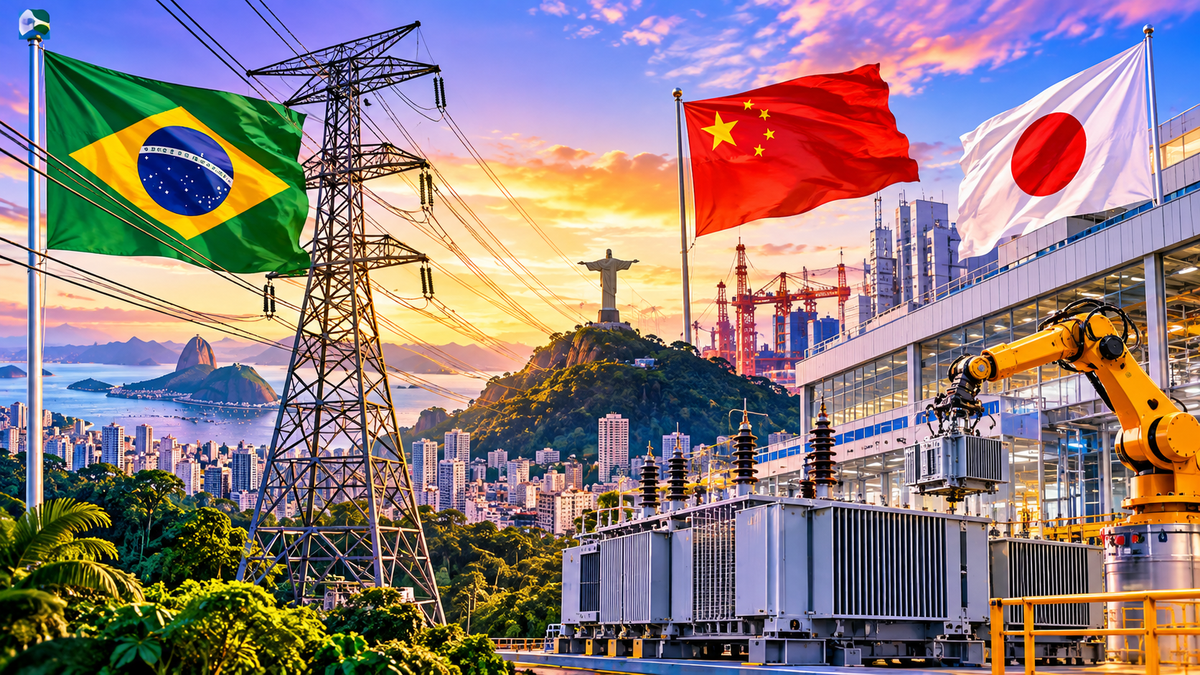
China's State Grid and Three Gorges entered Brazil as infrastructure owners; Japan's Toshiba built factories for 50 years, then sold them. Now, as a BRL 1.2 trillion grid expansion accelerates, both strategies are converging on the same prize: local manufacturing.
The world's largest emerging-market power grid buildout is forcing a strategic reckoning for Asian energy majors in Brazil. Chinese companies—having spent more than a decade acquiring transmission lines and hydropower concessions—are now pushing downstream into equipment manufacturing, while Japan's industrial capital has largely retreated from factory ownership, repositioning into financial stakes in generation assets and engineered components. The divergence illustrates how two of Asia's largest outbound investors can pursue the same market through fundamentally inverted playbooks.
The collision point is Minas Gerais state, where within six months two Chinese cable manufacturers planted flags. In May 2026, Hengtong Group acquired Cabelauto, an Itajubá-based cable maker with roughly 300 employees that had just commissioned a medium-voltage cable line following a BRL 30 million capital injection in 2025. On November 5, the state government announced that ZTT would invest BRL 110 million (approximately US$15.3 million) in a new power equipment plant in Três Corações, producing high-voltage cables, overhead conductors, and low-to-medium-voltage transformers—with groundbreaking set for December and production targeted for 2028, executed through ZTT's Turkish subsidiary Demirer Kablo.
Two Entry Vectors Define the Strategic Divide
The sequencing matters. Chinese enterprises entered Brazil through infrastructure ownership and are now extending into manufacturing. Japan's major industrial groups entered through manufacturing and are now holding financial positions in generation and gas distribution—with Hitachi Energy as the principal remaining Japanese presence in transmission equipment.
The clearest illustration of Japan's earlier trajectory is the Contagem factory in Minas Gerais, which Toshiba opened in 1968—more than 40 years before China's State Grid Corporation of China (国家电网) first acquired Brazilian transmission assets in 2010. By 2011, Toshiba had doubled down, investing approximately JPY 6 billion to build a second plant in Betim, 25 kilometers west, targeting medium-to-large power transformers, with exports reaching as far as Missouri utilities via the Port of Houston.
The retreat came quickly. After Brazil's consecutive GDP contractions of 2015 and 2016, combined with Toshiba's group-wide asset disposals, the company transferred its full stake in Toshiba South America to Brazilian private equity vehicle TSEA Participações in March 2018 for approximately BRL 50 million—after absorbing BRL 733 million in debt repayments and booking a JPY 33.8 billion disposal loss. The Betim plant subsequently changed hands again in 2020, acquired by Brazil's WEG for its large transformer division.
The strategic irony is sharp: Toshiba exited Brazilian transformer manufacturing just before the global transformer supercycle began. TSEA, now independently operated, reported BRL 1.5 billion in exports in 2023, supplies approximately 40 U.S. utilities, and is investing US$25 million in a North Carolina facility alongside a planned BRL 700 million expansion in Contagem to double capacity by 2029.
Hitachi Energy Bets BRL 385 Million to Anchor Japan's Remaining Equipment Position
Japan's most decisive recent move is Hitachi Energy's October 22 announcement of a BRL 385 million (approximately US$53.5 million) capacity expansion in São Paulo state, targeting high-voltage transformer bushings, tap changers, and insulation materials at its Pindamonhangaba plant and Guarulhos facilities. The company—whose technical foundation traces to ABB's power grid business, acquired by Hitachi in 2020—has accumulated 40 years of Brazilian manufacturing history, claiming cumulative output of approximately 100,000 bushings and 4,000 tap changers.
The stated rationale reveals the broader supply-chain logic driving all players: reducing lead times, cutting dependence on European and Asian component imports, and positioning Brazil as a Latin American supply hub. The same logic applies to ZTT and Hengtong, though their cost structures and integration into Chinese supply chains offer a different competitive profile.
Mitsui & Co. represents Japan's pivot toward financial infrastructure exposure. The trading house claims cumulative Brazilian infrastructure project value exceeding US$20 billion, holds a 20% stake in the Jirau hydropower concession (Brazil's fourth-largest hydroelectric plant), maintains equity in 18 natural gas distribution companies through Mitsui Gás, and took a 36% stake in power trading company Stima in 2022. Mitsubishi Power Americas, meanwhile, secured the engineering procurement and construction contract for Portocem, Brazil's largest peaking gas plant, in 2023.
China Holds the Grid, Now Wants the Supply Chain
State Grid Corporation of China operates more than 16,000 kilometers of Brazilian transmission lines across 13 states, with cumulative investment exceeding BRL 28 billion. Its Graça Aranha–Silvânia ultra-high-voltage direct current project, financed partly by a New Development Bank loan of up to RMB 2.15 billion (approximately US$298 million) approved in November 2025, is among the largest infrastructure projects currently under construction in Latin America.
Three Gorges Corporation entered Brazil in 2013 and within three years had acquired operational rights to two major hydropower stations—Jupiá and Ilha Solteira—for approximately BRL 13.8 billion, plus eight Duke Energy hydropower assets for US$1.2 billion, assembling an 8,270-megawatt portfolio to become Brazil's largest private power generator.
The critical structural point: owning the grid does not automatically route equipment procurement to Chinese suppliers. Brazilian transmission concessions operate under regulated competitive tendering; Hitachi Energy and WEG compete on the same procurement lists as any Chinese manufacturer. The ZTT and Hengtong investments represent an explicit attempt to close this gap—moving from asset ownership one layer down into the supply chain that feeds those assets.
The two companies chose structurally different entry mechanisms. ZTT is building greenfield, allowing full control over product specifications and technology systems, but requiring full capital deployment, production ramp-up, and customer development from scratch. The Minas Gerais state investment agency Invest Minas has facilitated introductions to Cemig's SupriMinas supplier program, though formal procurement contracts remain to be executed. Hengtong's acquisition of Cabelauto buys immediate production capacity, trained labor, and an existing customer base—at the cost of integration complexity.
Grid Expansion and U.S. Transformer Demand Create Simultaneous Pull
Two independent demand drivers are synchronizing investment timelines in 2026.
Brazil's domestic grid expansion is structural. Wind and solar generation is concentrated in the Northeast; industrial load centers anchor the Southeast. Brazil's Energy Research Company EPE projects transmission system expansion requiring approximately BRL 120 billion in investment through 2035. A series of transmission tenders from 2023 through 2026 has already committed approximately BRL 69.6 billion in planned investment. The October 30, 2026 Tender 04/2026 cleared all eight lots—covering 1,866 kilometers of new lines and 12,694 MVA of substation capacity—at an aggregate annual allowed revenue of approximately BRL 811 million, a 50.1% discount to ANEEL's BRL 1.625 billion ceiling.
That discount structure matters for equipment procurement. When concessionaires win contracts at half the regulatory ceiling, they optimize over 30-year operating horizons, weighting total lifecycle cost—price, delivery, certification, spare parts, and maintenance responsiveness. Locally manufactured equipment carries advantages in delivery lead time and potentially in BNDES FINAME financing eligibility, which favors certified domestic-content products.
The U.S. demand signal amplifies the investment case. Brazilian transformer exports reached US$649 million in January–July 2026, up 30% year-on-year, with US$495 million—76% of the total—destined for the United States, according to data from Brazil's electrical and electronics industry association Abinee. The U.S. grid modernization cycle has effectively subsidized Brazil's transformer manufacturing expansion, providing export revenue that cross-funds domestic capacity growth.
Impact Assessment: Who Holds the Structural Advantage
Japan's repositioning preserves stable, long-duration cash flows—Mitsui's generation and gas distribution stakes pay returns indexed to energy consumption and tariffs across multi-decade concession horizons. The trade-off is irreversible: Toshiba's exit from transformer manufacturing, executed eight years before the global supply crunch materialized, transferred the most valuable optionality in that trade to TSEA's private equity owners and subsequently to WEG.
China's position is heavier and structurally deeper. State Grid and Three Gorges hold physical infrastructure with decades of remaining concession life and direct operational relationships with Brazil's grid operators, regulators, and offtakers. The ZTT and Hengtong investments extend this footprint into the layer where recurring equipment revenue is generated.
The asymmetry to watch: Chinese infrastructure owners have procurement relationships that could, over time, favor domestically manufactured equipment—particularly as local manufacturing certifications mature and supply-chain integration with Chinese parent companies reduces component costs. Whether Brazil's regulatory and procurement framework allows preferential treatment of vertically integrated players will shape how much of that potential converts to realized market share.
Brazil's grid expansion has a ten-year planning horizon; the transmission lines being built today carry operating concessions of three decades. The companies that convert existing infrastructure positions into durable equipment supply relationships will capture the most defensible margin in the market. In 2026, that race is fully underway—and both Asian strategies have genuine, if asymmetric, claims on the outcome.
Related Coverage:
BYD Deepens Brazil Push With São Paulo SkyRail Test, Blade Battery Bus Delivery
ByteDance Races to Build Second Phase of Brazil's Largest Data Center