
China Completes Critical Flight Test for Lunar Landing Program as 2030 Deadline Looms
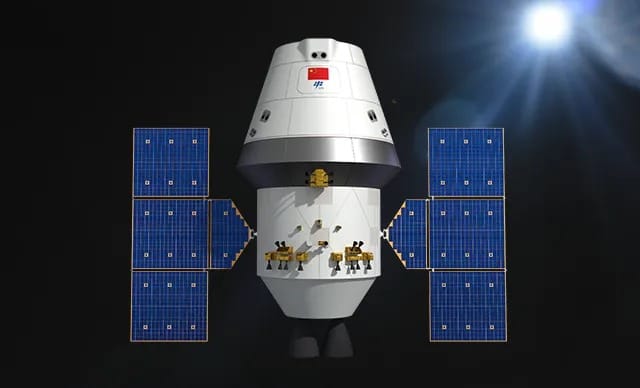
China successfully conducted a maximum dynamic pressure escape flight test for its next-generation crewed spacecraft and heavy-lift rocket on Tuesday, marking a significant milestone in the country's ambition to land astronauts on the Moon by 2030. The test verified the Mengzhou spacecraft's ability to safely separate from the Long March-10 rocket under the most dangerous flight conditions, while also demonstrating sea recovery capabilities for both the spacecraft's return capsule and the rocket's first stage.
At 11:00 a.m. Beijing time on February 11, 2026, the Long March-10 rocket's first stage lifted off from Wenchang Space Launch Site carrying the Mengzhou spacecraft. Upon reaching maximum dynamic pressure conditions, the spacecraft successfully received the escape command from the rocket and executed separation, according to the China Manned Space Agency. Both the rocket's first stage and the spacecraft's return capsule splashed down safely in predetermined sea areas.
The test represents China's first maximum dynamic pressure escape trial for a crewed spacecraft and the first sea recovery of both a crewed spacecraft return capsule and a rocket first stage. It follows earlier developmental tests including tethered ignition tests for the Long March-10, zero-altitude escape tests for Mengzhou, and landing verification for the Lanyue lunar lander.
New Spacecraft and Rocket System
The Mengzhou spacecraft represents China's new-generation reusable crewed vehicle, developed as a comprehensive upgrade from the Shenzhou spacecraft. Featuring modular design with a return capsule and service module, the spacecraft will serve both near-Earth space station operations and lunar landing missions. The lunar variant is designated "Mengzhou Y."
The Long March-10 series, coded "CZ-10," comprises China's new-generation heavy-lift launch vehicle designed specifically for crewed missions. The three-stage configuration with two boosters will launch both the Mengzhou Y spacecraft and the Lanyue lunar lander for Moon missions. A derivative variant, Long March-10A (CZ-10A), features a reusable first stage for near-Earth orbit missions and will conduct its maiden flight in 2026, carrying the unmanned Mengzhou-1 test mission.
According to the mission schedule, Mengzhou-1 will dock with the radial port of China's space station core module following its launch from Wenchang. The 2026 manifest also includes Shenzhou-23 and Shenzhou-24 crewed missions, plus the Tianzhou-10 cargo mission. One astronaut aboard Shenzhou-23 will conduct an extended stay exceeding one year.
Critical Safety Validation
The test addressed what industry analysts describe as a "life-or-death" safety validation for future astronauts. Maximum dynamic pressure represents the most dangerous phase of flight, when the combination of velocity and atmospheric pressure reaches extreme levels. The escape system must activate instantaneously during simulated failures at this critical moment, pulling the return capsule to safety.
The trial involved multiple firsts and technical challenges. Participating rocket and spacecraft hardware remained in prototype status, with the rocket using a single-core first-stage configuration following two prior tethered ignition tests. The spacecraft's return capsule had previously completed zero-altitude escape testing. All test components underwent adaptation modifications according to reusability requirements and procedures.
The test also validated sea recovery operations for the rocket's first stage, exploring cost-reduction pathways for space transportation. Wenchang Space Launch Site implemented a concurrent construction and operation strategy to meet the test schedule, while landing system teams conducted specialized training for the technically challenging first sea recovery of a spacecraft return capsule.
2030 Lunar Landing Timeline
The test directly supports China's stated timeline for crewed lunar exploration. In 2023, Lin Xiqiang, spokesperson for China's Manned Space Program and deputy director of the China Manned Space Agency, confirmed plans to achieve the first Chinese crewed lunar landing before 2030.
The lunar exploration program aims to conduct scientific investigations and related technology demonstrations, according to official statements. Key technical objectives include mastering crewed Earth-Moon transit, short-term lunar surface stays, and human-robotic joint exploration. Mission tasks encompass landing, roving, sampling, research, and return operations, ultimately establishing independent crewed lunar exploration capabilities.
The successful completion of this flight test provides critical flight data and engineering experience for subsequent lunar missions, validating the functional performance of the rocket's first-stage ascent and recovery phases, spacecraft maximum dynamic pressure escape and recovery systems, and interface compatibility across all program systems.