
China's AI Unicorn ModelBest Surpasses RMB 20B Valuation After RMB 5B AI Funding Surge
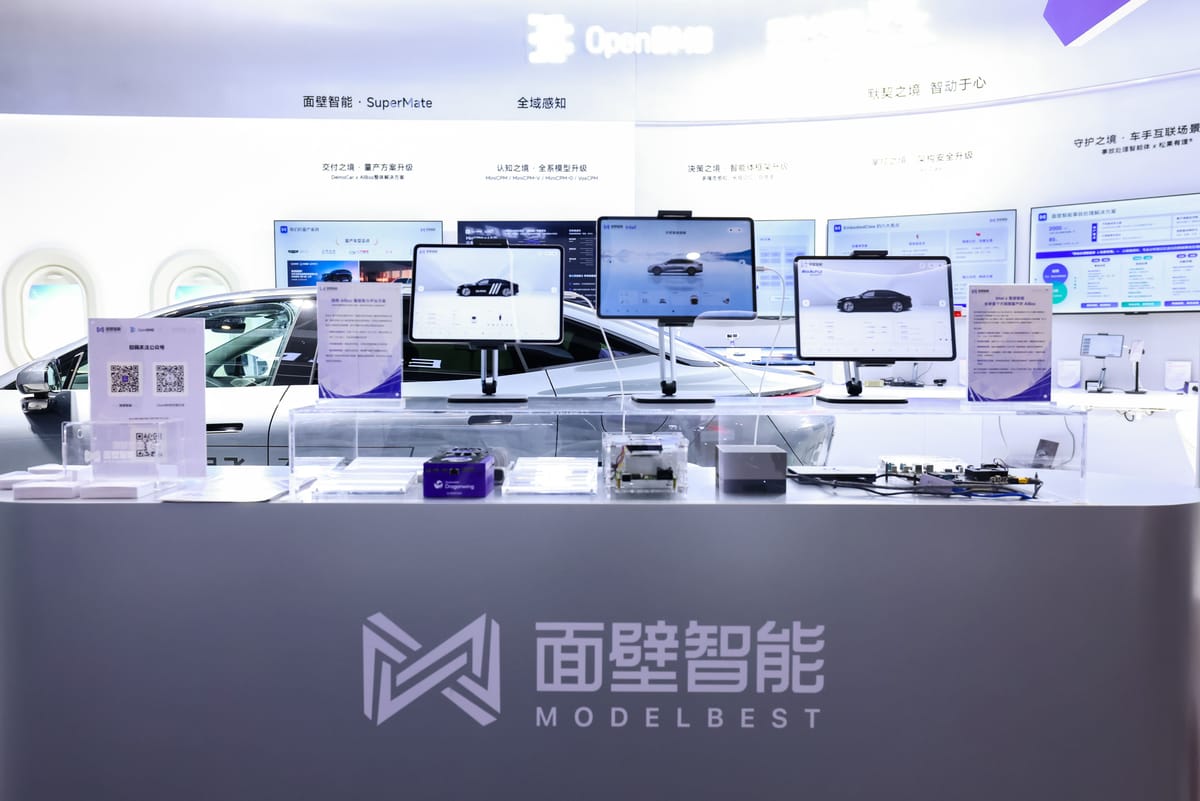
Beijing's ModelBest has emerged as China's most highly valued on-device AI unicorn, closing the first half of 2026 with cumulative fundraising exceeding RMB 5 billion (US$694 million) and a valuation surpassing RMB 20 billion (US$2.78 billion) — a milestone that signals a decisive shift in Chinese AI capital from cloud-scale model races toward edge-deployment commercialization.
The latest funding round, announced July 15, draws a notably broad coalition of backers: national-level government funds, central state-owned enterprises, automotive manufacturers, and institutional financial investors. The company declined to disclose the precise size of the current tranche, but the cumulative H1 2026 figure cements ModelBest's position ahead of all publicly valued peers in the on-device large language model (LLM) segment. The valuation leap reflects intensifying industrial-capital conviction that edge AI — models running locally on smartphones, vehicles, and robotics hardware without cloud dependency — is entering a phase of scaled commercial delivery rather than speculative promise.
Market observers note the investor composition itself carries strategic weight. China Telecom, which led a February 2026 round alongside China CITIC Financial Asset Management and CITIC Private Equity, brings cloud, network, and compute infrastructure that can accelerate ModelBest's hybrid deployment architecture. A subsequent April round, co-led by Shenzhen Capital Group and Inovance Technology's industrial investment arm, with participation from Dao He Long-Term Capital, Guotai Junan Innovation Investment, and WuYueFeng Venture Capital, extends ModelBest's reach into industrial automation, automotive intelligence, and embodied AI — precisely the verticals where on-device inference has a structural cost and latency advantage over cloud alternatives.
Densing Law Anchors a Differentiated Technical Thesis
ModelBest's fundraising trajectory is underpinned by a proprietary theoretical framework that has achieved rare academic validation. In 2024, the company's research team, in collaboration with Tsinghua University, proposed the "Densing Law" — positing that the peak capability density of open-source large models doubles approximately every 3.5 months. The paper was published in Nature Machine Intelligence in November 2025 and selected as a cover article, lending the company a credibility marker that few Chinese AI startups can claim.
The concept of "capability density" — measuring model performance per unit of parameters — is not merely academic positioning. It directly informs the commercial logic of on-device AI: if a 1-billion-parameter model can match or exceed the benchmark scores of models with far larger parameter counts, the economics of local deployment on constrained hardware become viable at automotive and consumer-electronics scale.
That thesis is being tested in practice. In May 2026, ModelBest, jointly with Tsinghua University and the OpenBMB open-source community, released MiniCPM5-1B, a 1-billion-parameter on-device text foundation model. The model scored 17.9 on the Artificial Analysis Intelligence Index, outperforming multiple open-source base models with significantly larger parameter counts. A companion release, BitCPM-CANN, employs 1.58-bit ternary quantization and was fully trained on Huawei's Ascend cluster — a detail that underscores both the domestic compute supply chain alignment and the memory efficiency gains. ModelBest claims BitCPM-CANN reduces VRAM consumption by approximately 6x compared with conventional models during inference, a figure that is material when deploying across millions of automotive or IoT endpoints.
The MiniCPM open-source model series has accumulated over 38 million cumulative downloads across GitHub and Hugging Face, a distribution metric that creates a developer ecosystem moat independent of any single commercial partnership.
Automotive Sector Drives Near-Term Revenue Visibility
Of the multiple verticals ModelBest has entered — including smartphones, PCs, smart home devices, low-altitude aircraft, civil aviation, legal services, and embodied intelligence — automotive represents the most advanced commercialization front. The company has achieved mass-production deployment across multiple vehicle lines from Changan Automobile, SAIC Motor, and Geely Auto. ModelBest projects that on-device models will be embedded in hundreds of thousands of vehicles in 2026, primarily powering intelligent cockpit applications.
This trajectory matters for revenue quality. Automotive design-win cycles are long, but once a model is integrated into a production vehicle platform, per-unit licensing revenue scales directly with output volumes — a fundamentally different economics profile from cloud API subscription models that face margin pressure from compute costs. The participation of at least one automotive manufacturer in the latest funding round further tightens the commercial loop between capital provider and end customer.
Beyond automotive, ModelBest is preparing to publicly launch CPM for Legal, its first dedicated professional legal services infrastructure product, signaling an intent to move up the value stack from foundation model provider toward domain-specific AI infrastructure.
State Capital Validates, But Commercialization Remains the Defining Test
Founded in August 2022 and spun out of Tsinghua University's Natural Language Processing Laboratory, ModelBest has now completed at least eight disclosed funding rounds in under four years. Prior investors include Zhihu, Zhipu AI, Primavera Capital, Huawei Hubble Investment, Beijing Artificial Intelligence Industry Investment Fund, Loongson Ventures, Dinghui Baifu, Zhongguancun Science City Fund, SAIF Partners, Moutai, Hongtai Capital, Guozhong Capital, Jingguo Rui, Guoke Investment, and CICC Porsche Fund.
The breadth of state-affiliated capital — from national-level funds to central SOEs — reflects Beijing's strategic priority on domestic edge AI as a counterweight to U.S. restrictions on advanced chip exports, which have structurally constrained cloud-compute scaling paths for Chinese AI developers. On-device models that run efficiently on domestically produced chips, including Huawei's Ascend series, are therefore both a commercial product and a policy-aligned technology direction.
CEO Li Dahai, a former partner and CTO at Zhihu, and co-founder and Chief Scientist Liu Zhiyuan, a sitting professor in Tsinghua's Department of Computer Science, bring a combination of commercialization experience and academic research depth that is uncommon in the sector. Liu previously led development of the knowledge-enhanced pre-training model THU-ERNIE and co-developed the Chinese pre-training language model CPM — the lineage from which MiniCPM directly descends.
The RMB 20 billion valuation and RMB 5 billion H1 fundraising total are significant benchmarks. They also define the pressure ModelBest now faces: converting 38 million model downloads, a growing roster of automotive design wins, and a Nature-published scaling law into durable, recurring revenue at a scale that justifies the capital structure. As the broader Chinese AI industry shifts from parameter-count competition to efficiency, deployment breadth, and sustainable monetization, ModelBest's next 12 months will determine whether its edge-first thesis produces a genuinely differentiated business or merely a well-funded research vehicle.
Related Coverage:
15 Embodied AI Unicorns in 6 Months: China’s Robot Race Hits a Reality Check