
China’s Auto Exports Surge, but Residual Value Gap Threatens Growth
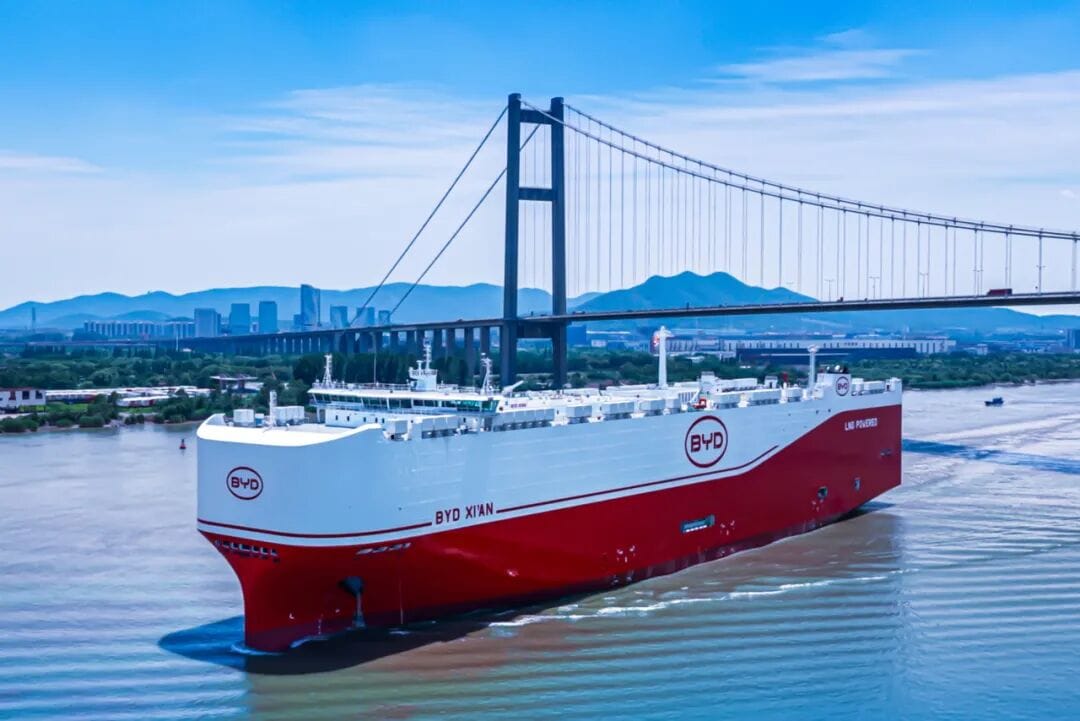
Chinese automakers have conquered volume—now they must conquer trust.
In the first four months of 2026, China exported 3.127 million vehicles, a 61.5% year-on-year jump that has reshaped dealer floors from Edinburgh to São Paulo. Yet beneath the headline numbers, a structural fault line is widening: a 15% to 25% residual value discount on Chinese EVs versus comparable European and Japanese models—driven entirely by ecosystem deficiencies, not product quality—is quietly eroding the price advantage that fueled the initial breakout.
The tension surfaced visibly at the 2026 Beijing Auto Show in May, where overseas distributors from Mozambique to Milan crowded around the booths of BYD, Li Auto, NIO, and Zeekr, scrutinizing suspension geometry and battery swap ports. Their presence signals genuine commercial appetite. Their hesitation signals something equally important.
Volume Metrics Mask a Deepening Regional Bifurcation
The raw export data flatters. In the United Kingdom, Chinese brand registrations climbed to 15% of new-car sales in March 2026, up from 7.4% in the same month a year earlier, according to the Society of Motor Manufacturers and Traders. In Germany, BYD's first-quarter registrations surged 644% year-on-year. In Mexico, vehicles manufactured in China captured 23% of total sales in January through April, per data from the Instituto Nacional de Estadística y Geografía (INEGI).
Yet the growth trajectories diverge sharply by market maturity. In Germany and the UK, Chinese brands are winning younger, tech-oriented buyers who discovered them through TikTok—but the dominant purchasing cohort, middle-aged and older consumers who finance vehicles through personal contract purchase (PCP) arrangements or fleet leases, remains largely unmoved. In those financing structures, residual value is the primary decision variable. Carlos García, Vice President and Global Automotive Center Head at Solera Group—which advises Chinese automakers on overseas repair-data compliance—quantified the problem precisely: "The 15-25% residual value discount is driven entirely by ecosystem factors—service network uncertainty and parts-data gaps—not by the vehicle itself. In some markets, that insurance and financing premium is large enough to fully offset the purchase price advantage."
Emerging markets tell a different story. Brazil, Mexico, and several Central Asian economies are absorbing Chinese vehicles at an accelerating pace, partly because incumbent offerings from Volkswagen, General Motors, and Toyota have historically prioritized basic specifications at mainstream price points. Chinese brands are importing large-screen cockpits and over-the-air software updates into segments where such features were previously unavailable. BYD's production base in Camaçari, Bahia, Brazil—now fully operational—has already rolled out more than 50,000 units. April alone generated 15,000 sales in Brazil, pushing the January-through-April cumulative registration count to 56,000-plus, an 86% year-on-year increase.
Localization Investments Begin Addressing Supply Chain Gaps
The strategic response is already visible in capital allocation. In May 2026, Leapmotor announced a deepened collaboration with Stellantis to expand capacity at a Spanish manufacturing facility, targeting local European production of the Leapmotor B10 through their joint venture, Leapmotor International. The arrangement also enables joint procurement, integrating Chinese and European supply chain resources—a direct attempt to compress the parts-availability lag that inflates insurance premiums and depresses residual values.
BYD's Brazil localization is the most advanced case study. By producing within the Mercosur trade bloc and adapting powertrain configurations to accommodate ethanol flex-fuel requirements—which still account for roughly 70% of Brazil's light-vehicle market—BYD and Changan have demonstrated a willingness to engineer for local conditions rather than simply re-badge domestic models. That distinction matters. J.D. Power China's Automotive Product Solutions Director Wang Shen noted that market-specific engineering failures—chassis corrosion from road salt in Russia and Scandinavia, range degradation at the sustained 160-180 km/h speeds common on unrestricted German autobahns, powertrain stress from Mexico's hilly terrain—are not manufacturing defects. They are a consequence of a development model that remains China-first and globally adaptive, rather than globally architected from the outset.
After-Sales Infrastructure Emerges as the Binding Constraint
Roland Berger Senior Partner and Asia Automotive Lead Zheng Yun ranked the constraints explicitly in order of priority: localized service network deficiencies first, regional product adaptation second, and global quality-control consistency third. The sequencing is analytically significant. It implies that even a technically superior vehicle will struggle to build brand equity if the ownership experience—warranty claims, parts availability, ADAS recalibration costs—remains unpredictable.
The insurance channel makes this concrete. When parts data is absent from standard industry databases and labor-time guides are undefined, insurers apply an "uncertainty premium" to Chinese EV policies. García's assessment: in certain markets, that premium fully neutralizes the sticker-price discount that Chinese brands rely upon to drive initial conquest sales. The implication for investor modeling is direct—volume growth supported by aggressive pricing faces a structural ceiling if after-sales infrastructure investment does not keep pace.
Geely Automobile Holdings CEO and Executive Director Gui Shengyue acknowledged the gap candidly: "The international capital market recognizes China's EV transition speed and value-for-money proposition. But whether Chinese brands can compete with traditional luxury marques—there is no consensus on that yet globally."
Smart Technology Accelerates Growth but Cannot Substitute for Durability
The temptation for Chinese OEMs is to lean on software differentiation—voice assistants, intelligent driving, over-the-air updates—as a substitute for the slower work of building service networks and corrosion-resistant platforms. Zheng Yun pushed back on that logic directly: "Intelligent features are China's core differentiation moat globally and can meaningfully support premium pricing. But they cannot compensate for durability shortfalls, and they cannot independently construct the foundational brand trust that underpins long-term residual value."
Arcfox founder and CEO Yan Feng framed the strategic shift in terms that resonate with the Roland Berger analysis: the transition is from "Made in China"—value-for-money manufacturing—to "Intelligently Made in China"—from value-for-money manufacturing to ecosystem-driven intelligent manufacturing. The distinction is not merely rhetorical. It implies a different investment profile: R&D spending must shift from feature velocity toward global durability certification, regional homologation depth, and owned or tightly managed service infrastructure.
Zheng Yun's three-step prescription for closing the reputation gap is operationally specific: first, standardize service quality and establish regional parts hubs in core markets to rapidly reduce service-related complaints; second, align domestic and overseas quality-control standards and complete full-lineup upgrades for corrosion resistance, durability, and extreme-condition reliability; third, build two to three flagship markets as proof-of-concept for a quality-and-value positioning—demonstrating that the brand can hold residual value before attempting broader premium expansion.
His three-to-five-year outlook: Chinese brands are fully capable of closing the quality-reputation gap with mainstream German and Japanese competitors in global markets, with selective leadership positions in specific segments. Full premium mindshare parity will require a longer cycle.
Related Coverage:
Morgan Stanley Cuts China EV Targets as Homogenization Looms, Bets on AI and Exports
China EV Outlook: Domestic Saturation Triggers Export Pivot and Channel Wars in 2026