
China’s Robot Exports Hit RMB 19.99 Billion, Break Into Germany and Japan
Chinese robot exports reached 10.377 million units across more than 150 countries and regions in the first five months of 2026, with export value nearing RMB 20 billion — a structural shift that signals Beijing’s high-end manufacturing export push is gaining momentum.
China’s General Administration of Customs released disaggregated trade data on July 5, 2026, showing cumulative robot exports of 10.377 million units valued at RMB 19.99 billion (US$2.78 billion) for the January–May period. That figure has already surpassed the full-year 2025 industrial-robot export total of RMB 11.97 billion (US$1.66 billion), although the two figures are not perfectly comparable because the 2026 data refer to the customs’ standalone robot category while the 2025 comparison refers specifically to industrial robots. The European Union and ASEAN are the two largest destination clusters.
The data arrives as China's so-called "new three" export pillars — electric vehicles, solar panels, and lithium batteries — show decelerating growth curves in 2026, leaving robotics to emerge as the most dynamic incremental contributor to China's advanced-manufacturing trade account. The transition is not merely volumetric: industry analysts note that the export model has fundamentally shifted from single-unit hardware sales toward bundled intelligent-manufacturing solution packages that carry materially higher per-contract values.
Cleaning Robots Anchor the Base, Generating Over 70% of Export Revenue
Consumer-oriented cleaning robots remain the undisputed revenue engine, contributing RMB 14 billion (US$1.94 billion) — more than 70% of total robot export value — in the first five months of 2026. The category encompasses robotic floor-scrubbers, commercial cleaning platforms, and autonomous lawn-mowing devices, all underpinned by domestically integrated supply chains covering LiDAR modules, AI vision processors, and autonomous navigation software stacks.
Ecovacs Robotics, Roborock, and Dreame Technology — the three dominant players in the segment — have systematically expanded cross-border e-commerce channels alongside offline retail partnerships in European hypermarkets and Southeast Asian electronics chains. Their current export products feature self-cleaning wastewater-circulation systems, multi-language voice interaction, and full-perimeter obstacle avoidance — proprietary capabilities that have enabled stable pricing premiums and reduced reliance on price-competition tactics that characterized earlier export cycles.
The competitive implication is significant: traditional Western and Japanese household-appliance brands are ceding measurable shelf space in the global consumer-cleaning-robot market to Chinese incumbents whose iteration cycles and cost structures are structurally advantaged by a complete domestic component ecosystem.
Industrial Robots Breaking Into Germany and Japan, Reversing Decades of Import Dependency
Industrial robots represent the fastest-growing segment by export velocity. China shipped approximately 70,000 industrial robot units in the first five months of 2026, a year-on-year increase of 39.5%, with handling robots, welding robots, and collaborative robots ("cobots") accounting for the highest demand concentration. End-use applications span overseas infrastructure projects, light-manufacturing lines, and food and pharmaceutical production facilities.
The most strategically consequential data point: industrial robot exports to Germany surged 84% year-on-year in the January–May period, while shipments to Japan rose 36.5% over the same interval. These two markets represent the historical heartland of global industrial robotics — home to KUKA (now Midea-owned), Fanuc, and Yaskawa Electric. China achieving net industrial robot export status in 2025 and now penetrating German and Japanese supply chains marks a definitive reversal of a multi-decade import-dependency pattern.
A qualitative shift is also reshaping order structures. Overseas factory buyers increasingly procure complete intelligent production-line solutions rather than standalone machines, with Chinese vendors now bundling installation commissioning, localized maintenance, and algorithm-update services into contracts. This migration from hardware unit sales to integrated-service packages directly expands per-deal revenue and deepens customer lock-in.
Humanoid and Bionic Robots Establish Beachhead, Eyeing Commercial Inflection
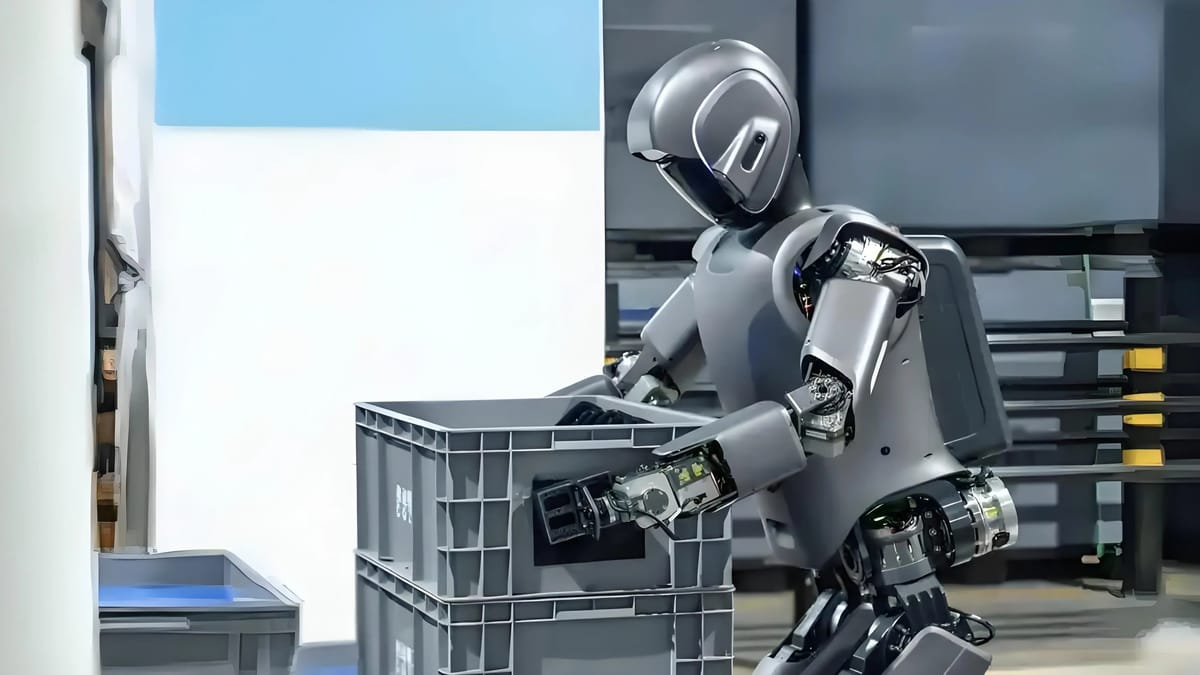
The humanoid and intelligent bionic robot category remains the smallest by volume but carries the highest long-term optionality. Exports exceeded 8,000 units in the first five months of 2026, with an aggregate declared value of approximately RMB 120 million (US$16.7 million). Primary deployment contexts include university research laboratories, industrial-park inspection circuits, and public-service installations at trade exhibitions.
China's Ministry of Industry and Information Technology and the State-owned Assets Supervision and Administration Commission jointly launched a 2026 Humanoid Robot and Embodied Intelligence Field Training Initiative earlier this year, signaling coordinated policy support for the segment's commercial maturation. More than 140 Chinese humanoid robot companies are currently active in the domestic market, competing across multi-degree-of-freedom dexterous-hand design, whole-body motion control, and real-time environmental perception.
Market participants broadly expect a commercial deployment inflection point within two to three years, at which stage humanoid robots would open a fourth export growth curve beyond the current consumer, industrial, and bionic categories. North American markets are already demonstrating higher acceptance rates for commercial inspection robots and bionic platforms relative to other regions, providing early channel infrastructure for that anticipated scale-up.
Supply-Chain Completeness Drives Systemic Cost Advantage Over Global Peers
The structural foundation sustaining near-RMB 20 billion in five-month export revenue is China's vertically integrated robotics supply chain — spanning servo motors, precision reducers, torque sensors, vision modules, and full-system integration — which enables new-product iteration cycles, mass-production lead times, and all-in manufacturing costs that international competitors cannot replicate at equivalent scale.
A regulatory catalyst has compounded this advantage: China Customs' introduction of dedicated harmonized tariff codes for robots has streamlined clearance procedures and statistical reporting, reducing compliance friction particularly for small- and medium-sized exporters entering overseas markets for the first time.
Regional demand profiles are diverging in ways that reward differentiated product strategies. The EU market prioritizes high-specification cleaning robots and lightweight cobots, with stringent energy-efficiency and safety-certification requirements. ASEAN buyers balance household cleaning and basic logistics-handling robots, with price-performance sensitivity driving volume. North America skews toward humanoid, bionic, and commercial-inspection platforms, with physical retail demonstration channels developing faster than in other regions. Leading Chinese manufacturers have responded with region-specific product matrices and are accelerating investment in overseas local warehousing and after-sales service networks.
Headwinds Remain: Certification Barriers, Component Dependencies, and After-Sales Gaps
Despite the export momentum, structural challenges persist. Divergent overseas trade barriers and certification frameworks — particularly CE marking in Europe and UL standards in North America — continue to inflate compliance costs and extend market-entry timelines. Humanoid robot core components, including certain high-precision actuators and specialized sensors, retain residual import dependencies that expose supply continuity to geopolitical friction.
After-sales service infrastructure remains a recognized weak point: local technical support teams in overseas markets are understaffed relative to the pace of installed-base growth, creating long-cycle maintenance risk that could erode brand equity in premium segments. Several leading manufacturers have initiated overseas localized manufacturing and regional R&D center investments as a structural hedge against these constraints — a capital-allocation shift that, if sustained, would further entrench Chinese robotics in global supply chains.
Related Coverage:
China’s $15.7 Billion Robotics Export Surge Maps a Post-EV Globalization Playbook