
Even Realities Raises $150M Pre-B Round at $1.2B Valuation, Backed by Meituan and Tencent
Shenzhen-based smart glasses startup Even Realities has secured a US$150 million Pre-B funding round co-led by Meituan and Tencent, vaulting the three-year-old company into unicorn territory at a US$1.2 billion post-money valuation — a milestone that underscores how a camera-free, privacy-first hardware thesis is finding traction against Meta’s dominant wearables playbook.
The round, announced July 6, 2026, is the largest single financing in Even Realities' history, surpassing four separate closes completed across all of 2024. Meituan Dragon Pearl and Meituan's strategic investment arm led the deal, with Tencent and existing shareholders participating on an oversubscribed basis, according to Chinese corporate registry platform Tianyancha. The capital injection brings the company's total disclosed funding to a figure that places it among the best-capitalized smart-eyewear pure-plays outside the United States.
Market context amplifies the significance of the timing: global smart glasses shipments hit 3.566 million units in Q1 2026, up 130.1% year-on-year per IDC data, yet Meta (META.O) still commands roughly 70% share. Even Realities is explicitly betting that a slice of the remaining 30% — captured through premium positioning and privacy architecture — can sustain a unicorn-scale business.
Differentiating Through Display, Not Surveillance
Even Realities occupies a deliberately narrow lane. Unlike Meta's Ray-Ban smart glasses and Snap's (SNAP.N) newly released Spectacles — both of which shipped camera-equipped hardware last month — Even Realities has eliminated the camera entirely. The strategic rationale, articulated by founder Will Wang in a Financial Times interview, is blunt: "We don't want to build something with a camera on your face."
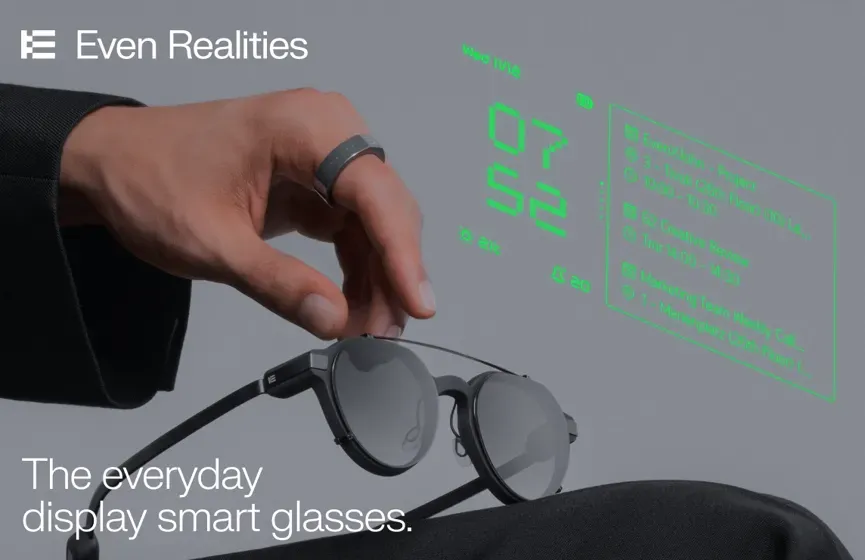
The company's flagship Even G2, launched November 2025, centers its value proposition on a binocular monochrome green Micro LED display with 640×350 resolution, a 60Hz refresh rate, and peak brightness of 1,200 nits — specifications that position it closer to an always-on heads-up display than an entertainment device. Waveguide optics project information directly into the wearer's line of sight. The frame weighs 36 grams, uses a magnesium alloy front and titanium temples, and is visually indistinguishable from premium optical eyewear.
Interaction is handled via voice commands or the optional Even R1 smart ring — a hardware accessory that lifts average order value toward US$1,000 when bundled with prescription lens customization, compared with the G2’s US$599 standalone price. That ASP is materially above the RMB 2,000–3,000, or approximately US$278–US$417, mainstream price band dominating the Chinese smart glasses market.
Privacy Architecture Becomes a Moat, Not Just a Feature
Even Realities has embedded privacy protection at the silicon and software layer rather than as a policy overlay — a distinction that matters increasingly as regulators in the EU, U.S., and parts of Asia scrutinize biometric data collection. The company's Conversate real-time conversation assistant converts voice to text locally without storing audio recordings. User data is encrypted end-to-end, and the infrastructure is certified to European privacy standards.
This architecture has a dual commercial function: it pre-empts regulatory friction in Even Realities' highest-revenue markets and serves as a credible selling point to the company's core demographic. More than half of its user base is located in the United States — its fastest-growing market — followed by Japan, South Korea, the Middle East, and Europe. Approximately one-third of users are corporate executives, and the typical buyer is a male professional aged 30–50. Roughly 80% of the developer community is also U.S.-based.
Notably, Even Realities manufactures across multiple factories in China but has not yet entered the domestic Chinese consumer market — a sequencing decision that suggests management is prioritizing margin-rich Western markets before navigating China's intensely competitive and price-sensitive wearables landscape.
Unit Economics Signal Rare Hardware Viability
The company's operational metrics are unusual for a hardware startup at this stage. Even Realities turned profitable after its first product, the Even G1, launched in 2024 — a year in which it also closed four funding rounds. Revenue "surged sharply" following the G2 launch, according to the company, without disclosing absolute figures.
Engagement data reinforces the profitability story: weekly active usage exceeds 90%, while daily active usage runs at 60–70%. For a wearable device priced near $1,000 all-in, those retention figures suggest the product is solving a workflow problem rather than satisfying a novelty purchase — a distinction that justifies the premium and reduces churn-driven demand destruction.
Headcount growth mirrors the revenue trajectory. Even Realities employed approximately 35 people in 2024; the team has since expanded to 400, a roughly 11-fold increase in under two years.
Meituan's Strategic Logic Extends Beyond Returns
The identity of the lead investor deserves scrutiny. Meituan — China's dominant local services platform with a market capitalization exceeding HK$1 trillion — is not a conventional hardware venture backer. Its participation through both Dragon Pearl (the financial return vehicle) and its strategic investment arm signals that Meituan sees Even Realities as potentially relevant to its own ecosystem ambitions, whether in last-mile delivery coordination, restaurant-facing enterprise tools, or the broader push by Chinese internet platforms into AI-native hardware interfaces.
Tencent's co-investment adds a social and gaming distribution angle. Together, the two strategic anchors provide Even Realities with access to two of China's most extensive consumer and enterprise networks — a resource that could prove decisive if and when the company decides to enter the domestic market.
The existing cap table is equally notable. Sequoia China, CDH VGC, Qingshan Capital, Monolith, Aier Eye Hospital Group, China Merchants Bank International, Dachen Capital, and Guanghe Ventures are all listed shareholders — a roster that spans generalist VC, healthcare optics, and state-linked financial capital.
Proceeds Target Next-Generation Platform and AI Integration
Even Realities said the Pre-B proceeds will fund three priorities: development of a next-generation smart glasses platform, deeper AI integration across the product stack, and expansion of global operations. The AI integration roadmap is particularly consequential: the G2's current Conversate feature is a narrow conversational assistant, and any move toward on-device multimodal AI — processing visual context without a camera, or integrating with third-party LLMs — would represent a meaningful capability step-change.
Founded in late 2023 by Wang, a former Apple (AAPL.O) engineer who contributed to Apple Watch and iPhone production engineering and holds degrees from Shanghai Jiao Tong University and UC Berkeley, Even Realities has reached unicorn status in roughly 30 months. Other co-founders bring backgrounds in consumer technology and premium eyewear, including Danish luxury optical brand Lindberg — a pedigree that explains the company's emphasis on form factor and wearability.
The global smart glasses market, still nascent at 3.57 million quarterly units, is bifurcating: camera-equipped social and AI-assistant devices on one axis, and display-forward, privacy-compliant productivity tools on the other. Even Realities has staked US$150 million — and a US$1.2 billion valuation — on the latter axis proving larger than the market currently prices it.
Related Coverage:
China's Smart Glasses War Reshapes as Alibaba's Qianwen and Xiaomi Crack the Top Five