
DJI Aggressively Expands Portfolio in 2025 with AI-Driven Industrial Drones and Smart Home Entry
DJI Technology significantly diversified its hardware ecosystem in 2025, moving beyond its dominance in aerial photography to establish a stronger foothold in industrial automation and consumer robotics. The Shenzhen-based company executed a dual strategy of refining its flagship aerospace capabilities with artificial intelligence while disrupting adjacent markets through new product categories.
The year marked a pivotal shift in the company’s enterprise segment, characterized by the integration of advanced AI into its Matrice and agricultural fleets to enable autonomous operations in complex environments such as power grids and maritime settings. This push toward "aerial intelligent driving" suggests a strategic move to reduce operator dependency and lock in high-margin enterprise clients in the logistics, surveying, and agriculture sectors.
Simultaneously, the company broke new ground in the smart home sector with the launch of its first robotic vacuum lineup, directly leveraging its proprietary obstacle avoidance and sensing algorithms. By internalizing the production of drone payloads previously left to third-party developers, the manufacturer also signaled a tighter consolidation of its supply chain and revenue streams throughout the fiscal year.
Industrial and Enterprise Autonomy
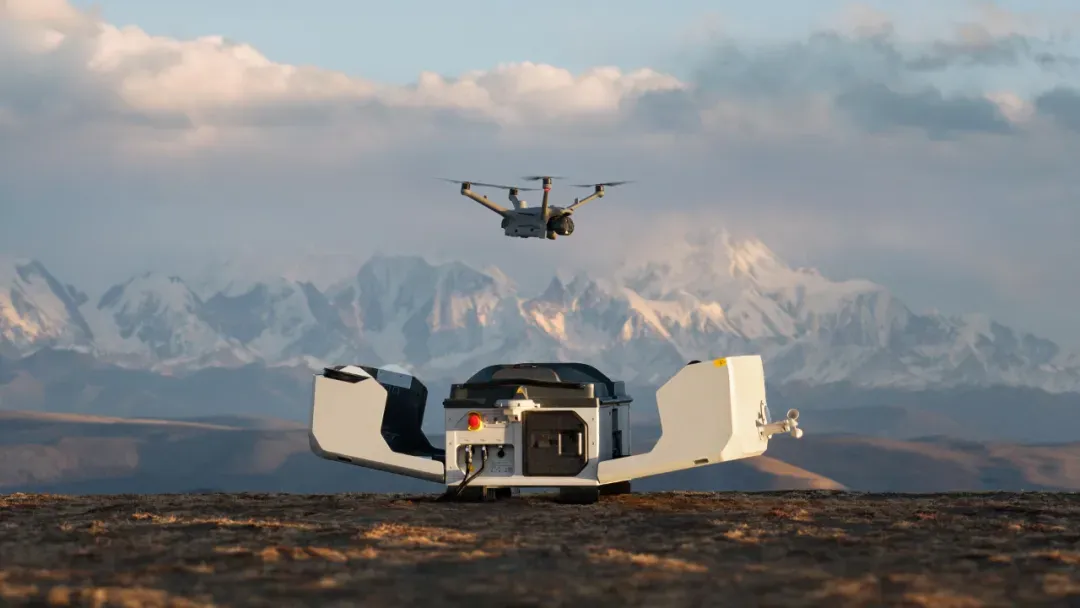
DJI’s industrial division saw the most substantial technical leaps this year, driven by the integration of AI and extended operational capabilities. The release of the DJI Matrice 4 series on Jan. 8, comprising the Matrice 4T and Matrice 4E, formally initiated the company's "AI intelligence era" for industrial drones. This was followed by the Feb. 27 launch of the DJI Dock 3, a vehicle-deployable unmanned platform designed for operations in severe environments.
A significant update to the flagship line arrived on Jun. 10 with the debut of the DJI Matrice 400. Marketed as a culmination of five years of development, the platform features a 53-minute hovering time and supports up to seven simultaneous payloads. It introduces intelligent operation modes, such as automatic wire routing for power grid inspections, targeting complex utility and maritime scenarios.
The company also tightened its grip on the accessories market. On Apr. 16, DJI introduced the self-developed Zenmuse S1 searchlight and Zenmuse V1 speaker. Historically, these payloads were supplied by third-party partners; the shift to in-house production represents a direct challenge to the existing ecosystem of accessory manufacturers. Further expanding its industrial reach, DJI released the Zenmuse L3 LiDAR system on Nov. 4, offering a detection range of up to 2,000 meters to support high-precision surveying.
Logistics and Agriculture Modernization
In the logistics sector, the release of the DJI FlyCart 100 (FC100) on Jun. 30 redefined professional aerial delivery standards, aiming to solidify the drone industry's role in low-altitude transport.
The agricultural division followed suit on Nov. 18 with a comprehensive refresh of its crop-spraying lineup. The new series includes the flagship T100S, with an 85-liter spray tank and 90kg spread capacity; the T70S for mid-sized plots; and the lightweight T55 for single-operator use. DJI framed these releases as the beginning of the "aerial intelligent driving" era for agriculture, emphasizing automation over manual piloting.
Consumer Drone Segmentation
The consumer drone portfolio became increasingly segmented in 2025, targeting specific user demographics ranging from vloggers to professional photographers.
- DJI Flip (Jan. 14): A sub-249g foldable drone designed for social media content creation, featuring AI tracking and controller-free "palm takeoff" capabilities.
- DJI Mavic 4 Pro (May 13): The flagship imaging drone introduced a 360-degree rotating gimbal and a 100-megapixel Hasselblad main camera, alongside O4+ transmission technology.
- DJI Mini 5 Pro (Sep. 17): Brought a 1-inch sensor to the Mini series for the first time, enhancing performance in the ultra-lightweight category.
- DJI Neo 2 (Oct. 30): Marketed as the company's smallest drone with omnidirectional obstacle avoidance, supporting gesture control.
Diversification into Smart Home and Imaging
In a notable departure from aerial products, DJI entered the smart home cleaning market on Aug. 6 with the DJI ROMO robot vacuum. The product line, which includes standard, advanced, and flagship models, applies the perception and obstacle avoidance technologies developed for drones to ground-based cleaning, placing DJI in direct competition with established appliance manufacturers.
The handheld imaging division also expanded. On Jul. 31, the company launched the Osmo 360, a 5.7K panoramic action camera, and the modular Osmo Nano wearable camera. Later in the year, on Nov. 13, the Osmo Action 6 was released, featuring a variable aperture (f/2.0-f/4.0) and a large 1/1.1-inch sensor to improve low-light performance. The audio segment was updated on Aug. 28 with the DJI Mic 3, capable of 32-bit float internal recording and a transmission range of 400 meters.