
Geely launches AI-driven i-HEV with 48.4% efficiency, advancing “no-charge” electrification
Zhejiang Geely Holding Group’s Geely Auto Group is betting that the next leg of China’s electrification will be led by hybrids that behave like EVs without relying on charging, unveiling an AI-enabled i-HEV system it says delivers a record 48.41% engine thermal efficiency and as low as 2.22 liters per 100 km fuel consumption.
The company introduced i-HEV in Hangzhou on April 13 and said the technology is “launch-and-mass-produce,” with installations planned this year across its China Star lineup, including Xingrui, Xingyue L, the fourth-generation Boyue L and fifth-generation Emgrand. Two models will open pre-sales on April 19, Geely said, accelerating commercialization amid intensifying price competition and increasingly crowded EV showrooms.
Early market significance lies less in a single mileage claim than in Geely’s attempt to define hybrids as an AI-optimized energy system—positioning internal combustion as a managed component rather than the primary source of motion. If execution matches the specifications, i-HEV could pressure Japanese hybrid incumbents in China while offering automakers and suppliers a scalable route to meet efficiency expectations without the infrastructure burden of plug-in solutions.
AI Orchestrates Powertrains to Cut Waste Across Real-World Driving
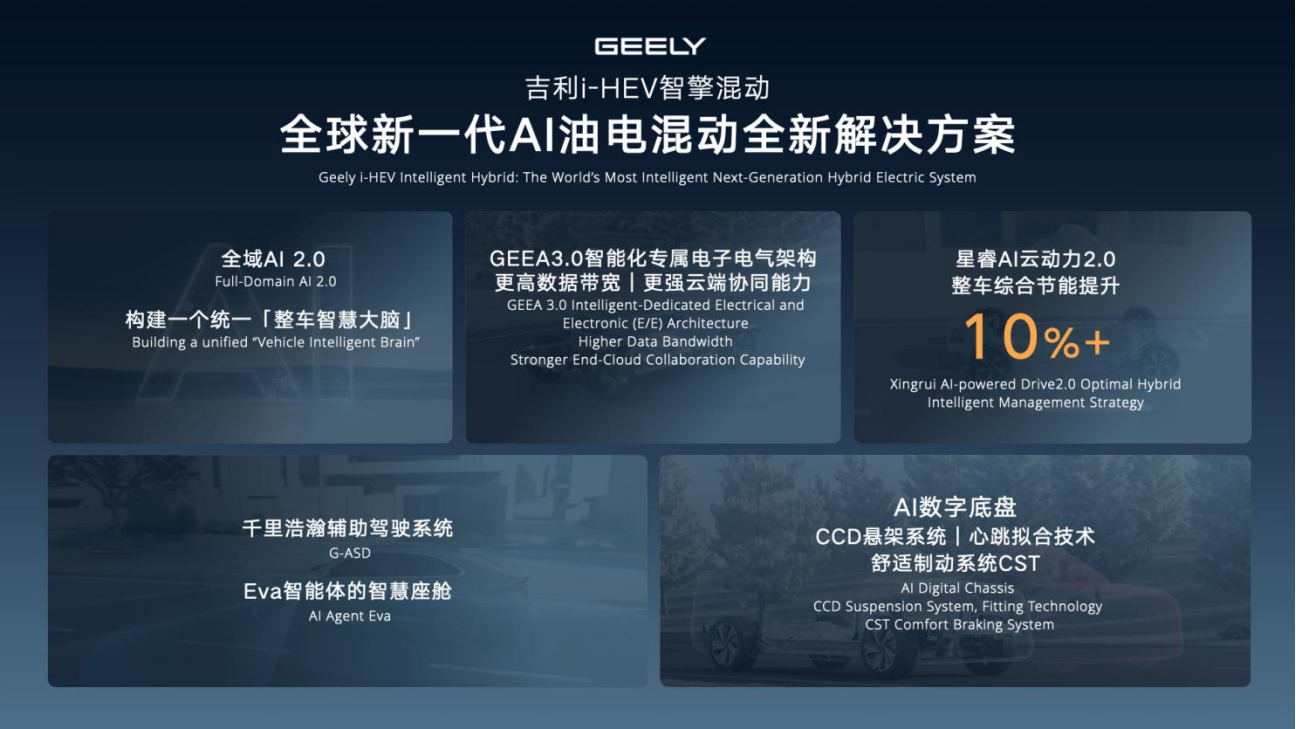
Geely framed i-HEV as a shift away from “mechanical matching” toward software-defined energy allocation, built on its GEEA 3.0 electronic and electrical architecture and an “Xingrui AI Cloud Power 2.0” model that adjusts engine-motor strategy using environmental and route signals such as temperature, humidity, altitude and gradient.
Geely said the AI cloud power layer can improve overall vehicle energy savings by more than 10%. In its examples, the system pre-charges on free-flowing sections and prioritizes electric drive in congestion to reduce time spent in low-efficiency engine zones. For investors, the key signal is that efficiency is being marketed as a data problem—suggesting future differentiation may depend on compute, control software and cloud-vehicle collaboration, not just mechanical parts.
Efficiency Records Redefine Hybrid Benchmarks—and Reset Rival Comparisons
The headline number is a 48.41% peak thermal efficiency for the hybrid-dedicated engine, certified by China Automotive Technology and Research Center, which Geely said sets an industry record for mass-produced engines. Geely engineers estimate each 1 percentage point improvement in thermal efficiency can reduce fuel consumption by 2% to 3%.
Geely also said an Emgrand i-HEV achieved 2.22 L/100 km in a Hainan island highway fuel consumption test, earning a Guinness World Records entry and undercutting Toyota’s Prius record of 2.52 L/100 km set in the US, according to the company. A larger Xingrui i-HEV recorded 2.58 L/100 km, Geely said.
On the WLTC cycle, Geely said i-HEV models reduce fuel use by about 41% versus comparable gasoline vehicles and are about 10% lower than “Japanese hybrid benchmarks.” In urban congestion, Geely said fuel consumption reductions can reach 65% and run about 15% lower than Japanese hybrids. The competitive implication is direct: Geely is inviting side-by-side comparisons with Toyota’s Hybrid Synergy Drive-type architectures—especially on high-speed efficiency and re-acceleration, where Geely argues some traditional hybrids are constrained by their operating modes.
Higher-Power E-Drive Shifts Hybrids Toward an EV-Like User Experience
Geely’s i-HEV uses a P1+P3 motor layout and a 230 kW drive motor, which Geely said is about 1.72 times the output of comparable Japanese hybrid motors. The company claims 0–30 km/h acceleration of 1.84 seconds, a 10-millisecond power response time, and pure-electric driving up to 66 km/h—about 20% higher than typical hybrids, it said.
Geely also said that under WLTC conditions the vehicle operates in an “electric-dominant” state more than 80% of the time, with engine operating time reduced by more than 27% versus traditional hybrids. That framing matters for positioning: the company is effectively selling hybrids as “EV-first” products, aimed at buyers who want quieter, smoother urban driving without changing refueling habits.
Battery configurations include 1.38 kWh and 1.83 kWh packs weighing about 30 kilograms, according to Geely, supporting 110 kW discharge power and 60C regenerative capability. While small by EV standards, the packs are designed to support frequent charge-discharge cycles and energy recovery—shifting more propulsion duty to the motor and improving stop-and-go efficiency.
Redundancy and Extreme Testing Target Reliability as a Purchase Trigger
Geely emphasized safety and uptime, using a decoupled three-power-source redundancy design—engine, P1 motor and P3 motor—intended to prevent single-point failures from immobilizing the vehicle. Battery safety follows Geely’s “Shield Battery Safety Standard,” with IP68 protection and compliance testing under China’s GB38031-2025 requirements, the company said. Geely added that its control strategy keeps state-of-charge between 30% and 80% to reduce overcharge and overdischarge risk.
On durability, Geely said it completed a 120-hour “ironman” hybrid reliability test under supervision of China Automotive Engineering Research Institute, spanning extremes including -40°C cold, 50–55°C high-heat radiation with solar intensity above 1,000 W/m², altitude shifts from 4,650 meters to 1,200 meters, and humidity variation from 40% to 80%. Geely also cited 15,000 hours of bench durability testing, equivalent to about 4.8 million kilometers of vehicle driving, and said its standard is more than 20% higher than Japanese hybrid global benchmarks.
For the supply chain, Geely’s pitch implies increased demand for high-power e-drive integration (11-in-1 hybrid e-drive), thermal management, sensors and compute capable of closed-loop optimization. For competitors, the immediate pressure is narrative and pricing: if “no-charge” hybrids deliver EV-like driving and measurable fuel savings, they can become a volume hedge against fluctuations in EV demand and charging convenience across lower-tier cities and long-distance users.
Related Coverage:
Geely Galaxy Unveils M7 With 225 km EV Range, Pushing Plug-In Hybrids Toward “EV-First” Use